Why can a drone return to the wrong place from a boat?
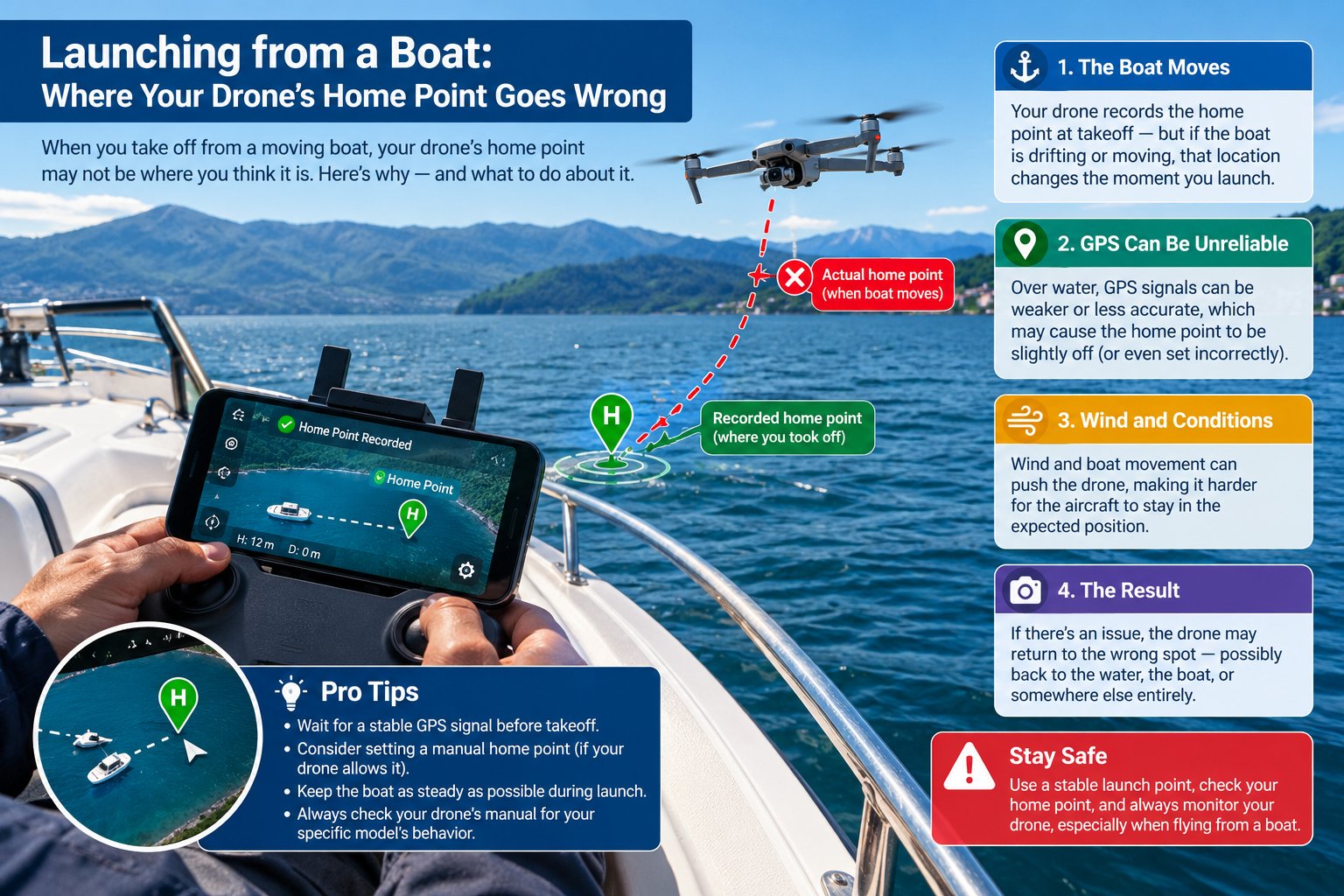
A drone launched from a moving boat can record its home point at the boat’s position when the aircraft takes off. The boat may then travel away, while the saved home point remains at the original coordinates. If Return to Home (RTH) is triggered later, the aircraft may navigate towards that earlier position instead of the boat’s current location. The exact behaviour depends on the drone, controller, app and selected RTH mode. [1]
This is the central risk of boat launches: the home point is usually a geographic location, not a live marker that automatically follows the vessel. Pilots should understand how their specific model records and updates its home point before attempting an over-water flight.
How the home point works
On many GPS-equipped camera drones, the aircraft records a home point after it has acquired a suitable positioning fix. The app normally shows a confirmation message or a marker on the map. The home point gives the aircraft a reference location for supported RTH functions, but it does not mean the drone can identify or track the boat as it moves. DJI’s RTH documentation describes home-point recording and return behaviour for supported aircraft; pilots should consult the manual for their exact model. [1]
For example, imagine a boat launches a drone near a harbour entrance. The drone flies out to film a coastline while the boat continues along the shore. If the control link is lost, a failsafe return may send the aircraft towards the launch coordinates. The boat could now be hundreds of metres away, leaving the aircraft approaching an empty patch of water.
Can the home point move with the controller?
Some drone and controller combinations provide a function to update the home point to the remote controller’s current location. This can be useful when the pilot changes position, but it is not available in the same way on every model. It may also depend on whether the controller can determine its own location and whether the app and aircraft support the feature. Never assume that the home point is following the controller unless the manual confirms it and the app shows that the update has succeeded. [1]
Even if the home point can be updated, it is still a coordinate update—not a guarantee of a safe landing on a moving deck. The boat may continue moving after the update, and the aircraft may need time and battery to reach the new location. The pilot must keep checking the map and the vessel’s movement.
Why a moving-boat landing is difficult
A boat is not a fixed landing pad. It can pitch, roll and yaw as waves pass, and it may change speed or direction during the drone’s approach. Wind over open water can differ from the wind near the shore. Rails, antennas, rigging, passengers and other equipment can also obstruct the landing area.
A small drone may appear stable while hovering, but a moving deck can shift underneath it. An automatic landing routine may not be designed to compensate for every movement of a vessel. Treat a deck landing as a demanding manoeuvre that requires suitable conditions, a clear area and a pilot who understands the aircraft’s limits.
Plan the recovery before take-off
1. Read the exact aircraft and controller manual
Before the trip, find out how the aircraft records its home point and whether the controller can provide a location update. Check the instructions for the selected RTH mode, signal-loss behaviour and low-battery response. Different models can behave differently, so a tip that works for one drone may be wrong for another. [1]
2. Decide where the drone can safely land
Choose a realistic recovery option before launching. That might be a suitable landing area on shore, a clear section of deck in calm conditions or another safe location identified during the flight plan. Do not launch if the only possible recovery depends on a difficult moving-deck landing in rough conditions.
3. Do not rely on RTH to chase the boat
RTH normally navigates towards a recorded home point or follows a model-specific return procedure. It should not be treated as a boat-tracking feature. If the vessel is moving, a pilot must understand where the aircraft will attempt to go and how to manage the flight safely if the boat has moved away. [1]
4. Keep a generous battery reserve
Over-water flights leave fewer convenient places to land if something goes wrong. Wind, distance, a missed approach and a second attempt can all consume battery. Begin the return while there is enough power for a controlled recovery and an alternative plan. Do not wait for a critical battery warning before deciding what to do.
5. Keep visual contact and assign crew roles
The pilot should maintain visual line of sight and focus on the aircraft. If another crew member is available, that person can help monitor the boat’s position, nearby traffic and landing area. Agree on simple communication signals before take-off, especially if engine noise or wind makes conversation difficult. Manufacturer safety guidance also stresses checking the environment and maintaining control of the aircraft. [2]
6. Avoid launching in unsuitable conditions
Strong wind, rough water, rain, poor visibility and crowded decks can make launch and recovery unsafe. Check the aircraft’s operating limits and the weather before flight. If the boat is moving unpredictably or the landing area is not clear, postpone the flight. A missed shot is less costly than losing the aircraft or injuring someone.
What if the control signal is lost?
The aircraft’s response depends on the signal-loss action selected in the app and the model’s failsafe logic. Some aircraft can initiate RTH when the required positioning conditions are met; others may hover or land if those actions are selected or if the aircraft cannot complete the expected return. Read the manual and verify the chosen behaviour before take-off. [1]
If the boat has moved away from the saved home point, the pilot should not assume that the aircraft will find the vessel. A pre-planned alternative landing location may be safer, depending on the aircraft’s position, remaining battery, weather and local conditions. Do not attempt an improvised manoeuvre that exceeds your skill or the manufacturer’s limits.
India: a boat launch does not change drone rules
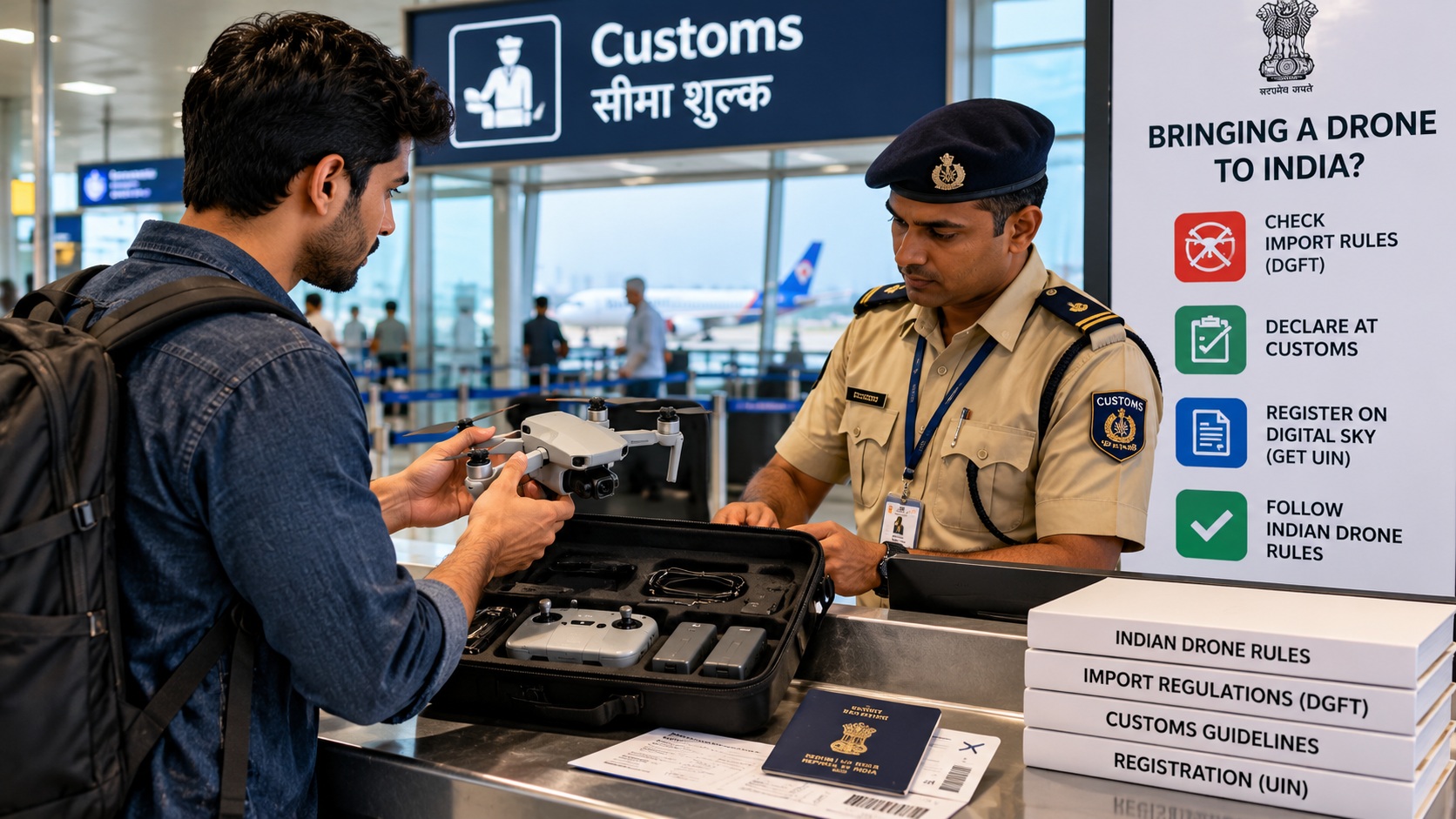
Launching from water or a vessel does not exempt a flight from India’s drone requirements. Before operating, check the Digital Sky airspace map for the actual location and date. The Drone Rules, 2021 establish the airspace-zone framework, and the Ministry of Civil Aviation publishes the rules and amendments. Check current restrictions and permission requirements rather than relying on an old map screenshot. [3][4][5]
Pilots should also follow the applicable requirements for their drone category, registration or documentation where relevant, remote-pilot qualification where required, and safe operation. Check current DGCA and Ministry guidance because requirements can change. A boat’s location may be near a port, airport, naval facility or other sensitive area, so verify the airspace before launching. [3][4][6]
A realistic example: the boat keeps moving
A recreational pilot launches from a boat close to the coast and records the home point. The boat then travels along the shoreline while the drone films a nearby rock formation. The pilot notices the battery level falling and presses RTH, expecting the aircraft to return to the boat. Instead, the drone begins heading towards the original launch coordinates.
The safer approach would have been to understand the aircraft’s home-point behaviour in advance, decide whether the model supports a verified controller-location update, and plan a safe landing alternative. The pilot should also have kept enough battery for a controlled return and avoided relying on RTH as an automatic moving-boat recovery system.
Boat-launch checklist
Confirm the home point has been recorded and check its map position.
Read the manual to see whether the home point can be updated from the controller.
If an update is supported, confirm it on the map after making the change.
Know what the aircraft will do after signal loss and at low battery.
Identify a safe landing alternative before take-off.
Check wind, waves, visibility, vessel movement and available battery reserve.
Keep the aircraft in visual line of sight and keep people clear of the launch and landing area.
Check Digital Sky and current Indian airspace restrictions for the operating location.
The takeaway
Before launching from a boat, ask yourself one simple question: if RTH started right now, where would the drone go? Confirm the saved home point, understand whether your model supports a controller-location update and verify any change in the app. Plan a safe recovery that does not depend on the drone automatically chasing a moving boat.