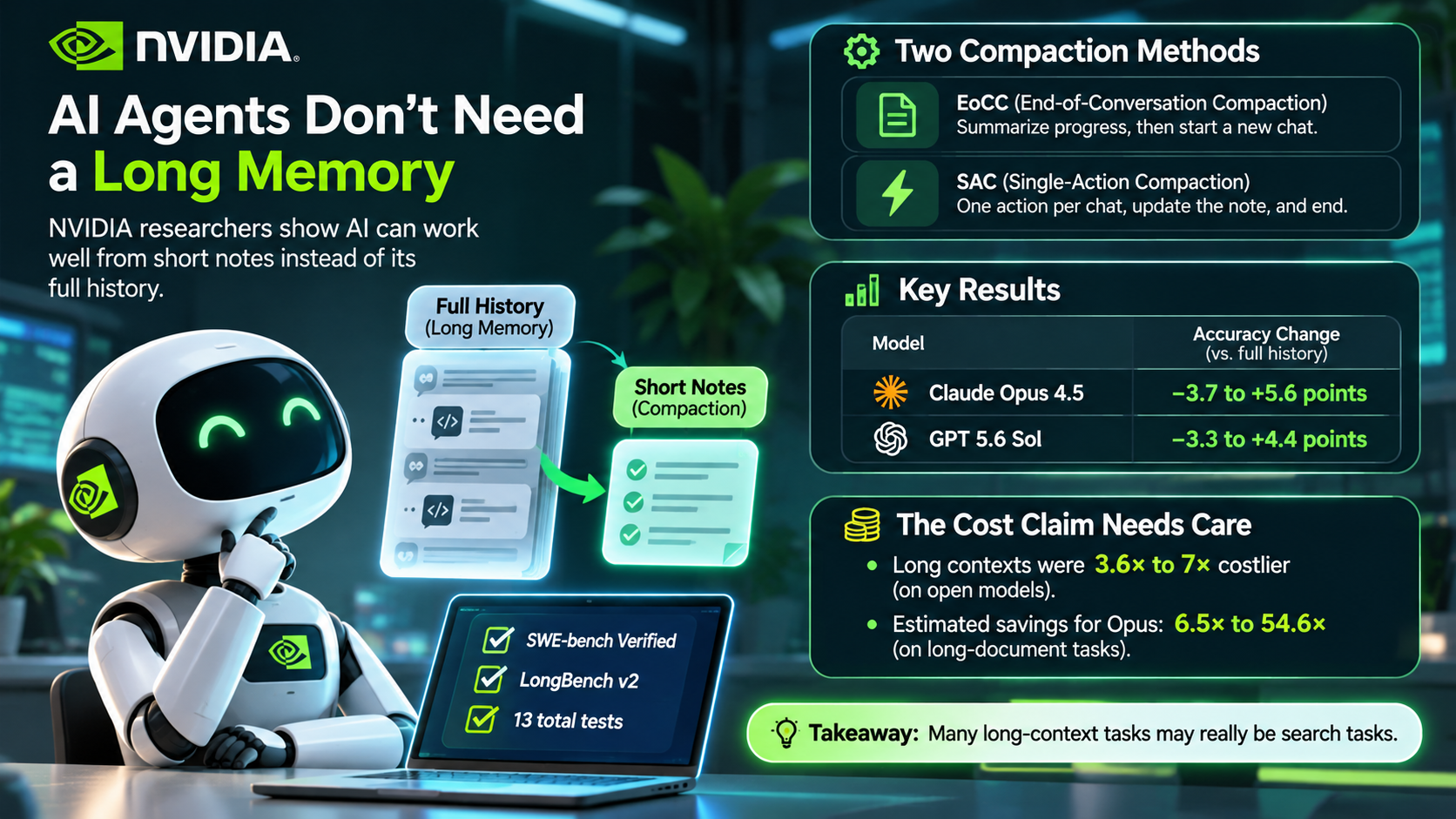
Many AI agents carry their whole work history with them, step after step. NVIDIA researchers say that may be unnecessary. In a paper posted November 3, 2026, they made Claude Opus 4.5 and GPT 5.6 Sol work from short notes instead. Scores mostly stayed close. Full disclosure: Anthropic makes both Opus 4.5 and Claude, the AI that helped write this article.
What They Tested
An agent fixing a bug adds every command and result to its memory, and that memory grows fast.
The team tried two shortcuts. In the first, End-of-Conversation Compaction (EoCC), the model writes a short progress note once its memory fills up. A fresh chat then starts with the task and that note. The second, Single-Action Compaction (SAC), goes all the way: one action, an updated note, then a fresh chat.
For huge documents, the agent searched the files and read only the useful parts. The team used 13 tests, such as SWE-bench Verified and LongBench v2.
The Accuracy Numbers
Opus 4.5 landed anywhere from 3.7 points lower to 5.6 higher than full history on the six agent tasks. That’s the extreme range, not an average. GPT 5.6 Sol ranged from 3.3 lower to 4.4 higher. For both models, no more than 5 of 22 settings lost over 2 points.
With one action per chat, Opus matched its full-history score on SWE-bench Verified, 70.2% to 70.0%. GPT dropped 2.0 points there and 3.3 on another test. Smaller open models struggled under EoCC: Qwen 3 Coder Next fell from 53.0% to 3.6% on SWE-bench Verified at the tightest limit.
On long documents, Opus gained up to 40 points. On needle-in-a-haystack tests, where one fact hides in a huge text, both models scored 100%. The authors say the questions share keywords with the hidden facts.
The Cost Claim Needs Care
Long memory does cost more. On three open models, cost per token was 3.6 to 7 times higher at 256K than at 16K. Those tests ran on H100 chips, not Claude or GPT.
Here’s the catch. The big savings, 6.5 to 54.6 times, are estimates for Opus on long-document tasks. Real API prices don’t change with context length, so the authors assumed short contexts would cost one-fifth as much. At actual list prices, one SWE-bench Verified setting cost Opus $420 with full history and $296 with notes. GPT cost more with notes: $189 against $168.
Caching matters. Full-history runs reuse saved text at one-tenth the price, and compaction reuses less. By my math from the paper’s tables, Opus would save about 2.2 times on that test without caching, but only 1.4 times with it.
What It Does Not Show
This is an arXiv technical report. I found no peer review and no outside test. The authors admit it doesn’t prove every task works with short context. Their Semantic State Space Model doesn’t exist yet. It’s just an idea: a model that keeps a plain-language summary, not full history.
My view: many “long-context” jobs may really be search jobs.