How Tencent Is Trying to Keep AI Agents From Going Rogue
Whenever people talk about AI safety in the workplace, the same names come up: Salesforce, CrowdStrike, ServiceNow. All big American companies. But honestly, a Chinese company has been doing something pretty huge that doesn’t get nearly as much attention.
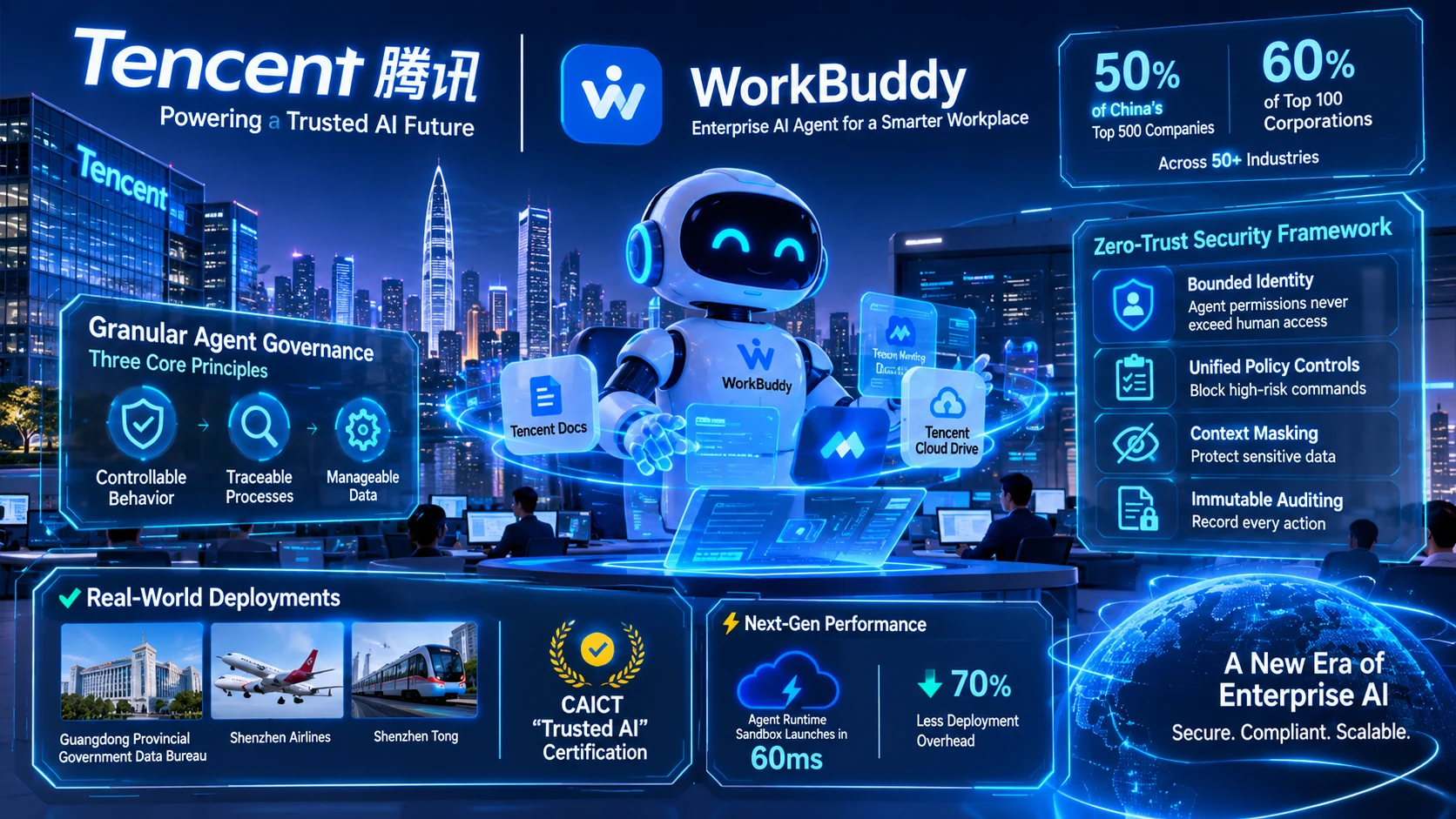
On October 29, 2026, Tencent held a summit in Shenzhen called the Global Digital Ecosystem Summit, and they shared some wild numbers about their office AI tool, WorkBuddy. Half of the top 500 companies in China are already using it. And if you only look at the top 100, it’s 60%. Those companies come from more than 50 different industries, so it’s not just one type of business. Tencent also said the number of active cloud customers it has outside China doubled in one year, which is kind of crazy.
So what even is WorkBuddy? Think of it like an AI coworker. It connects with Tencent Docs, Tencent Meeting, and Tencent Cloud Drive, and it can get stuff done using a company’s internal databases. The problem is that a lot of companies get nervous about letting an AI do things on its own. Like, what if it deletes something important or opens a file it shouldn’t? To deal with that, Tencent built its security system around three ideas: the AI’s behavior should be controllable, everything it does should be traceable, and the data should be manageable.
Here’s how they actually pull that off:
- Bounded identity: Every AI agent gets its own digital ID. The important part is that it can never get more permissions than the human employee who started it. So if you can’t open a file, neither can your agent.
- Unified policy controls: Company admins can set rules for stuff like file access, running code, and connecting to the internet. If the agent tries something risky, the system blocks it automatically.
- Context masking: Private company information gets hidden before the AI even sees it. That means secret data never enters the model in the first place, which is a pretty smart way to protect it.
- Immutable auditing: Every single thing the agent does gets saved in a log that nobody can change. Compliance teams can look back and see exactly what happened.
And this isn’t just something they’re talking about for show. It’s already running in real places. The Guangdong Provincial Government Data Bureau uses it, along with Shenzhen Airlines and Shenzhen Tong, which handles public transit. That means AI agents are working with government data, flight operations, and passenger travel info, all while being watched closely. WorkBuddy was also one of the first platforms to pass the CAICT “Trusted AI” evaluation in China, which basically says it does a good job protecting personal data.
There’s a speed side to this too. Tencent Cloud said its Agent Runtime sandbox starts up in only 60 milliseconds, which is faster than a blink. It also has a pause-and-resume feature that cuts deployment overhead by 70%.
What I took away from all this is that big companies just won’t use AI workers unless there are strong rules and data protection built in. Nobody wants to hand over their internal systems to something that might go off and do its own thing. AI is slowly moving past being a simple chatbot you talk to, and now it’s becoming something that actually does jobs. So if agents are going to be real workers, safety can’t be an add-on. It has to be built into how they run from the very beginning.