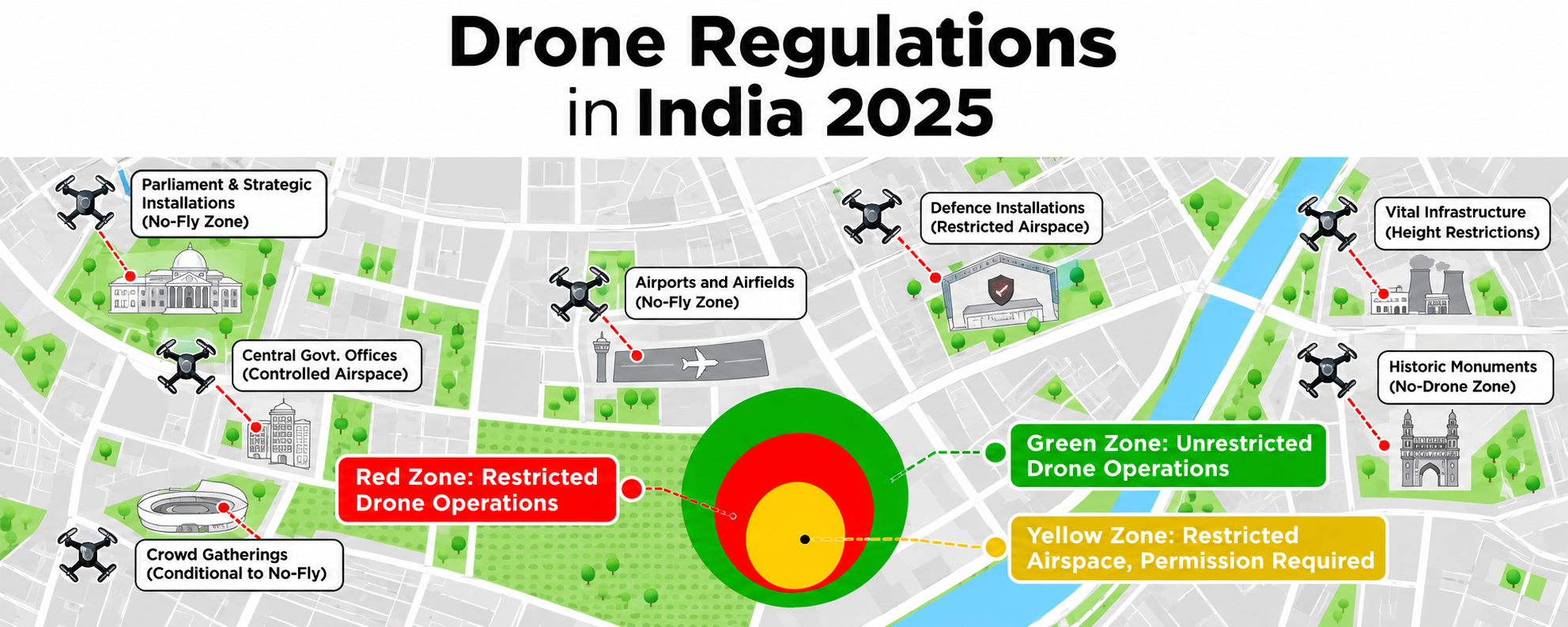
A drone weighing 250 grams and a large industrial UAV may both be called drones, but Indian aviation regulations do not treat them as identical aircraft.
India regulatory framework distinguishes drones by weight and sets requirements around registration, certification, remote pilots and where an aircraft can operate. And there is an important reason to keep checking the rules: the system is still evolving.
India has different categories of drones
Under the Drone Rules framework, drones are classified according to their maximum all-up weight, including payload.
A nano drone weighs up to 250 grams. A micro drone is above 250 grams and up to 2 kilograms. A small drone is above 2 kilograms and up to 25 kilograms. A medium drone is above 25 kilograms and up to 150 kilograms. A large drone is above 150 kilograms.
These categories matter because the regulatory requirements can differ depending on the aircraft and operation.
Registration and certification are not one simple process
India has a Unique Identification Number system for applicable unmanned aircraft, while type certification establishes that a particular drone design meets the required standards.
But there is a particularly important current development. As of September 9, 2026, the DGCA's current drone page states that registration of non-type-certified UAS has been temporarily suspended until further notice.
The government has also continued shifting aviation services onto the eGCA platform. The February 2026 government backgrounder said regulatory services including drone registration, Remote Pilot Certification, type certification and RPTO permissions had moved from Digital Sky to eGCA, while operational services such as flight plans and airspace maps remained integrated with Digital Sky.
Where can a drone fly?
India's drone airspace framework uses green, yellow and red zones. Green areas are generally the least restrictive, subject to the applicable rules and height limitations. Yellow zones involve controlled or restricted airspace and additional permissions or coordination may be required. Red zones are areas where drone operations are prohibited unless specifically authorised.
Airports are particularly important. Operators cannot simply see an open sky and assume that the flight is legal. Before an operation, the relevant airspace information must be checked and any applicable restrictions followed.
What about the person flying it?
India uses the concept of a Remote Pilot Certificate for applicable operations. The government reported 39,890 DGCA-certified remote pilots by February 2026, alongside 244 approved training organisations.
However, the exact requirements depend on the type of aircraft and operation. Not every small drone operation should be assumed to have exactly the same pilot requirements.
Why regulation matters to the industry
It is tempting to describe regulation only as a restriction on drones. For an industry trying to scale, however, predictable regulation is also infrastructure.
A logistics company needs to know where it can operate. A mining company needs compliant survey procedures. An infrastructure operator needs to understand where inspections are possible. Autonomous-drone companies face an even larger challenge because future operations may involve flights beyond the operator's direct visual range and larger fleets sharing airspace.
India has already developed a substantial regulated ecosystem. The government reported more than 38,500 registered drones by February 2026. The next challenge is making the system work efficiently as operations become more frequent and more autonomous.
For operators—and for anyone writing about Indian drone regulation—the safest rule is simple: check the current DGCA requirements and applicable airspace restrictions before every important operation. Drone regulations are not static, and an article written months earlier may already contain outdated information