Radio signals take minutes to reach Mars, so a rover cannot be steered by joystick. It must decide some things itself, such as where to drive and which rocks deserve a closer look. As of 13 October 2026, that autonomy is growing, but the harder problem is what happens after a sample is collected.
Choosing a Rock When Earth Is Minutes Away
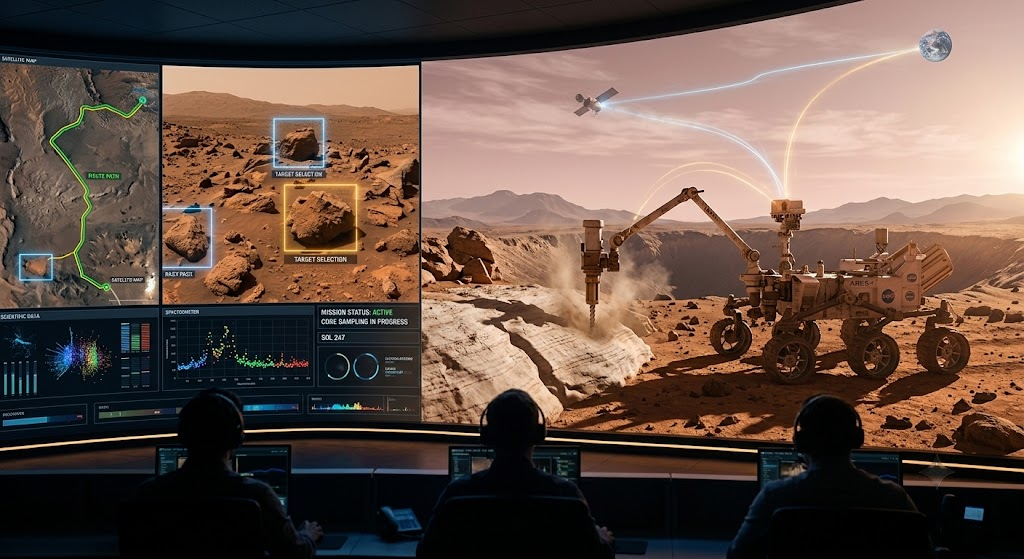
Perseverance can drive itself with its AutoNav software. After driving, it can autonomously select and target scientifically interesting features with a system called AEGIS. AEGIS picks candidate rock targets for follow-on measurements from onboard imagery and user-defined priorities, using time that would otherwise be idle. Instruments also adapt: the PIXL spectrometer uses early readings to decide where to measure next.
Choosing a target to measure is not the same as choosing a rock to keep. SuperCam data from an AEGIS target may help decide whether a location is a candidate for sampling. The sampling decision itself still goes through the science team, which is my inference from that wording. The mission’s goal was to select, document, core and deploy a high-value sample collection within one Mars year of landing.
The 2026 Shift: AI Begins Planning the Drive
In December 2025, Perseverance completed what NASA’s Jet Propulsion Laboratory calls the first drives on another world planned by artificial intelligence. Reported in early 2026, the demonstration used vision-language models to generate waypoints from the same imagery human planners use. The work was led by JPL in collaboration with Anthropic, using its Claude models. On 8 December the rover drove 210 meters on those waypoints. Before sending commands to Mars, the team checked them in a digital twin of the rover, covering more than 500,000 telemetry variables. JPL says it is working toward generative AI that could help rovers handle kilometer-scale drives while reducing operator workload.
Samples in Hand, but Not Yet Home
Perseverance has filled 33 tubes with rock, dust and atmospheric samples. Bringing them to Earth has become uncertain. A 2026 appropriations bill declined to support the existing Mars Sample Return program. NASA said its current architecture options remain unaffordable, that the samples remain safely stored on Mars, and that it is exploring simpler options, including commercial or international contributions.
China’s Tianwen-2 is attempting the other approach, sampling an asteroid. It closed to within 20 kilometers of Kamoʻoalewa in July 2026 and carries three ways to grab a sample. Those methods are hovering, touch-and-go and anchor-and-attach. Return to Earth is planned for 2027. I found no report of a completed sample collection.
What Is Proven, and What Is Only Promised
Working products versus demonstrations
AEGIS and AutoNav are working flight systems that have been used on Mars. The AI-planned drives were a demonstration of two drives, not routine operations.
Research prototypes versus commercial systems
Everything described here is agency-built. AI route planning is a prototype demonstration, and Tianwen-2’s sampling methods have not yet been shown on the asteroid.
Company claims versus verified results
The AI-drive results come from JPL’s own announcements. I found no independent audit. JPL’s own safeguard was the digital-twin check before commands were sent.
Near-term versus long-term
Near-term, expect more onboard target selection and AI-assisted route planning. A review of space AI says fully autonomous hypothesis generation remains beyond current operational practice, so a rover that chooses its own science goals is long-term speculation.
What Smarter Sample Collection Could Change
If rovers can screen more rocks on their own, scientists spend scarce communication windows on the best candidates, and a rover’s limited sample tubes go further. But a better-chosen sample is worth little if it stays on Mars. Watch for Tianwen-2’s sampling attempt, NASA’s alternative return plan and independent evaluation of AI-planned driving.