Eyes, Spectra and Fast Hands: How Robots Pull Recyclables Out of Mixed Garbage
Cameras, spectral sensors and artificial intelligence are helping recycling facilities sort mixed waste more efficiently. Robots use this technology to identify recyclable materials on moving conveyor belts, then separate them using robotic arms or air jets. While automation can improve sorting speed and consistency, its effectiveness still depends on sensor accuracy, operating costs and the type of waste entering a facility.
The Recycling Partnership’s 2024 State of Recycling report found that only 21% of recyclable material in U.S. residential waste was captured for recycling under its methodology. Smarter sorting could help recover more valuable materials, but improving recycling rates also requires effective collection systems and reliable markets for recovered materials.
Step One: Seeing the Belt
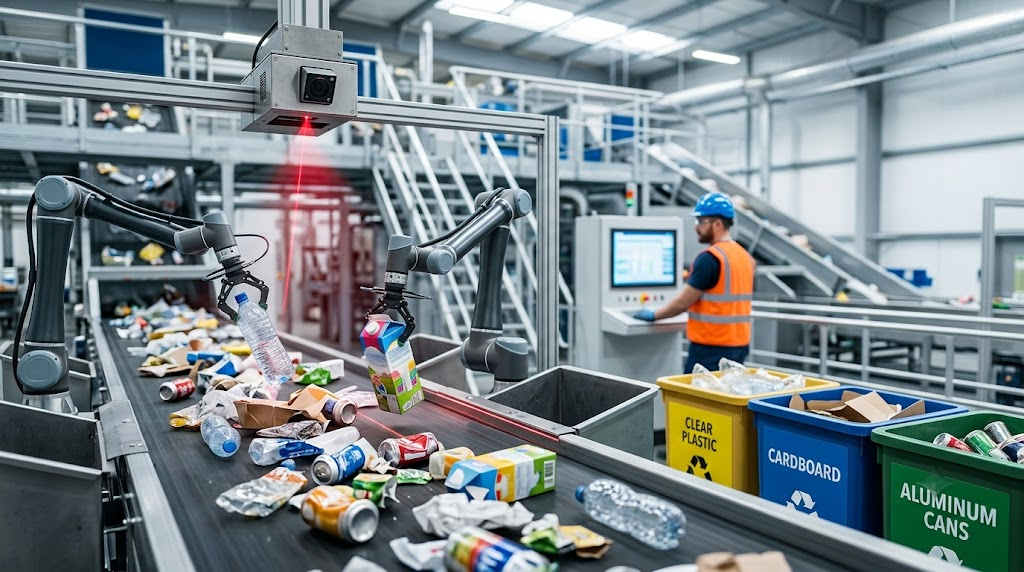
The process begins with cameras mounted above a conveyor belt. Artificial intelligence analyses images to identify objects such as plastic bottles, cardboard and metal containers. Features including shape, size and colour help the software distinguish between different items as they move through the facility.
AMP Robotics says its AI-powered systems can recognise recyclable objects and direct them for sorting. The company has reported picking speeds exceeding 80 items per minute. However, this figure is a company-reported performance claim, not an independently verified result for every operating condition.
Step Two: Identifying the Material
Recognising an object is only part of the challenge. A camera may identify a bottle’s shape, for example, but its appearance alone may not reveal the exact material it contains. To improve identification, some recycling systems use near-infrared (NIR) or hyperspectral sensors to analyse how materials reflect light.
Combining camera images with spectral data can help distinguish different types of plastics and other materials. However, challenges remain. Food residue, dark plastics and multilayer packaging can make identification more difficult. Even with advanced sensors, not every item can be classified correctly.
Step Three: Picking or Ejecting
After identifying an item, the system directs it towards the appropriate recycling stream. A robotic arm can pick up selected objects, while air jets can push lighter items off the conveyor into designated areas. The choice depends on factors such as the object’s size, shape, position and the conveyor’s speed.
One example is the AI-powered recycling facility announced by AMP Robotics and Waste Connections in Commerce City, Colorado. According to the companies’ announcement, the facility was designed to process up to 62,000 tons of single-stream recycling annually, with commissioning scheduled for early 2026. This figure represents planned processing capacity, not independently verified operating output.
The Economics
Sorting quality directly affects the value of recovered materials. Contamination can reduce the value of recyclable materials or make them harder to sell. Automation may improve consistency and reduce some repetitive manual work, but the financial benefits depend on equipment costs, maintenance, labour expenses and market prices for recycled materials.
Large facilities may find it easier to justify automation because they can spread equipment costs across larger volumes of waste. Smaller facilities may face greater financial challenges, particularly when material prices fall, waste volumes fluctuate or maintenance costs increase. The technology’s value therefore depends on the facility’s operating conditions, not just the robot’s speed.
What Still Goes Wrong?
Robotic sorting is not perfect. Food residue, overlapping objects, multilayer packaging and certain plastics can interfere with detection. Items may also pass through without being picked up, while robotic arms or air jets can occasionally send materials into the wrong stream.
More importantly, accurate sorting alone cannot solve every recycling problem. Gaps in collection, packaging that is difficult to recycle and limited demand for recovered materials can all prevent waste from being recycled successfully. Better robots can improve one part of the process, but they cannot replace a functioning recycling system.
What to Watch
The next step is to evaluate robotic sorting systems independently under real-world operating conditions. Important measures include sorting accuracy, material recovery rates, contamination levels, processing throughput and total operating costs. Comparing these results across different facilities will help operators determine whether automation delivers lasting benefits beyond the performance figures reported by technology companies.
As recycling facilities handle increasingly complex waste streams, the combination of AI, cameras, spectral sensors and robotic handling could play a growing role in material recovery. Its long-term impact, however, will depend on proven performance, practical economics and whether recovered materials can be used again.