A tiny metal particle inside a lithium-ion battery can create a problem far bigger than its size. Under certain conditions, conductive contamination can damage the thin separator between the electrodes and trigger an internal short circuit. Manufacturing defects are not the only cause of battery failure, but research identifies metal contamination and electrode misalignment as important risks during cell assembly.
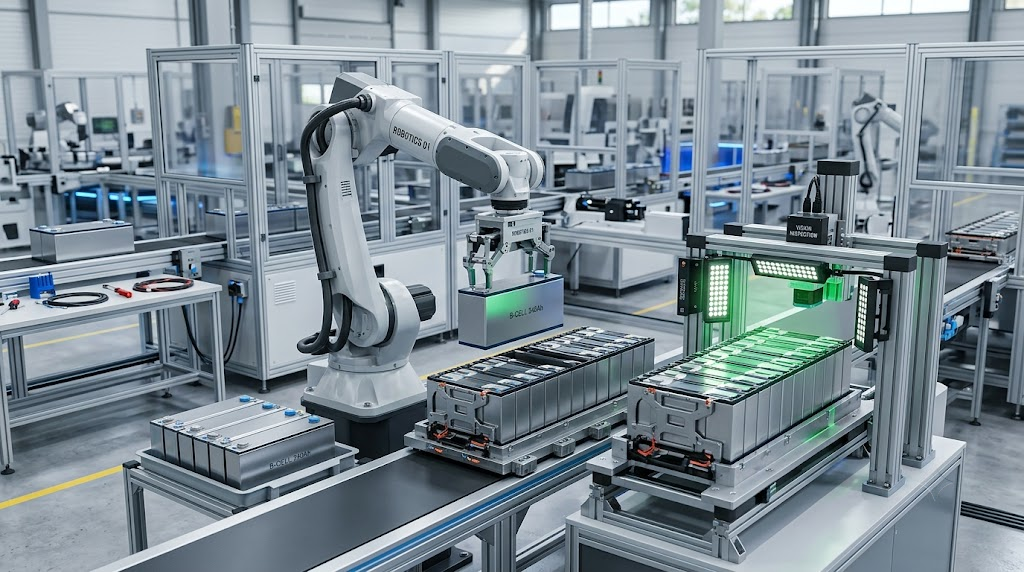
This is why battery manufacturing depends on more than fast robotic arms. Automated equipment must handle delicate materials accurately, control the production environment and collect inspection data that helps manufacturers identify defects before batteries reach vehicles.
From Coated Foil to a Finished Battery Pack
Battery production involves several stages, and robots perform different tasks at each one.
First, electrode materials are applied to thin metal foils, which are dried and processed into precisely controlled sheets. Machines then cut and stack or wind the electrode layers with a separator between them. The resulting assembly is placed inside a cell casing, connected through tabs, filled with electrolyte and sealed.
Robots and automated handling systems can move these delicate materials, position components, support tab welding and transfer cells between production stations. After assembly, cells undergo formation—a controlled initial charging and discharging process—and further testing before being graded for use.
At the next level, automated systems assemble cells into modules or directly into battery packs, depending on the design. Robotic equipment can weld electrical connections, apply adhesives, install cooling components and secure the enclosure.
The important distinction is that automation does not mean every battery follows the same production route. Cylindrical, prismatic and pouch cells require different handling methods, and cell-to-pack designs may eliminate the separate module stage.
Why the Air Is Part of the Process
Battery assembly requires careful control of moisture and contamination. Water can react with electrolyte salts used in many lithium-ion batteries, potentially forming hydrofluoric acid and causing unwanted chemical reactions that affect cell performance and durability.
For this reason, manufacturers use specialised dry rooms. TEAM Group, an industrial environmental-control contractor, describes dry-room systems that target dew points near −40°C. A dew point measures the temperature at which moisture begins to condense; it is not the same as a relative-humidity reading.
Very dry environments also make electrostatic discharge control important. Static charge can accumulate on people, equipment and materials, potentially damaging sensitive components or creating hazards in areas containing flammable substances. Grounding, suitable flooring, static-safe tools and controlled material handling help manage these risks.
Robots can reduce some contamination opportunities by limiting unnecessary human contact with exposed materials. However, automation alone cannot guarantee cleanliness: robot joints, tooling, conveyors and maintenance activities can also introduce particles. The production environment and the equipment must therefore be managed as one system.
How Automated Inspection Finds Defects
Battery defects are not always visible from the outside. A cell may look normal while containing an internal alignment problem or a defect around a weld.
Manufacturers combine several inspection techniques to examine different parts of the production process:
-
Machine vision: Cameras inspect component placement, surfaces, edges and visible assembly defects.
-
Laser measurement: Sensors measure dimensions, thickness, position and alignment.
-
Weld inspection: Monitoring systems assess the quality and consistency of electrical connections.
-
X-ray and computed tomography (CT): These techniques reveal selected internal structures and defects that ordinary cameras cannot see.
-
Ultrasonic testing: Sound waves can provide information about internal conditions without cutting the battery open.
Research published in 2026 on digital non-destructive evaluation describes how sensing, automation, data analysis and artificial intelligence can support battery quality checks at multiple manufacturing stages.
Each method has trade-offs. Cameras are comparatively straightforward to integrate into fast production lines, but cannot reveal every hidden defect. X-ray and CT provide valuable internal information, yet equipment cost, inspection speed, radiation shielding and image analysis can limit where they are used. Ultrasound is a promising alternative for some applications, but its suitability depends on the battery design and the defect being investigated.
This means a factory cannot simply choose one powerful inspection system and expect it to catch everything. A more practical strategy is to match each inspection method to the risks at that production stage, then combine the results.
Where AI and Robots Work Together
Robots perform physical tasks, while AI-based vision systems help interpret images and identify unusual patterns. Together, they can support more consistent inspection and provide feedback when a process begins to drift.
For example, if a vision system repeatedly detects a change in component alignment, the factory's control system may flag the station for investigation. Depending on the system's design and validation, measurements can also be used to adjust positioning or trigger a production stop.
However, AI does not automatically make inspection reliable. Models need representative training data, clear acceptance criteria and validation against real defects. Rare defects may be difficult to detect if they are poorly represented in the training set, while lighting changes or variations between cell designs can affect performance.
Manufacturers must also decide whether a check belongs directly on a fast-moving production line or at a slower offline inspection station. The first approach offers quicker feedback but places stricter demands on speed and reliability; the second allows more detailed examination but may identify problems later.
A Real-World Example of Equipment Validation
On 24 August 2026, Electrovaya announced that it had begun factory acceptance testing for automated lithium-ion cell assembly and formation equipment intended for its Jamestown, New York, manufacturing facility. The company said the testing would use production-grade materials to assess equipment functionality, process performance and repeatability.
The announcement illustrates an important step in automation: a production line must be tested and validated before it is installed and prepared for manufacturing. Factory acceptance testing checks equipment at the supplier's site; installation, site acceptance testing and commissioning follow at the destination.
The announcement describes a commissioning process, not proof that the equipment has already achieved full production output. That distinction matters because a machine's performance during testing does not by itself establish long-term factory yield, reliability or cost savings.
Safety, Cost and the Limits of Automation
Battery manufacturing combines precision engineering with chemical, electrical and thermal risks. Manufacturing defects can contribute to internal short circuits, and some battery failures can escalate into thermal runaway—a chain reaction involving rapid heat generation that may spread to neighbouring cells.
Robots can improve repeatability and reduce direct human exposure to certain hazardous tasks. Automated inspection can also help detect problems earlier, reducing the number of defective cells that move further down the line.
But automation brings its own challenges: high initial investment, maintenance requirements, specialist integration and the need to validate sensors and control software. A robot may repeat an incorrect movement consistently if its calibration is wrong, while an inspection system may miss defects outside its detection capabilities.
The strongest manufacturing strategy is therefore not maximum automation at any cost. It is to automate the tasks where precision, repeatability and risk reduction justify the investment, while maintaining independent quality checks and clear traceability for each cell.
In EV battery production, robots are essential tools—but safe, reliable batteries depend on the entire manufacturing system: clean materials, controlled air, accurate assembly, appropriate inspection and evidence that each process performs as intended.