Dust Never Sleeps: How Robots Keep Solar Farms Clean, Dry and Productive
Autonomous cleaners, soiling detection and waterless brushes are cutting the cost of keeping panels clear. Many of the strongest numbers still come from vendors.
Dust is a quiet drain on a solar farm. In a 2026 Scientific Reports study of four identical modules in Roorkee, India, soiling losses above 5% appeared when cleaning intervals grew longer. Washing is also costly and water-hungry. MIT researchers, cited in an October 2026 report, estimate that cleaning panels uses roughly 10 billion gallons of water a year worldwide, and that one cleaning of a 10-megawatt farm costs about $5,000. Autonomous robots aim to cut both bills while keeping output up.
Robots on the Rows
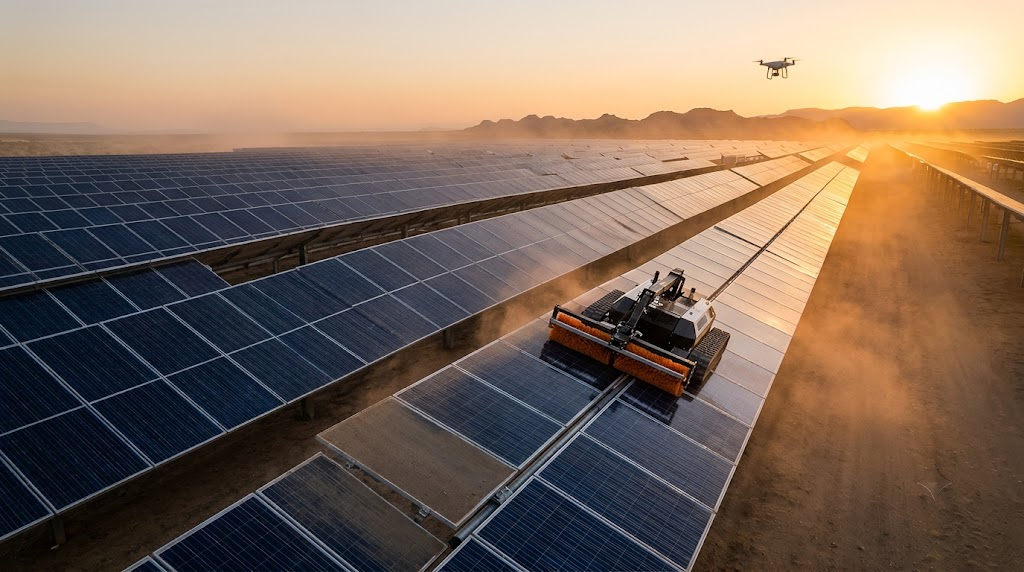
Many utility-scale systems are waterless robots that travel along panel rows. Ecoppia, whose robots clean at night with rotating microfiber brushes and no water, lists more than 35 large-scale sites and over 5,000 megawatts of deployments on its website, according to an October 2026 report. Those are company figures.
Fleet size depends on the plant. One vendor estimates that a 100 MW fixed-tilt plant needs 8 to 15 rail-mounted robots or 4 to 8 wheeled units to finish a full cleaning cycle in 7 to 14 days. Design problems remain. A patent filing on tracker-cleaning robots notes that existing automatic solutions usually use large volumes of water or special grids to move cleaners between trackers, and that owners worry about robot safety in high wind and about robot weight damaging anti-reflective coatings.
Detecting Dust Before Cleaning
Cleaning on a fixed calendar wastes effort. A 2026 Sustainability study combines deep-learning image classification with inverter-level energy data, and triggers cleaning only when the expected energy recovery outweighs the energy cost of extracting water. A 2026 Scientific Reports paper reports accuracy above 90% for a camera paired with a trained AI model acting as a soiling sensor.
From the air, a drone-based pipeline can detect both dust and bird droppings, though the authors say small droppings are harder to spot than large dust patches. There is a caution too. A 2026 cost-benefit study of machine-learning cleaning schedules says its cleaning-needed labels are operational advisory labels, not directly measured soiling, so such models still need field validation.
Saving Water
Water is the other pressure. Ecoppia says its waterless robots have saved about 2.6 billion gallons, a company figure. A 2026 Applied Energy review says waterless methods suit dusty desert regions, and that a smarter cleaning system can eliminate unnecessary cleaning cycles and allow waterless operation in water-scarce areas. Cutting water use and unneeded cycles together is where the savings are most plausible.
The Maintenance Bill
Costs are harder to pin down. Mordor Intelligence values the solar panel cleaning market at $1.54 billion in 2026. Its report says removing tanker-truck logistics cuts operating expenses by 30 to 40% in deserts, which is the report’s claim, and that Chinese rivals undercut pricing by 20 to 30%.
Robots add their own upkeep. The Applied Energy review lists drawbacks of robotic cleaning, including the need for specialized technicians for driving and monitoring, and shading during cleaning. One vendor testimonial claims soiling losses fell from 6% to under 1%, but that is a marketing claim, not an independent result. Independent data on robot repair, downtime and replacement costs was thin in the sources reviewed.
What to Watch
The next test is independent, site-level comparisons that report robot uptime, repair costs and energy gained per cleaning, set against manual washing and tanker trucks.