Eyes Under the Street: How Robots Inspect Sewers Without Digging Up the Road
Crawlers, floating robots and sonar now map pipe condition from the surface, and AI helps flag defects. Flooded, silted and corroded pipes still push every system to its limits.
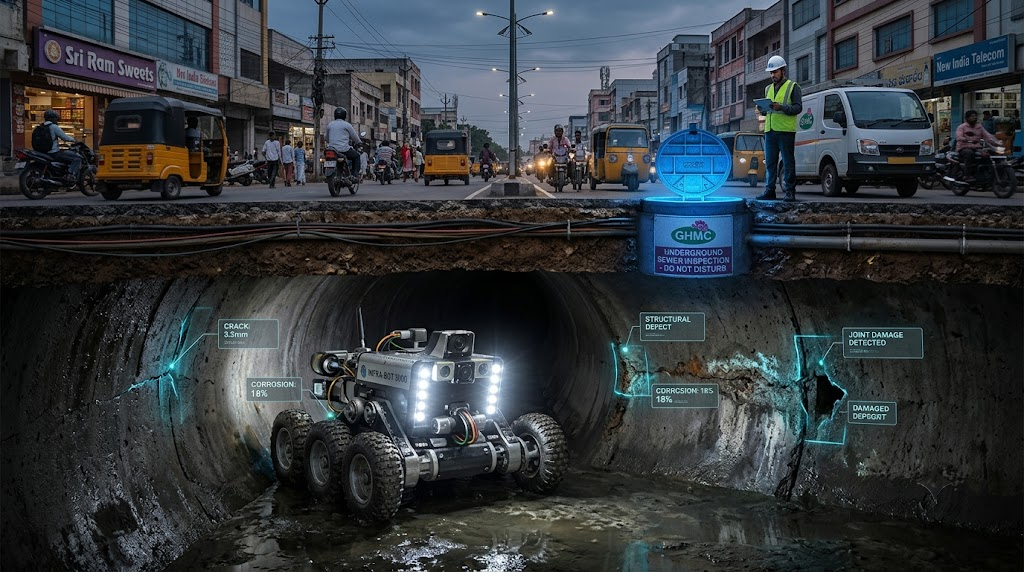
Sewers fail out of sight, and digging up a road just to look is slow and disruptive. Inspection robots avoid that. They enter through a manhole, carry cameras and sensors through the pipe, and send data to a crew above. In 2026 the trend is toward robots that handle flooded pipes and AI that reads the footage.
Crawlers and Cameras
The workhorse is the wheeled or tracked CCTV crawler. Fiberscope’s mainline crawlers are built for 6 to 84 inch pipelines, with a Full HD pan-and-tilt camera, 10x optical zoom and a laser that measures defects. Optional LiDAR adds 3D mapping, and the maker says its X10 model can travel up to about 1 kilometer in a single run. These are manufacturer specifications.
Robots for Flooded Pipes
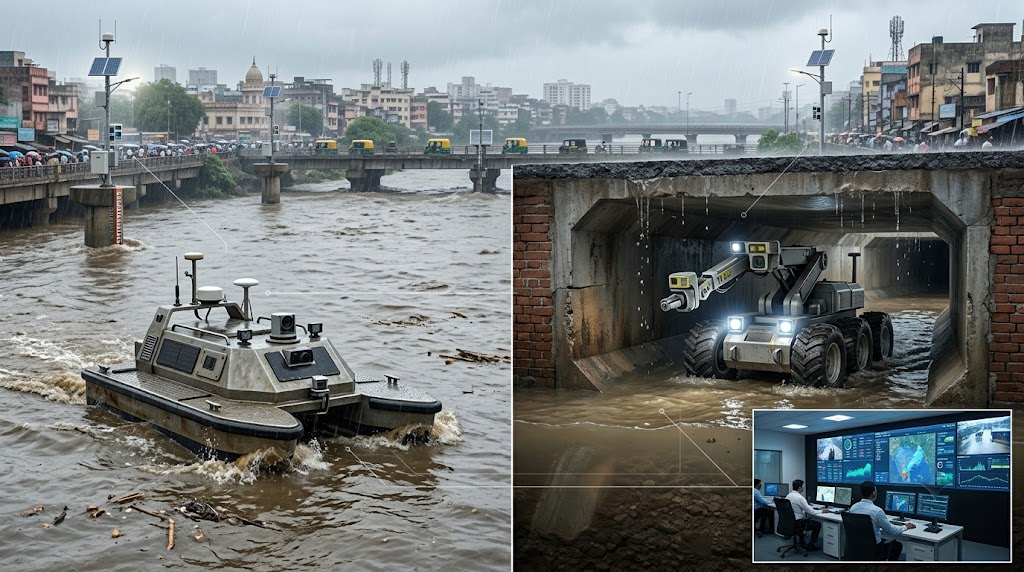
Water and silt are the usual reasons inspections get postponed. On June 24, 2026, Fiberscope announced the TRACER X20, a floating screw-drive robot for flooded and surcharged lines, and one of its sales specialists said high water is among the most common reasons an inspection is put off. The company’s product page describes a 16 kg crawler with a 360-degree camera, an optional sonar that maps the submerged part of the pipe with a 1 MHz transducer, and an optional 2D LiDAR that measures deformation, ovality and corrosion loss above the waterline. Its software combines video, sonar, radar and inertial data. All of this comes from the vendor.
Japan is also adopting these tools. A July 2026 report describes the new “NO Entry Pipe Diagnosis Zone” at Sewage Works Exhibition 2026 Tokyo, where Space One planned to show a CHASING M2 underwater drone, a Deep Trekker PHOTON ROV and a PIPETREKKER A-200S crawler. The report stresses that these drones supplement established inspection, and that each sewer needs a safety and performance review.
Spotting Cracks With AI
Reading hours of footage is the bottleneck. A July 2026 state-of-the-art review in the Journal of Pipeline Systems Engineering and Practice traces sewer inspection from rule-based image processing to advanced deep learning. Researchers also say human review is a problem. An arXiv paper on robotic sewer inspection notes that manual review of crawler footage is inefficient and prone to error, and it tests an explainable anomaly-detection method whose settings trade fewer false positives against more missed faults.
A March 2026 paper on self-supervised learning for multi-label sewer defect classification aims to cut dependence on large expert-labeled datasets, and its authors report better generalization and fewer false positives across 17 defect types despite training on fewer images. Vendors such as Oxmaint say their AI is trained on hundreds of thousands of CCTV images and codes defects to the NASSCO PACP standard. That is a company claim.
Corrosion Mapping
Corrosion is harder to see than a crack. LiDAR profiles the pipe wall to detect deformation and loss of thickness above the waterline, and sonar covers the submerged invert, according to Fiberscope. Hydrogen sulfide is a known hazard in these pipes, and Oxmaint’s 2026 stormwater guide lists it among the harsh conditions robots face.
Working in Confined, Wet Places
The environment is punishing. Oxmaint describes drainage robots as working submerged, coated in sediment, exposed to hydrogen sulfide and navigating broken pipe sections. It recommends checking housing seals, lights, camera lenses and wheel traction before every deployment. A January 2026 Scientific Reports paper on a modular pipe crawler, built for petroleum pipelines rather than sewers, uses a compact corrosion-resistant chassis, ultrasonic obstacle sensors, gas detection and wireless data links. Choosing the right tool matters. The Japan report says operators must weigh diameter, water, current, turbidity, curvature and range when selecting between an ROV, crawler, surface craft or aircraft.