Reaching, Standing, Eating: How Assistive Robots Are Widening Everyday Independence
Wheelchair-mounted arms, standing-support robots and feeding systems are tackling the tasks that decide who can live with less help. Most evidence comes from small studies, and cost, control and home environments still limit real-world use.
For someone with limited mobility, independence often comes down to small tasks, such as fetching a cup, standing up, using the toilet or finishing a meal. Researchers say assistance robots could increase independence for people who need daily care because of limited mobility or wheelchair use. The evidence so far comes mostly from prototypes and small studies, and the practical hurdles are real.
Reaching and Fetching
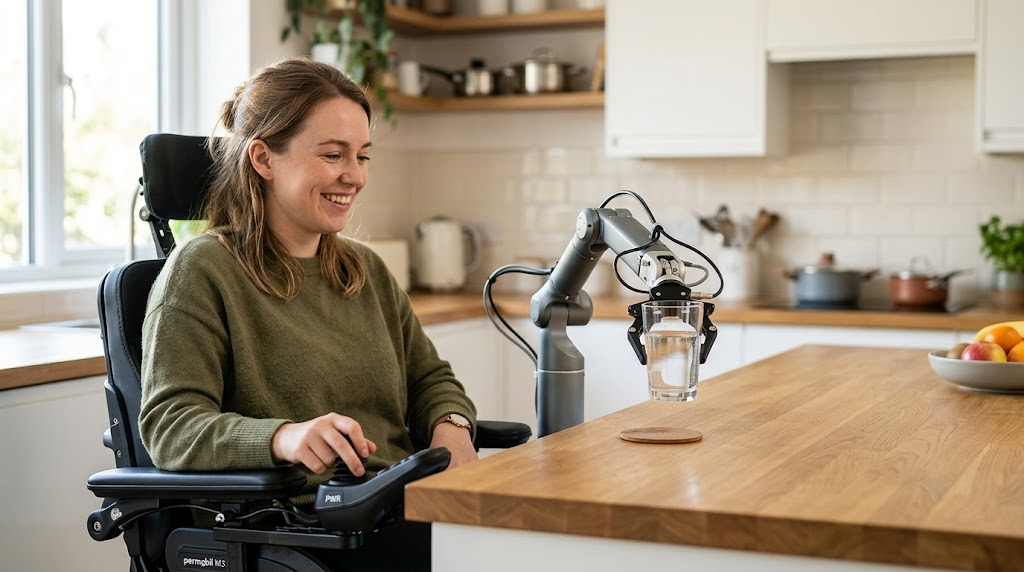
The best-known approach is the wheelchair-mounted robotic arm. Kinova says its Jaco arm can be operated through a chair’s joystick, head array, sip-and-puff device or almost any other interface. A 2026 protocol for a feasibility study in people with tetraplegia cites earlier findings that Jaco saved about 1.31 hours per day for 31 of 34 users across 16 standard tasks .
Mounting an arm on a chair has trade-offs. Added size and weight reduce maneuverability, and sharing the wheelchair’s battery limits power and operating time. A 2026 study proposes a quadruped robot instead, with automated pick-and-place and navigation plus a mouth-level joystick for precise control. It was shown at Cybathlon 2024 and tested in an at-home setup. The study found that more robot autonomy reduces the operator’s mental load. But the authors note the robot navigates by itself and does not independently handle random objects.
Standing, Transfers and Toileting
Mobility tasks are among the hardest. A mixed-methods study found walking and toilet transfers were the most common and burdensome challenges for older adults with disabilities. One response is “Moby,” a standing-support robot for posture changes and short-distance movement. Its developers say it reduces physical and cognitive effort during toileting while leaving the user in full control. Those are the developers’ own conclusions.
A separate 2026 study of robotic standing and sitting assistance reported that its best handle trajectories cut peak hip extension moment by over 70% and knee extension moment by more than 50%. That figure comes from a secondary summary of an experimental evaluation, so check the original paper before relying on it.
Eating Without a Helper
Feeding robots face a different problem: the face is crowded. A University of Washington team says many users already have assistive devices mounted near the face for controlling a wheelchair or phone, and the robot must not interfere with them. Preferences differ too, since some users who can turn their heads slightly prefer the robot to approach from the front so they can watch it.
Practical Challenges for Users
Home conditions. In a 2026 study of assistive robots in older adults’ homes, navigation depended on stable internet and clear pathways, while cluttered hallways, closed doors or tight spaces could restrict movement.
Control. Moby’s current joystick control may be hard for people with limited dexterity. The study that automates tasks reports the lowest reliance on residual upper-limb mobility among the systems compared .
Coverage. A Jaco supplier says several state and managed Medicaid plans have covered the arm, most Medicare plans will not review an order, and Aetna and Cigna specifically exclude it . Because that comes from a seller, confirm coverage with the insurer.
Acceptance. Attitudes vary. In one study, respondents who wanted more independence were willing to try assistive robots, while those who felt resigned placed little value on them .
What Comes Next
Developers of the quadruped system list door opening, pick-and-place and feeding among their next autonomy goals. In the home study, participants also proposed uses beyond the robot’s design, such as linking it with voice assistants to contact family . The gap between lab results and daily life is the main thing to watch.