How Does a Robot Choose Its Next Move?
When a robot encounters an obstacle or picks up a component, it must decide what to do next. Fixed instructions cannot cover every situation because objects move, surroundings change and unexpected problems occur.
Robots combine perception, planning, decision-making and feedback control to respond to these changes. Research in 2026 is exploring how advanced AI models can connect visual understanding and reasoning with physical actions, helping robots move beyond fixed routines.
Perception: Understanding the Surroundings
Before selecting an action, a robot needs information about its environment. Cameras identify objects, while depth sensors and lidar estimate distances and positions. Force sensors help detect contact with objects and surfaces.
For example, a warehouse robot approaching a package must determine its location, check whether its path is clear and estimate how to pick it up. Poor lighting, reflective surfaces and blocked camera views can make these estimates inaccurate.
The robot must therefore recognise uncertainty rather than assume every observation is correct.
Planning: Turning Goals into Actions
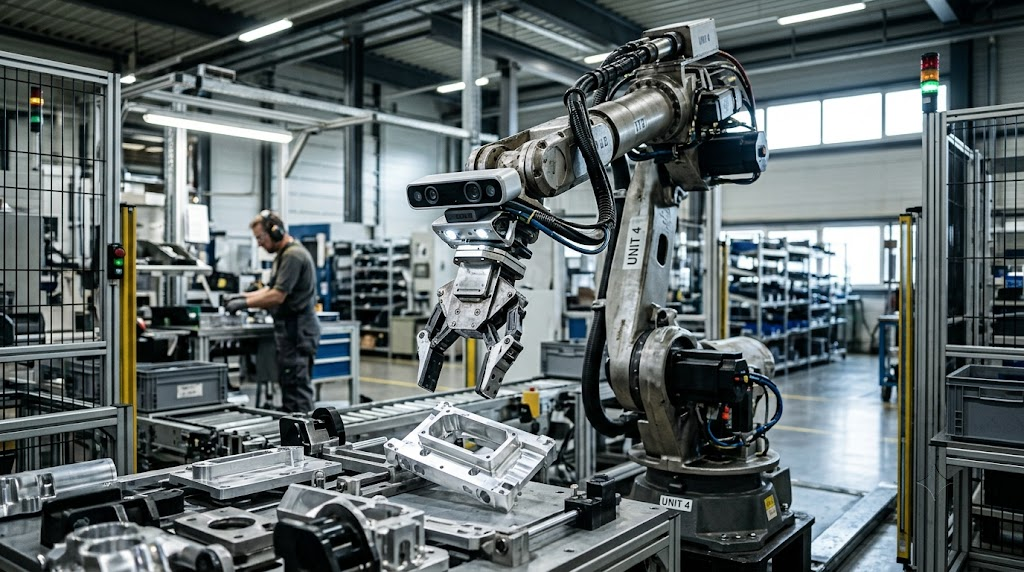
Planning determines how a robot can achieve its goal. A mobile robot might calculate a route around obstacles, while a robotic arm plans movements to grasp and place a component.
AI models can interpret instructions and divide them into smaller steps. For example, "pick up the box and place it on the shelf" becomes a sequence of locating, approaching, grasping, lifting and placing actions.
Research on embodied robot manipulation examines how foundation models connect high-level task planning with low-level action generation. These approaches aim to translate goals into executable movements while considering physical constraints.
However, a digitally planned action may fail in reality if an object moves or the available space changes.
Decision-Making Under Uncertainty
Robots rarely have complete information. A camera might not reveal whether a container is empty, or a person might suddenly cross the robot's path. Decision-making systems evaluate possible actions according to their expected outcomes, costs and risks.
Research on world models for physical AI explores how robots can predict the likely consequences of actions while accounting for uncertainty. These models connect perception, prediction, planning and control, although inaccurate predictions can still lead to poor decisions.
When confidence is low, a robot may gather more sensor data, slow down, choose another route or request human assistance. This is particularly important when mistakes could injure people or damage equipment. Safe robotic manufacturing therefore requires attention to both motion planning and reliable perception.
Feedback Control: Turning Decisions into Movement
Planning selects an action, but feedback control helps execute it. Sensors continuously measure the robot's actual movement, allowing its controller to compare the result with the intended action.
If a gripper slips, the robot may adjust its grip. If a mobile robot moves away from its planned route, the controller can correct its direction. This continuous cycle of sensing, acting and correcting helps the robot respond to changing conditions.
The challenge is coordinating AI reasoning with control systems that require fast, precise responses. High-level reasoning alone cannot replace reliable low-level control.
What Comes Next?
Combining perception, physical reasoning, planning and feedback could make robots more adaptable in factories, warehouses and other changing environments. However, uncertainty and physical constraints remain important challenges for safe deployment.
Robots must do more than select an apparently sensible action. They need to check whether it is safe and physically possible, monitor the outcome and change their approach when necessary. The goal is to build robots that can make informed decisions and correct mistakes before they become serious problems.