Sniffing Before the Spark: Can Robots Find Gas Leaks Before They Become Industrial Disasters?
Patrolling robots carry gas, thermal and acoustic sensors into places people avoid, and new 2026 research is improving how they find a leak’s source. The evidence is strongest for detection and weakest for proven disaster prevention.
Robots can detect gas leaks, but “before they become disasters” is a bigger claim than the evidence supports. A new preprint from KAIST and UNIST researchers, posted in August 2026, notes that fixed sensor networks have limited coverage and poor adaptability, while manual inspection is slow and hazardous. Mobile robots offer wider coverage and faster response. None of the sources I reviewed documents a specific disaster that a robot prevented.
Sensors That See and Smell Gas
Optical gas imaging (OGI) is the core technique. EPA’s technical fact sheet on its Appendix K protocol describes OGI as using an infrared camera to identify the presence and location of volatile organic compound and methane leaks that may otherwise be invisible. EPA’s final rule requires OGI surveys under Appendix K at natural gas processing plants, and the agency says the protocol may be applied to other sectors through future rulemaking. The protocol itself is written around a field-portable infrared camera, and none of the EPA documents I reviewed address robot-mounted cameras, so any use of a robot for regulatory surveys should be confirmed with the regulator. A patent filing on autonomous leak detection adds that handheld OGI is labor-intensive and expensive. Eni and ANYbotics tested an OGI camera on the four-legged ANYmal D robot, and their 2025 IPTC paper says it performed autonomous missions and detected methane leaks, with images shown on the control panel.
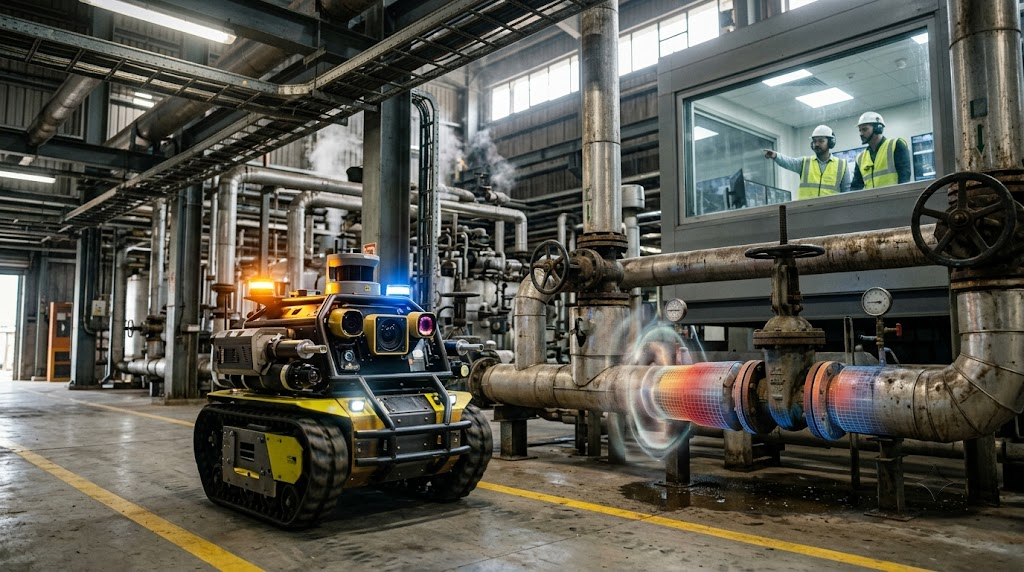
Other sensors add coverage. ExRobotics says its ExR-2.5 robot combines point gas detectors, thermal infrared cameras that visualize the rapid expansion and cooling of leaking gas, acoustic imaging and OGI that it claims can show methane plumes as small as 0.1 liters per minute. ANYbotics says its 360-degree acoustic imaging payload, paired with modular gas detectors, can pinpoint leaks of steam, compressed air, vacuum, toxic gases and hydrocarbons and quantify their rate and cost. Those figures are company claims. Drones can carry imaging too, such as MFE’s long-wave infrared OGI camera for DJI M300 and M350 aircraft.
Autonomous Patrols
Timing is where robots could help. The patent filing notes that scheduled inspections happen monthly, quarterly or annually, so a leak that starts just after one can go unnoticed. It argues a robot could inspect daily, and that turbulent flow can let gas slip past a fixed sensor by only a few inches. One vendor, Oxmaint, says its steel-plant robot samples at breathing-zone height and builds spatial gas maps rather than just alarming at a detector’s location. That is a vendor description.
Pinpointing the Source
Finding that gas is present is easier than finding where it comes from. The August 2026 preprint says walls and obstacles make indoor dispersion complex, and that high-fidelity simulation is too slow for online use. The authors trained a deep probabilistic model on simulated airflow and ran it on an onboard Nvidia Jetson. In six simulated environments it located the source in every trial, and in two lab experiments with a real robot (10 trials each) it succeeded every time, against 0% to 60% for the baselines.
The tests were controlled. The lab used CO2 as the gas, a fan for airflow, one source and steady conditions. In out-of-domain environments the robot still succeeded but took less direct routes, with path inefficiency rising from about 1.9 to 3.6 times the shortest path.
Safety in Hazardous Facilities
A robot that sparks is a hazard. The Eni paper notes that ANYmal X is certified for ATEX Zone 1 operation, and EnergyNow says ExR-2.5 is IECEx and ATEX Zone 1 certified. A June 2026 iFactory guide lists ANYmal X, Taurob Inspector and ExR variants as Zone 1-certified options and says the 2026 challenge is no longer whether certified platforms exist. It also says ANYmal X’s 90-minute runtime is extended by an ATEX-certified docking station. These are industry-guide statements.
Procedures still matter. Oxmaint describes a protocol where readings above immediately dangerous levels trigger a plant alarm and an evacuation-zone recommendation, but that is one vendor’s design, not a standard.