Clean Samples From the Dark: How Deep-Sea Robots Keep Seafloor Specimens Uncontaminated
Contamination can come from the robot’s own tubes, from the previous sample or from the long ride to the surface. Materials, sealing and in-place filtering all help, but results still depend on the method.
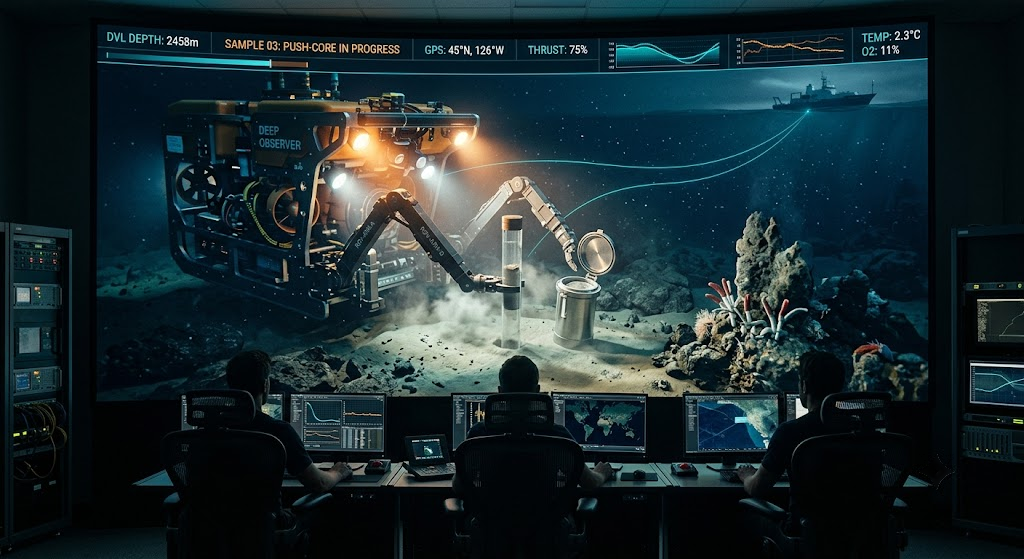
Deep-sea sampling is partly a fight against contamination. A sample can pick up material from the robot, from an earlier sample or from the water column on the way up, and changes in pressure and temperature can alter it as well. The routine side shows up in 2026 expedition work. During a dive in American Samoa, NOAA’s ROV Deep Discoverer used its manipulator arm to collect a volcanic rock sample, one of three on that dive. For delicate, microbial or DNA samples, design details matter far more.
Start With Materials That Leave No Trace
Equipment can contaminate what it collects. A study of microplastics in deep-sea sediment calls contamination from the surroundings, particularly the inner wall of plastic core tubes, a major problem. It adds that contamination can also occur during sample processing. Its team tested aluminum-tube push corers on the seafloor, at 1,548 m with the ROV Hyper-Dolphin and 5,719 m with the crewed submersible Shinkai 6500, alongside conventional polycarbonate corers. Those tests were aimed at plastic contamination, so they do not cover every contaminant.
Gentle Handling and Leak-Free Plumbing
Many ROV grippers were built for industrial work, not delicate samples. A systematic review notes that industrial ROV grippers are widely used for scientific collection even though they were not meant for fragile structures. It says the goal is an intact specimen in a condition as close as possible to its state before sampling .
For sediment, one German design project (GEOMAR) describes a suction sampler for ROVs rated to 6,000 m . Its main storage challenge is avoiding cross-contamination, so the conduit and containers must have no grooves or dead volumes where sediment could get trapped . The design also lets the ROV hover about 1 m above the seafloor to limit sediment disturbance, and it holds multiple containers to prevent cross-contamination. It is a design concept, not proof of field performance.
Seal It Before the Ride Up
Contamination and damage also happen during recovery. In one ROV sampling-box design, a sediment corer is placed in a storage chamber that is then capped, which avoids contamination as the sample travels to the surface. The box also has insulated compartments to keep conditions closer to those on the seafloor.
Pressure matters too. A pressure-retaining sampler can hold samples at in situ pressure up to 60 MPa during collection and ascent, and the authors say their results show the biological importance of maintaining deep-sea conditions. A 2026 paper reports that rapid depressurization and warming during recovery can stress microbes and speed up RNA degradation. Its ROV sampler addresses this by filtering microbes in place and adding an RNA preservative, with check valves to suppress backflow contamination.
Filtering Where the Water Is
For environmental DNA (eDNA), the cleanest approach is to filter water where it is collected. A large-volume eDNA sampler on the midwater robot Mesobot takes up to 12 samples per deployment with in situ filtration, and its performance was compared against conventional CTD-mounted Niskin bottles . A 2025 review notes that one commercial eDNA sampler comes in 20 m, 200 m and 3,000 m depth versions and was field-tested alongside Niskin and manual filtration .
Even automated systems can contaminate themselves. In one 2023 test, researchers found a bacterium that likely came from contamination left in the sampler from earlier testing .
What Remains Unproven
The 2026 filtration-and-preservation sampler was verified in a 20 MPa high-pressure chamber, which confirmed stable filtration and intact recovery of membrane samples. That is a lab test, not a deep-sea deployment. Several designs here are prototypes or concepts. None of the sources I reviewed claims a method that rules out contamination entirely.