Why Eye Surgery Needs Extreme Precision
The human eye contains delicate structures that can be damaged by small unintended movements. During retinal surgery, surgeons may need to guide tiny instruments near blood vessels and sensitive layers of tissue. Natural hand tremors, limited working space, and difficulties judging depth make these procedures particularly challenging.
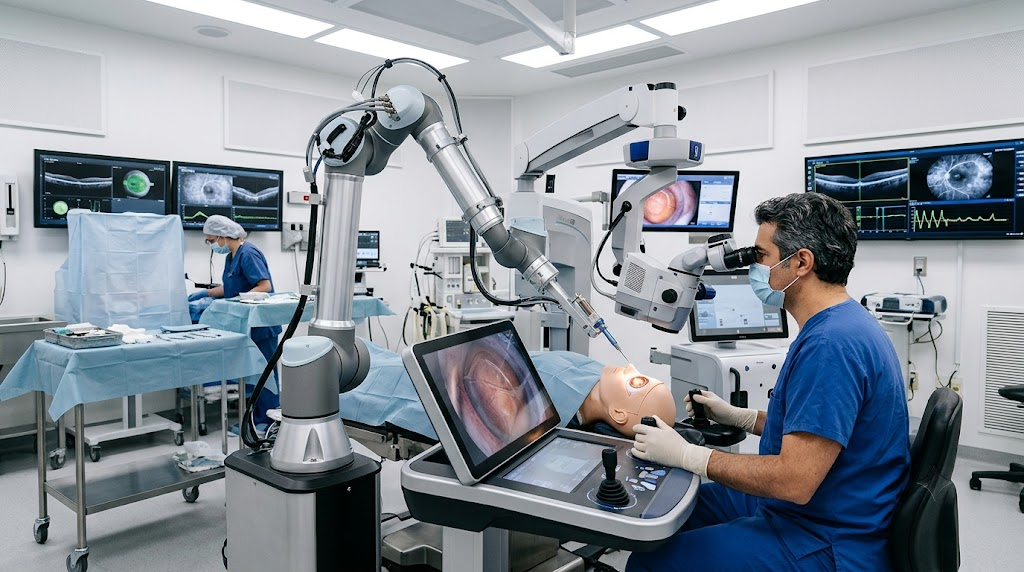
Robotic systems are being developed to stabilise instruments and translate hand movements into smaller, more controlled actions. Most are designed to assist the surgeon rather than independently perform an entire operation.
Microsurgical Instruments and Motion Scaling
Robotic microsurgery systems use specialised instrument holders, miniature tools, robotic arms, or remotely controlled mechanisms. Some allow surgeons to manipulate instruments through a control console, while others support hand-guided movements.
One important feature is motion scaling. A large movement made by the surgeon can be translated into a much smaller movement at the instrument tip. This allows fine adjustments when working close to delicate tissue. The amount of scaling depends on the system and its settings.
Researchers are also developing softer robotic mechanisms intended to control movement and limit unwanted forces. However, instrument size, mechanical friction, limited working space, and safe operation inside the eye remain important engineering challenges.
Tremor Reduction and Motion Stabilisation
Even experienced surgeons have small, involuntary hand movements. Tremor-filtering systems can detect and compensate for some of these movements, helping keep an instrument tip stable.
A 2025 study of a soft, high-precision robot for retinal surgery reported improved instrument trajectory accuracy compared with manual operation. The researchers also described preliminary human-testing results showing reduced instrument drift with robotic assistance. These findings are promising, but they do not establish that the system is suitable for every eye operation or widely available in hospitals.
Robotic assistance may be useful for delicate tasks such as retinal membrane peeling and targeted injections beneath the retina. Each application requires its own safety assessment and clinical evaluation.
Image Guidance and Emerging Autonomous Systems
Robotic instruments can be combined with high-resolution cameras and optical coherence tomography (OCT), an imaging technique that reveals detailed structures within the eye. These technologies can help surgeons assess instrument position and surrounding tissue.
In a 2026 study published in Science Robotics, researchers investigated an autonomous robotic system for targeted retinal injections. The system combined information from multiple views and sensors to guide instrument positioning. Testing included eye phantoms, pig-eye specimens, and live animal models. These experimental results should not be interpreted as proof that autonomous retinal surgery is ready for routine use in human patients.
Current Clinical Applications and Limitations
Robotic systems have been investigated in human eye surgery, including procedures involving the retina. Other systems remain at the simulation, laboratory, or animal-testing stage. The level of evidence and clinical readiness varies between technologies.
Cost, equipment compatibility, specialist training, and the need for larger clinical studies can limit adoption. Systems must also respond safely to unexpected movement and equipment problems. For now, their most realistic role is to assist trained surgeons rather than replace their judgement.
What Comes Next?
Future systems may combine robotic stabilisation, advanced imaging, and carefully controlled automation to support increasingly delicate procedures. Progress will depend on demonstrating better patient outcomes, not simply more precise instrument movement. Wider clinical use will require reliable equipment, appropriate regulation, specialist training, and strong evidence of safety.