Sparks, Lasers and Sensors: How Robotic Welding Is Reshaping the Car Body Shop
Robots already dominate arc and spot welding, and lasers, seam tracking and vision inspection are being added for EVs. Mixed materials, large castings and full autonomy remain open problems.
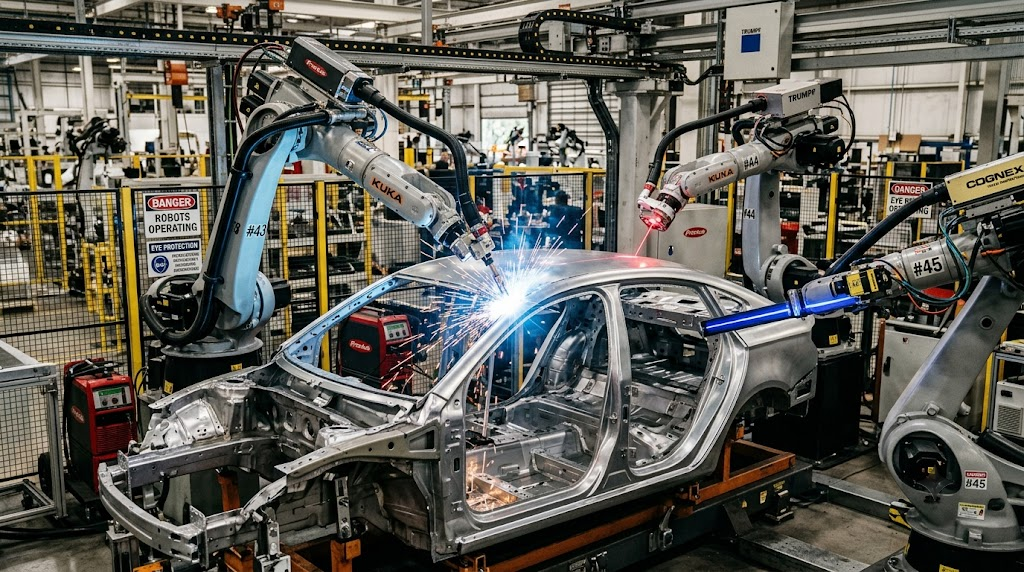
Few factories rely on robots as heavily as car plants. The International Federation of Robotics (IFR) reported on September 24, 2026 that the global operating stock of industrial robots reached a record 5 million in 2025, with more than 600,000 new units installed. A 2026 paper in Interdisciplinary Description of Complex Systems says the automotive industry remains the most significant sector for robot deployment, with high concentrations in welding, assembly and painting. Welding, the work that joins a vehicle’s structure, is where much of the change is now happening.
Arc and Spot Welding: The Body Shop Backbone
A 2026 overview from Global Automation Technologies says resistance spot welding dominates body-in-white panel assembly, while MIG/MAG arc welding covers chassis and structural work. It adds that spot welding needs tip-management methods to limit electrode wear. An integrator article from EVS International says a typical passenger-car body-in-white line runs 400 to 600 robots completing spot-weld cycles in under six seconds per station. That is a vendor-side estimate, not an industry survey.
Laser Welding Meets the Electric Vehicle
EVs push welders toward lasers. Global Automation Technologies lists EV battery enclosures, aluminum body panels and thin-wall brackets as laser-welding applications. EVS International says laser and laser-hybrid processes are growing fastest on EV programs, where manufacturers want narrow heat-affected zones. The same article notes that large aluminum die castings bring laser-hybrid or cold-metal-transfer MIG joining at the casting-to-sheet interface.
For battery housings, Global Automation Technologies says KUKA documents robot-assisted friction stir welding, which produces leak-tight joints without the porosity risks of fusion welding.
Seam Tracking: Following a Moving Joint
No two parts are exactly alike. An August 2026 article in the American Welding Society’s Inspection Trends describes vision systems that find and locate the joint before welding, track it in real time to compensate for variation during the weld, and then inspect the finished bead. It says automation has historically been limited to high-volume, low-mix production such as automotive, and that restriction is beginning to disappear.
Technology differs by line. Weldfabworld says AI seam tracking uses laser scanners, structured-light sensors or cameras with machine learning to locate the joint and adjust torch angle, speed and weave without stopping the cycle. On casting surfaces that vary, EVS International says a laser profilometer mounted ahead of the torch is standard practice, and describes an Asian battery-tray line where profilometers sat 80 mm ahead of each torch and fed the robot path at 500 Hz. That is an integrator case study. Researchers behind a YOLOv8-based seam-inspection robot note that laser navigation tracks accurately but requires an expensive laser or infrared sensor.
Inspecting Every Weld
Inspection is moving inline. According to AWS, a robot using laser-based 3D vision can measure weld height, width, toe angle and surface defects across the entire joint, creating a digital record of every weld. EVS International reports AI vision inspection detecting 96 to 99% of surface and near-surface defects, against about 87% for manual visual testing, citing industry deployment data. Treat that as an unverified vendor-side claim.
A ScienceDirect review of machine-learning weld defect detection says the field has advanced but still faces challenges in efficiency, complex defects and deployment, and that the existing literature is fragmented. EVS International adds that weld-by-weld serialization against the battery tray’s serial number is mandatory under most OEM programs to limit the scope of a recall.
Why Complex Structures Remain Hard
EV programs add aluminum MIG, laser-hybrid and friction-stir processes that EVS International says existing lines were never designed to handle. Variable casting surfaces demand constant adjustment, and friction stir welding can leave voids if tool pressure drops. Global Automation Technologies lists mixed-material structures among the growing complexities.
Full autonomy is also not here. Weldfabworld’s comparison table lists laser seam tracking and parameter logging as what commercial systems offer today, and fully autonomous parameter selection and quality prediction without human review as a future capability.