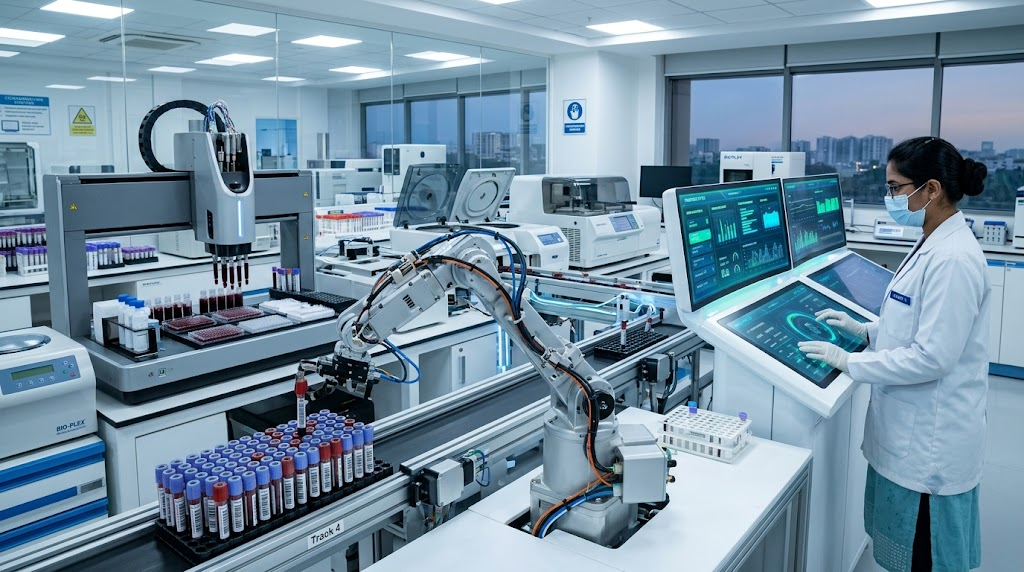
Hospital laboratories are using robotic systems to handle repetitive tasks, prepare samples, and connect diagnostic equipment. As testing demand grows, these technologies can help laboratories process specimens more consistently while allowing staff to focus on complex testing, quality checks, and clinical decisions.
Why Hospital Laboratories Need Automation
Hospital laboratories process blood, urine, tissue, and other biological samples throughout the day. Many steps, including sorting tubes, removing caps, preparing samples, and loading analyzers, require repetitive handling. Manual work can increase staff workload and create opportunities for labeling mistakes or inconsistent processing.
Total laboratory automation connects several stages of testing into a coordinated workflow. Collaborative robots, also known as cobots, can extend automation to tasks that are difficult to manage using fixed conveyor systems alone. A 2026 review describes how laboratory automation, collaborative robots, and mobile robotic platforms can work together to improve operational efficiency.
Sample Preparation: From Manual Work to Robotic Handling
Sample preparation is one of the most important areas for laboratory robotics. Before a sample can be tested, it may need to be sorted, identified, uncapped, divided into smaller portions, and delivered to the correct analyzer.
A 2026 study published in Diagnostics examined collaborative robots integrated into the pre-analytical workflow of a large centralized medical laboratory. The system performed tasks such as tube decapping, barcode orientation and verification, analyzer loading, liquid aliquoting, and specimen sorting. It also communicated with the laboratory information system.
During a 90-day operating period, the study reported more than 4.77 million samples processed using collaborative robots in one laboratory branch. The researchers reported an 87% reduction in labor input and a 3.4% improvement in liquid aliquoting accuracy. However, human operators completed aliquoting faster than the robots, showing that automation does not outperform people in every task. These results come from a specific implementation and should not be assumed to apply to every laboratory.
Liquid Handling and Diagnostic Workflows
Liquid handling involves accurately transferring measured amounts of a sample or reagent between containers. Robotic liquid-handling equipment can follow programmed instructions to dispense liquids repeatedly, helping standardize preparation for diagnostic tests.
When connected to analyzers and laboratory software, robotic systems can help move samples through different testing stages. Barcode checks and electronic records can also help staff track where each sample is and which procedures it has completed. The overall benefit depends on equipment compatibility, correct configuration, and validation of the workflow.
Contamination Control and Sample Tracking
Biological samples must be handled carefully to protect staff and maintain the reliability of test results. Automated tube handling and controlled liquid transfers can reduce unnecessary manual contact. Barcode verification and sample-tracking systems can also help identify mismatches before testing proceeds.
However, robots cannot eliminate contamination risks. Laboratories still need suitable protective equipment, validated cleaning procedures, quality controls, and clear protocols for handling spills or damaged samples. Automated systems must be monitored to identify errors and respond to unexpected situations.
Connecting Robots with Laboratory Equipment
A laboratory may use equipment from several manufacturers, each with its own software and operating requirements. Connecting robotic arms, sample transport systems, analyzers, and laboratory information systems can therefore be challenging.
A 2026 review highlights the potential of combining fixed laboratory automation with collaborative robots and autonomous mobile robots. Mobile robots can support transport between work areas, while robotic arms can perform selected bench-level tasks. However, integration, safety, validation, and maintenance remain important practical considerations.
What Comes Next?
Robotic systems are becoming a useful part of modern laboratory automation, particularly for repetitive sample-handling tasks. Their strongest role is not to replace laboratory professionals completely, but to support consistent workflows and reduce manual workload. Future progress will depend on reliable equipment integration, appropriate quality controls, and evidence that automation improves performance in real clinical settings.