Eyes in the Smoke: How Robotic Swarms Could Watch Over Forest Fires
A small wildfire can become a disaster within hours, so the first hour matters most. Researchers are testing drone swarms that patrol forests, spot heat or smoke, and report to firefighters. The idea is promising, but most of the evidence comes from models, trials and early deployments rather than routine fire operations.
Many Small Drones, One Wide View
A September 2026 preprint by MIT researchers Romain Puech, Danique de Moor, Ana Trišović and Dimitris Bertsimas shows what coverage could mean at scale. The team optimized where to base drones and how to route them, then tested the plan on 3,693 California ignitions from 2021 to 2024. In their results, a drone network on a $100 million five-year budget detected 97.3% of fires, including 74% within the first hour. The authors say that works out to about $20 million a year, roughly 5% of California’s annual wildfire-prevention spending. It is a modeling study on historical fires that has not been peer reviewed, not a field deployment.
Thermal Imaging: Finding Heat Through Smoke
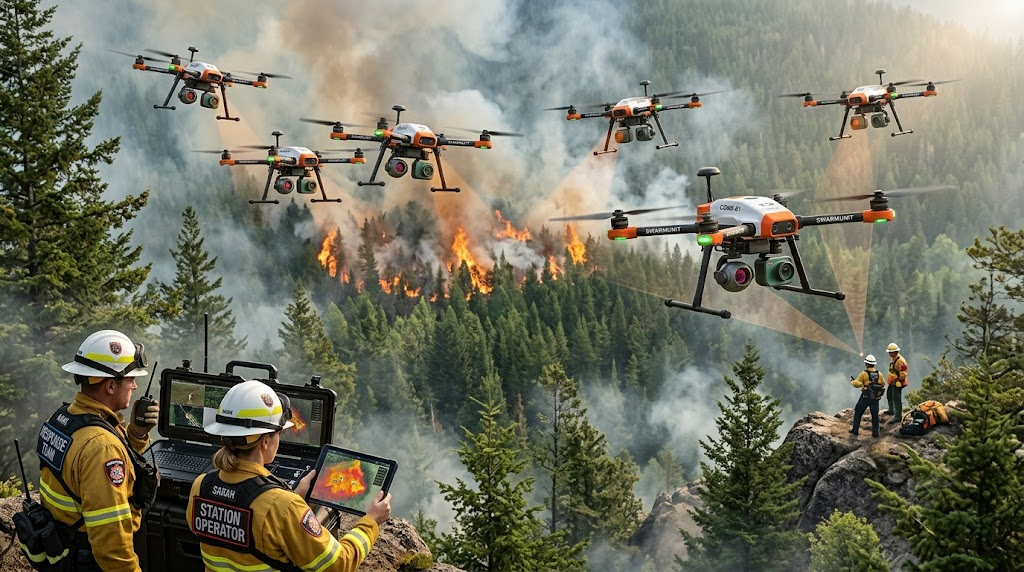
Thermal cameras make heat visible. In University of Sheffield trials, the fire service typically flew a DJI M300 RTK drone with a Zenmuse H20T thermal camera, and the thermal footage helped the team build fast, lightweight detection models using simple image processing. In the trial, drones using thermal and optical imaging could detect and investigate fires, then self-coordinate to drop retardant. The researchers said a swarm could potentially cover an area the size of Greece, which is their projection.
A recent Association for Drones guide says thermal drones can survey suitable areas and flag temperature anomalies for firefighters to investigate. It adds that drone imagery should feed firefighters, dispatch and GIS teams rather than operate as a separate information source. Smoke detection has limits too. Fraunhofer’s Evolonic system relies on computer-vision smoke detection, and its developers name nighttime detection as a remaining challenge.
How the Drones Talk to Each Other
Communication is the weak point. A June 2026 Fraunhofer release says civilian swarms are often controlled centrally over a mobile link, and if that link is damaged in a disaster, the swarm can no longer share information. Its answer is a decentralized mesh network in which each drone sends regular “I’m here” heartbeats, so the swarm can rebuild an almost complete picture of its members every few seconds, even without mobile coverage.
A ScienceDirect design study describes the same trade-off. Centralized control sends every drone’s data to a command center, which makes the swarm semi-autonomous. Decentralized control is better suited to the restricted communication range of remote, harsh wildfire environments. A separate simulation of drones working with ground sensors found that, given enough budget, such a network could detect fires faster and more reliably than satellite imaging.
From Alert to Response
Speed is the goal. In a trade article on California drone programs, drones launch automatically when a fire is detected through the dispatch system, with a goal of reaching it in 3 to 10 minutes. The same article says Dryad Networks used a two-step approach in which an observation drone located a fire with optical and infrared imaging and a suppression drone extinguished it within 12 minutes. That is a company result, not an independent test.
Sheffield researchers developing the Aura swarm worked with Lancashire Fire and Rescue and said it aims to extend firefighters’ reach and safety, not replace their expertise.
What Still Limits Swarms
Regulation is a major barrier. The ScienceDirect study says rules remain very restrictive on operations beyond visual line of sight, autonomy and self-organization. Sheffield’s team adds that beyond-line-of-sight flights usually need special authorization, and that dropping even small amounts of water on a fire requires lengthy safety assessments. The ScienceDirect paper also lists energy autonomy, safety, communication and public acceptance as key issues. The Association for Drones guide adds that wildfire drone pilots need specialist training and that drones should complement established detection and firefighting systems.