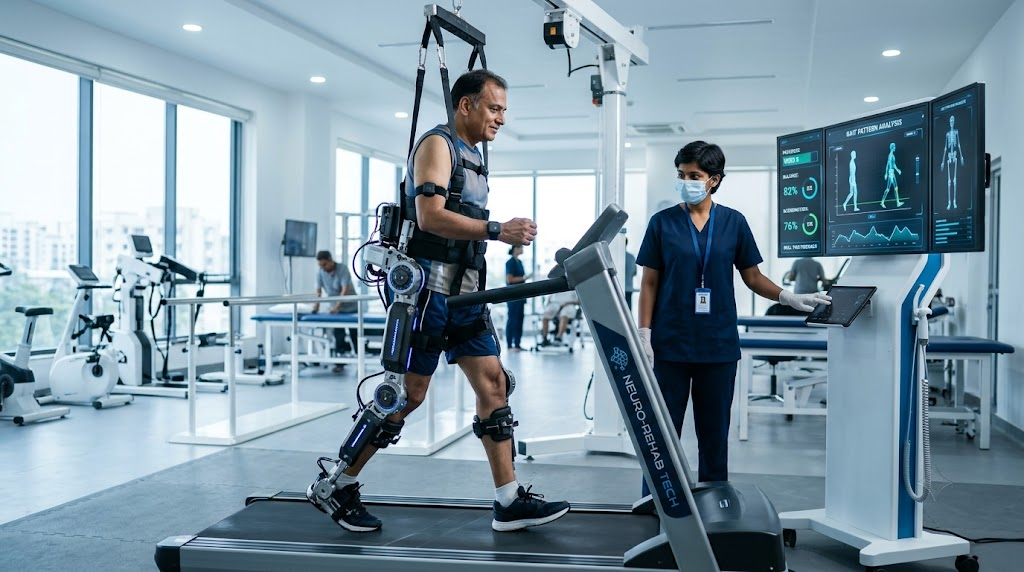
Robotic rehabilitation systems are helping therapists guide repeated movements, train walking, and measure recovery. Their real value depends on whether these improvements translate into meaningful benefits for patients.
Why Rehabilitation Needs Repeated Practice
After a stroke, spinal cord injury, or serious leg injury, patients may struggle to stand, balance, or walk independently. Recovery often requires repeated exercises that gradually help rebuild strength, coordination, and movement control.
Robotic rehabilitation systems support this process by guiding limbs through controlled movements or helping patients practise walking. Depending on the design, a device may provide partial assistance, support body weight, or allow therapists to adjust the level of help as a patient progresses. These systems are generally intended to complement rehabilitation professionals, not replace them.
Assisted Movement and Robotic Exoskeletons
Some rehabilitation robots are wearable exoskeletons that support the hips, knees, or other joints. Others attach to a treadmill or guide the feet through a walking pattern. These systems can help selected patients practise movements that might otherwise be difficult to repeat safely.
The amount of assistance matters. If a robot does too much of the work, the patient may contribute less active effort. Therapists therefore need to adjust support to the person's ability, medical condition, and rehabilitation goals.
Robotic systems can also make it easier to repeat similar movements across sessions. However, the right approach varies with the injury, the patient's strength, and their ability to follow instructions.
Gait Training and Rehabilitation Feedback
Gait training focuses on improving the way a person stands and walks. Robotic treadmills and exoskeletons can support repeated stepping while helping manage body weight and movement. This may allow some patients to practise walking earlier or for longer periods under professional supervision.
Many systems collect information such as step count, walking speed, joint movement, distance, and the amount of assistance provided. Therapists can use these measurements to track performance, adjust exercises, and compare progress between sessions.
Sensors and visual feedback may also help patients understand how they are moving. Still, a better score on a device does not automatically mean that someone can walk more safely at home or manage everyday activities independently.
What Does the Evidence Say?
Research suggests that robotic gait training can improve some movement outcomes, particularly for certain patients recovering from stroke or spinal cord injury. A 2026 systematic review of randomised trials after stroke found possible improvements in walking speed and balance, but the authors rated the overall certainty of evidence as low. Differences between studies and limited follow-up made it difficult to establish whether robotic training consistently outperforms conventional rehabilitation.
A separate 2026 review of walking rehabilitation after spinal cord injury reported improvements in several activity measures, including walking time, distance, and speed. However, the certainty of evidence for these changes was very low, so the results require careful interpretation.
For people recovering from traumatic lower-limb injuries, a 2026 systematic review found that robotic systems with dynamic body-weight support may help with early gait and balance training. The review included only seven studies involving 265 participants, highlighting the need for stronger evidence.
Measuring Real Patient Benefits
To demonstrate that a rehabilitation robot genuinely helps, researchers need to measure more than the number of movements completed. Useful outcomes include walking speed, balance, distance walked, independence in daily activities, falls, patient comfort, and quality of life.
Well-designed studies should compare robotic rehabilitation with appropriate conventional therapy, include enough participants, and follow patients after treatment ends. Researchers should also examine cost, access, safety, and which patients benefit most.
What Comes Next?
Robotic rehabilitation is becoming a useful option for structured, measurable movement training. Its future will depend on matching each system to the right patient and proving that improvements during therapy lead to lasting benefits in everyday life