From Muscle Twitch to Grip: How Robotic Prosthetic Hands Read Intent, and Why Natural Feel Is Still Hard
Electrodes pick up muscle signals and software maps them to movement, but touch feedback, cost and long-term use remain open problems.
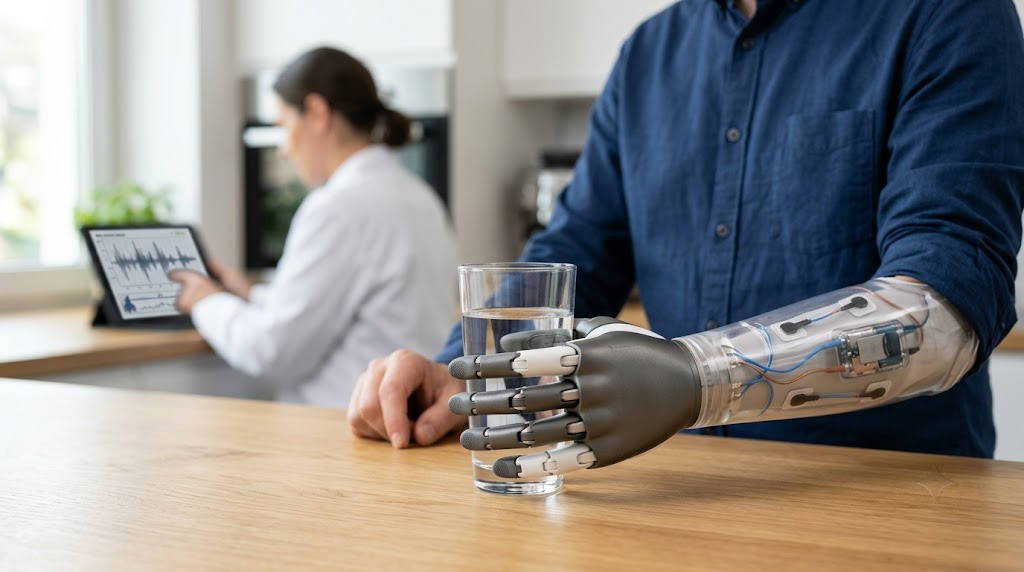
A robotic prosthetic hand has to do three things: detect what the user wants, work out which movement that means, and carry it out. Many systems start from the electrical potentials that the nervous system sends to the remaining muscles, picked up by electrodes . The harder problem is the return path. Several 2026 papers say most commercial prostheses give the user little natural feedback .
Reading the Signal at the Skin
Commercially available systems in 2026 still rely mainly on muscle-activated sensors, while brain-controlled arms remain largely in clinical trials and research settings, according to one prosthetics provider . In BionIT Labs’ Adam’s Hand, surface electrodes on the limb detect signals that reflect the user’s intended contractions, such as opening or closing the hand or grasping an object.
Researchers are also trying to cut cost and complexity. An April 2026 conference paper presents a three-fingered hand controlled by surface EMG from forearm muscles, built around an Arduino microcontroller. Its authors say advanced myoelectric systems often depend on complex algorithms, expensive hardware and calibration routines.
Predicting the Movement
BionIT Labs says its hand runs an AI algorithm on the device that maps myoelectric signals to the user’s intent, so it can respond quickly without a cloud link . That is a company statement, not an independent test.
A study record updated in August 2026 describes a comparison of machine-learning controllers that use velocity control with those that use position control. It involves eight transradial and four transhumeral amputees with implanted neural interfaces and intramuscular EMG. It is a study plan, so no results are claimed here.
The Missing Sense of Touch
A March 2026 IEEE paper says most commercial prostheses lack natural, intuitive sensory feedback and names this as one reason for their high abandonment rate . A September 2026 study likewise says most clinical systems remain open loop. The Veterans-focused study record adds that many amputees abandon prostheses because current options do not meet their needs .
Feedback appears to help. An April 2026 Lancet Neurology review reports significantly better functional task performance when sensory feedback was provided, especially biomimetic feedback. Naturalness was less consistent: in one study of four amputees, three mainly reported tingling or mixed sensations, and one mainly reported naturalistic ones.
Non-invasive options are being tested too. The September study used a single lightweight actuator to deliver grasp-force feedback. It was tested in non-disabled participants, so the results may not transfer to people who use prostheses daily.
Cost and Access
PatSnap estimates that advanced myoelectric hands cost between $10,000 and $100,000 in high-income markets, and that about 40 million people worldwide need upper-limb devices. A prosthetics provider lists entry-level myoelectric arms such as the Hero Arm at roughly $5,000 to $10,000. Both figures come from commercial sources and are estimates.
What Comes Next
Some teams are looking beyond surface sensors. The European MYKI project plans to test whether magnets implanted in muscle allow natural, multi-degree control of robotic hands, comparing them with conventional surface EMG, and says the magnets could also provide sensory feedback . A 2026 industry overview lists Esper Bionics and Phantom Neuro among companies working on muscle-signal control . The evidence cited here for implanted and neural approaches is still study plans and small studies , and none of the sources reviewed report everyday-use outcomes for them.
Editor’s Takeaway: Muscle-signal control is the main commercial approach , while natural touch feedback is still largely missing from commercial devices . Check whether a claim comes from a company demo, a small study or a clinical product before treating it as proven.