One Lesson, Many Machines: How Robots Learn From Each Other Across Cities and Continents
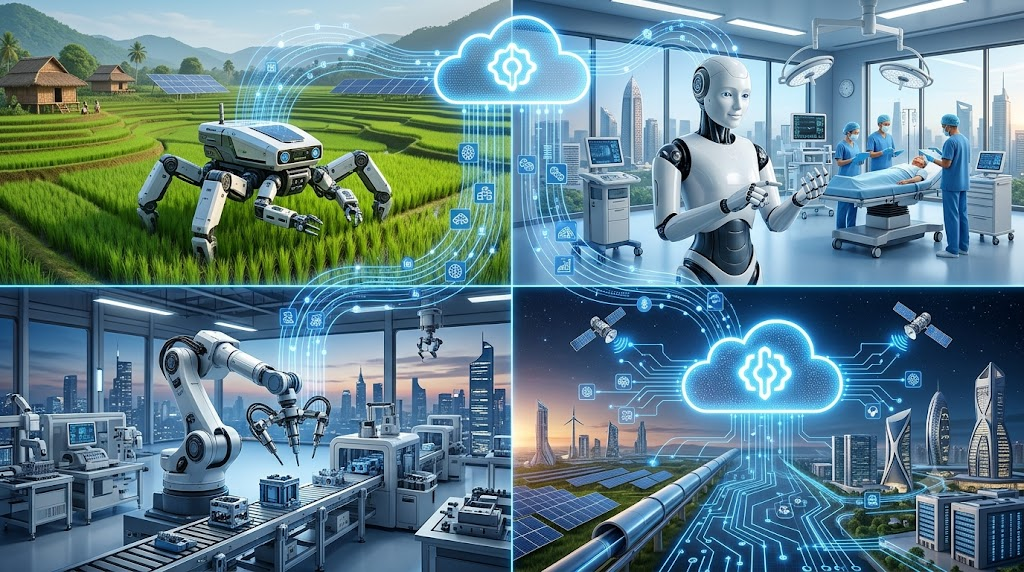
Robots can pool experience in the cloud, share model updates instead of raw data, and transfer skills between different bodies. Connectivity, mismatched hardware and rare edge cases keep real fleets from learning perfectly.
A robot in one warehouse can improve because a robot in another one struggled. The idea is not new. A 2016 Google Research post explained that robots can instantly transmit their experience over a network, which is how they can learn from each other. Its demonstrations were simple, such as pushing objects and opening doors. In 2026 the experiments are larger, but the hard problems are the same: what to share, how to combine it and whether it works on a different machine.
Pooling Experience in the Cloud
The simplest approach sends experience to a central server. In OpenBot-Fleet, a 2024 ICRA paper by Matthias Müller and colleagues, 72 low-cost robots were distributed to crowd workers who operated them in homes. The robots uploaded task data to the cloud, where navigation policies were learned and sent back, reaching over 80% success in unseen homes.
An October 2026 preprint, “Learning from Fleet Experience,” goes further. It proposes collective experience learning, in which deployed robots share their execution experience to improve a common policy. When a robot fails, the system retrieves similar successful trajectory segments from the fleet’s shared experience and uses their actions as supervision, without collecting more expert demonstrations. A fault-tolerant asynchronous training system copes with local interruptions. On multi-stage phone packaging, learning with 96 robots raised success from 79.2% to 98.3%. This is a preprint summary, not a peer-reviewed deployment.
Federated Learning: Sharing Updates, Not Data
When data cannot leave a site, robots can share what they learned instead. A 2026 survey of AI-IoT-robotics explains the method: each agent trains a local model and periodically shares parameters or gradients with an aggregator, which produces a global update. It is attractive when privacy, bandwidth and organizational boundaries prevent centralized data collection.
A ROS 2-based study in the journal Electronics compared federated learning against classical centralized learning and reported improved generalization, a more stable reward distribution and reduced training variance. The 2026 survey lists the costs: communication overhead, unstable convergence on mismatched devices and non-identically distributed data across robots.
Different Bodies, Different Lessons
Knowledge does not move easily between unlike machines. An ICLR 2026 study by Haruki Abe and colleagues trained on locomotion data from 16 robot platforms. It found that as the proportion of suboptimal data and the number of robot types grew, conflicting gradients across morphologies began to hinder learning. Grouping robots by morphological similarity helped.
Another October 2026 preprint, “Silicon Language,” argues that federated learning and shared datasets aggregate gradients or data, but robots do not decide what is worth sharing. In its design the receiving robot, which may have different sensors and actuators, adapts the incoming knowledge and judges through its own trial protocol whether it is safe to adopt. The authors describe their results as initial evidence, with fleet-level evolution left as future work.
The Long Tail and the Human Backstop
Even large fleets meet situations nobody has seen. UC Berkeley researchers describe this “long tail” problem and propose interactive fleet learning, where a smaller number of humans are assigned to the robots that need help most, and the robots learn from those interventions.
What Fleet Learning Is, and Is Not
A June 2026 ETC Journal overview of humanoid fleet learning says the practice usually means distributing newly learned network weights to all robots in a fleet. It stresses that this does not mean one model updating in real time across all units, and that “instantly” is rhetorical shorthand. It also calls cross-manufacturer collective intelligence a speculative long-term scenario.
Infrastructure is another limit. The 2026 SwiftBot paper notes that existing federated systems largely assume a stable topology in which robots stay connected to a central server, and that fleets mix low-power boards with stronger edge nodes. Real sites with weak connectivity and old hardware complicate that picture.