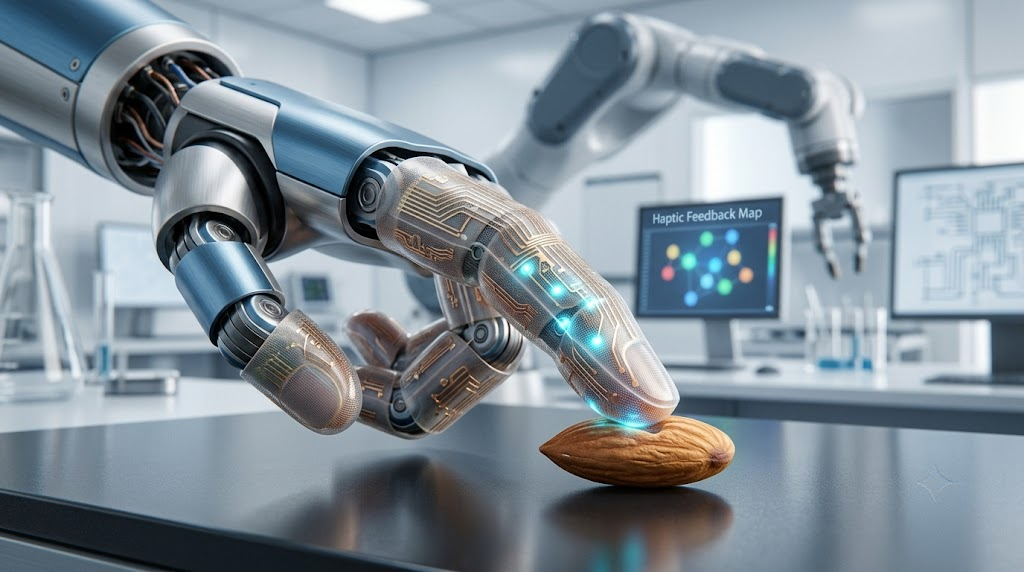
A miniature sensor reported in Nature Materials in March 2026 can detect a grain of sand, and the system adapts in real time when an object starts to slip. It is one sign that touch, long a weak sense for robots, is catching up with vision. Giving a machine something like skin means solving three problems at once: feeling, interpreting and reacting.
How a Sensor Feels Pressure
Electronic skin is a grid of tiny sensing points, often called taxels. When something presses on a point, a physical property changes and is read as an electrical signal. Capacitive designs, like a 2026 fish-skin-inspired origami skin covering 60,000 square millimetres, sense how the electrical behaviour of stacked layers changes as they deform. Piezoresistive designs change resistance, magnetic designs track the movement of tiny magnets, and optical designs use a camera to watch a soft gel deform. Exhibitors at ICRA 2026 showed magnetic, piezoresistive and optical options, and a tactile-skin maker there saw no sign of one design winning.
From Signal to Reaction
A reading is useless until software interprets it. Seoul National University researchers reported in Nature Materials in June 2026 a single ultrathin sensor that switches rapidly between sensing temperature and pressure; paired with AI and a wireless board, a fingertip version identified 20 everyday objects with 83 percent accuracy. The team also built an array that maps temperature and pressure at a resolution similar to human skin, suggesting the design can scale beyond one sensor. The March graphene-based sensor goes further by reacting: it adapts in real time by detecting slip rather than relying on prior knowledge of an object’s properties.
Other reactions are protective. In the origami skin study, a robotic arm fitted with the skin stopped automatically as it approached a human hand. And researchers at City University of Hong Kong described a neuromorphic skin that encodes touch as neural-like pulse trains and triggers protective reflexes on harmful contact, without waiting for the robot’s main processor.
What Changed in 2026
The year brought both research and products. XELA Robotics integrated its magnetic uSkin sensors into Tesollo’s five-fingered DG-5F hand in December 2025, showed it at CES 2026, and says each fingertip has 12 sensing points able to detect down to 0.1 gram-force; those are company figures. In April 2026, University of Turku researchers attached a stretchable skin to a robotic hand whose pressure sensors responded to touch, in lab tests that the researchers describe as an early step.
On 10 September 2026, a review from Korea’s KIMM argued that keeping latency low across a humanoid’s body calls for computing built into or beside the sensor, using neuromorphic designs that mimic nerve signalling.
Why Touch Is Still Hard
Most research results above are lab demonstrations on small patches, fingertips or single arms, not skins covering a robot working a full shift. Durability is one open problem: in August 2026, National University of Singapore researchers described an elastomer skin that senses touch, proximity and punctures, then heals itself, working on land and underwater, but it is a research prototype. Another is standardisation. A skin maker at ICRA 2026 noted that taxel count, such as a 900-taxel demonstration against 20 to 140 taxels per commercial sensor, is a weak measure of usefulness, and that sensor types remain fragmented.
Data is the third problem. Many sensing points produce a constant stream that must be read and acted on within milliseconds, which is why the KIMM review pushes processing into the skin. Wiring is another: the origami-skin authors say the structural and wiring complexity of conventional sensor arrays hinders scalability.
For now, electronic skin gives robots fragments of touch: pressure here, slip there, a reflex somewhere else. A whole-body sense that works for years outside the lab is still unproven.