In 2026, a surgeon in Colombia operated on a patient in Indore, India, using a robot, across roughly 22,000 kilometres of fibre network. SS Innovations, which makes the system, calls it the longest robotic telesurgery on record, a claim that is the company’s own. The story captures a surgical robot’s real role: it extends a surgeon’s hands over distance and through tiny incisions, but the surgeon still does the operating.
What the Surgeon Does at the Console
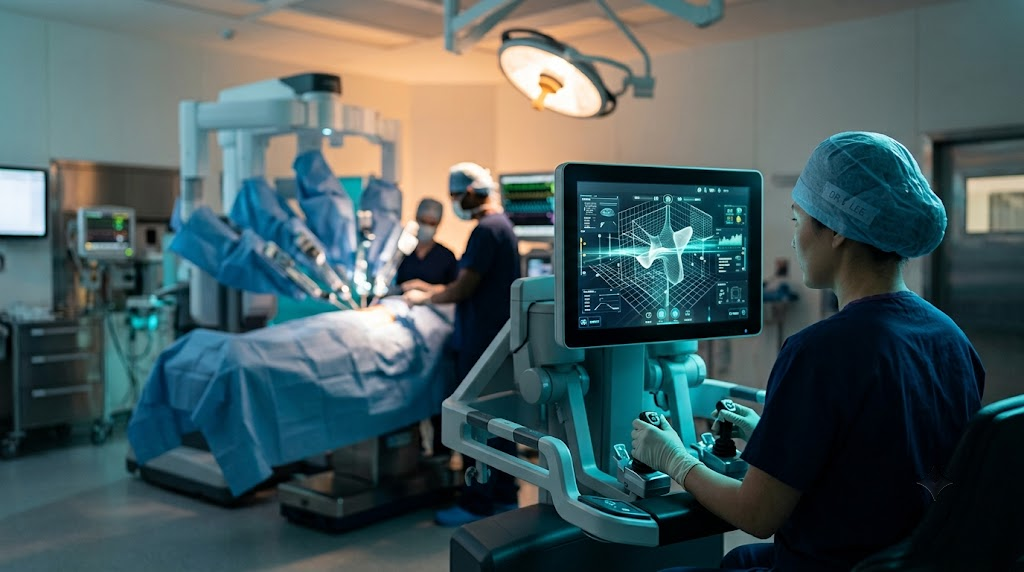
Most surgical robots are not autonomous. The surgeon sits at a console, views a 3D image from a camera inside the patient, and moves hand controllers. The system converts those movements into smaller, steadier motions of thin instruments passed through small incisions, with tremor filtered out. The instruments have wrist-like joints that bend inside the body in ways rigid laparoscopic tools cannot.
Intuitive says its da Vinci 5, cleared in 2024, adds new controllers, tremor controls and optional force feedback, which in preclinical testing reduced force on tissue by up to 43 percent. Without force feedback, surgeons judge tissue mainly by sight.
What Changed in 2026
On 26 January 2026, Intuitive announced FDA clearance of da Vinci 5 for certain cardiac procedures, including mitral valve repair, allowing surgeons to work through small incisions without opening the breastbone. The clearance covers instruments without force feedback. Intuitive reported placing 468 systems in the second quarter, 246 of them da Vinci 5, with that installed base passing 1,700, according to an analyst summary of its results.
Competition is widening. Medtronic’s Hugo won US clearance for urology in December 2025. On 22 July 2026, Johnson & Johnson received FDA De Novo authorisation for Ottava, which it calls the world’s first table-integrated soft-tissue robotic system. J&J will launch with select US customers first.
Does Precision Mean Better Outcomes?
Not always. A 2026 meta-analysis of randomised trials in rectal cancer found robot-assisted surgery took about 40 minutes longer and cut conversions to open surgery (odds ratio 0.52), with no clear difference in major complications. Its authors concluded that current trials do not establish overall superiority over laparoscopy and indicate higher direct costs where measured, with results depending more on patient and surgeon factors than on the platform.
A 2026 meta-analysis of cholecystectomy, pooling randomised and observational studies, found fewer serious complications with robots (odds ratio 0.82) and fewer conversions, yet still concluded that laparoscopy remains the standard for most patients because of its proven cost-effectiveness.
Safety, Autonomy and the Limits
Safety data are imperfect. A 2026 analysis of US FDA adverse-event reports covered an estimated 15.9 million da Vinci operations and found 66,651 reports, or 420 per 100,000 procedures, including 55 injuries and 3.1 deaths. These are reports, not confirmed device failures, and cannot show whether robotic surgery is safer than other approaches. The authors called events relatively uncommon but numerous given widespread use, and found higher reported risks for the single-port da Vinci SP than for X/Xi models.
Telesurgery adds a network to the safety chain. In its 10 September 2026 update, SS Innovations reported remote procedures from its Gurugram headquarters on patients at Shalby Hospital in Ahmedabad, about 950 kilometres away. These are company-reported cases, and remote operation still relies on a local surgical team and a dependable connection.
Autonomy remains experimental. Johns Hopkins researchers reported in 2025 that an AI-controlled da Vinci completed the clipping and cutting steps of gallbladder removal on eight pig gallbladders without human intervention, but only on tissue removed from animals, not living patients.
For patients, the useful question is not whether a robot is involved, but which operation, which surgeon and what the evidence says for that combination, at what cost.