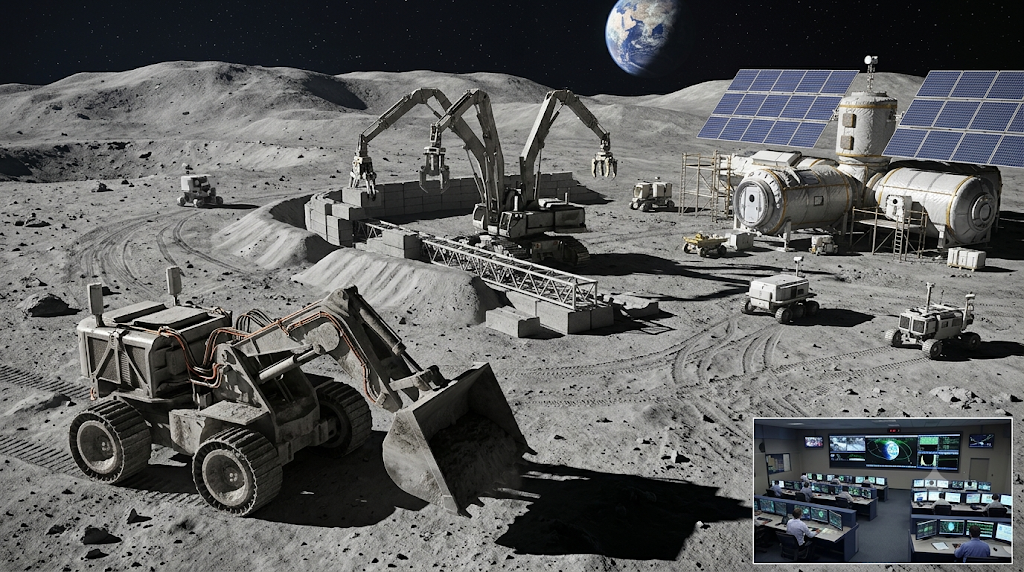
Robots can service satellites in orbit today, but building big structures there is still mostly a plan. Past demonstration missions were cancelled, and new ones are only starting.
Everything launched into orbit has to fit inside a rocket’s nose cone, called a fairing. That limit is the main reason engineers want robots that can build large structures in space. In 2026 the technology is moving forward, but it is still closer to servicing satellites than to constructing anything big.
The 2026 Milestone
On July 21, 2026, Northrop Grumman’s Mission Robotic Vehicle launched on a Falcon 9, according to NASA. It carries the NASA-supported Robotic Servicing of Geosynchronous Satellites payload, with twin robotic arms, and is heading to geosynchronous orbit to service spacecraft. DARPA funds the program, and NASA says it supports the agency’s goals for in-space servicing, assembly and manufacturing. This is servicing, not construction. Payload’s State of ISAM 2026 review calls assembly perhaps the furthest from reality, since everything flying in orbit still has to fit inside a rocket fairing.
Three Ways to Build
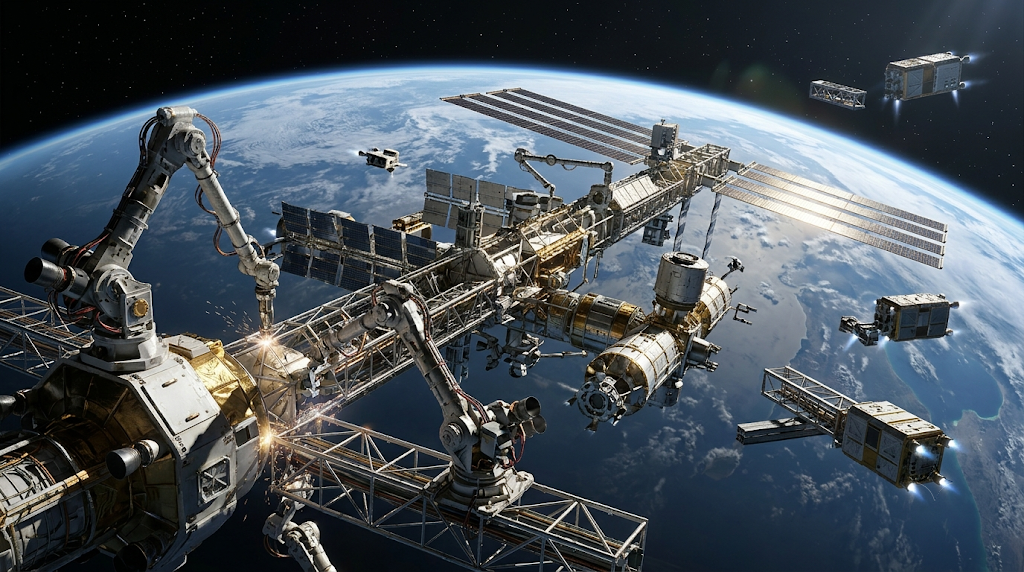
Assemble prefabricated parts. A Frontiers editorial says NASA has called for autonomous on-orbit assembly of large structures, and describes work comparing stationary and mobile robots with two dexterous arms assembling a truss. A NASA roadmap adds that satellites will need modular designs to make this easier.
Print the structure. NASA’s OSAM-2 mission, formerly Archinaut One, was designed to 3D print a 10-meter beam and deploy a solar array with a robotic arm, according to Aerospace America. Its mission manager said the aim was to avoid complicated folding mechanisms like those on the James Webb Space Telescope.
Combine both. An innovation newsletter says ThinkOrbital is developing robotic electron-beam welding to assemble spherical pressure vessels in low Earth orbit, and describes Redwire’s approach as pairing assembly with additive manufacturing. These are company plans, not flown results.
What Was Cancelled
A Secure World Foundation fact sheet says NASA concluded OSAM-2 in 2023 before a flight demonstration, and canceled OSAM-1, which would have assembled an antenna with a robotic arm, in March 2024 because it was years delayed and heavily over budget.
Why Demand Is Growing
On March 24, 2026, NASA announced a plan called Ignition that pauses the Gateway lunar station to focus resources on a Moon base, according to The Planetary Society. ABC News reported a $20 billion plan. Outpost’s vice president of commercial partnerships told Payload that as launch costs fall, more people look at what production can happen in orbit.
Our Assessment
The sources point to a clear order of difficulty. Inspecting and servicing existing satellites comes first, because it needs no new structure design. Assembly comes next, but only if parts are built to be joined by robots. Printing and welding come last, because they ask a robot to create the structure and prove the joints are sound.
That order explains the cancellations. Both canceled missions tried to leap ahead: OSAM-1 to a robotic assembly demonstration, and OSAM-2 to printing in orbit. A hybrid of modular assembly and limited printing looks like the most realistic near-term path, though that is our reading of the evidence, not a finding in any source.
One tension is worth watching. If launch costs keep falling, building mid-size structures in orbit becomes harder to justify against launching them whole. The case is strongest for very large structures that no fairing can hold.
Three milestones would change the picture: a flown mission that assembles even a simple truss, independent reports on joint quality in orbit, and a cost comparison against launching the same structure whole.