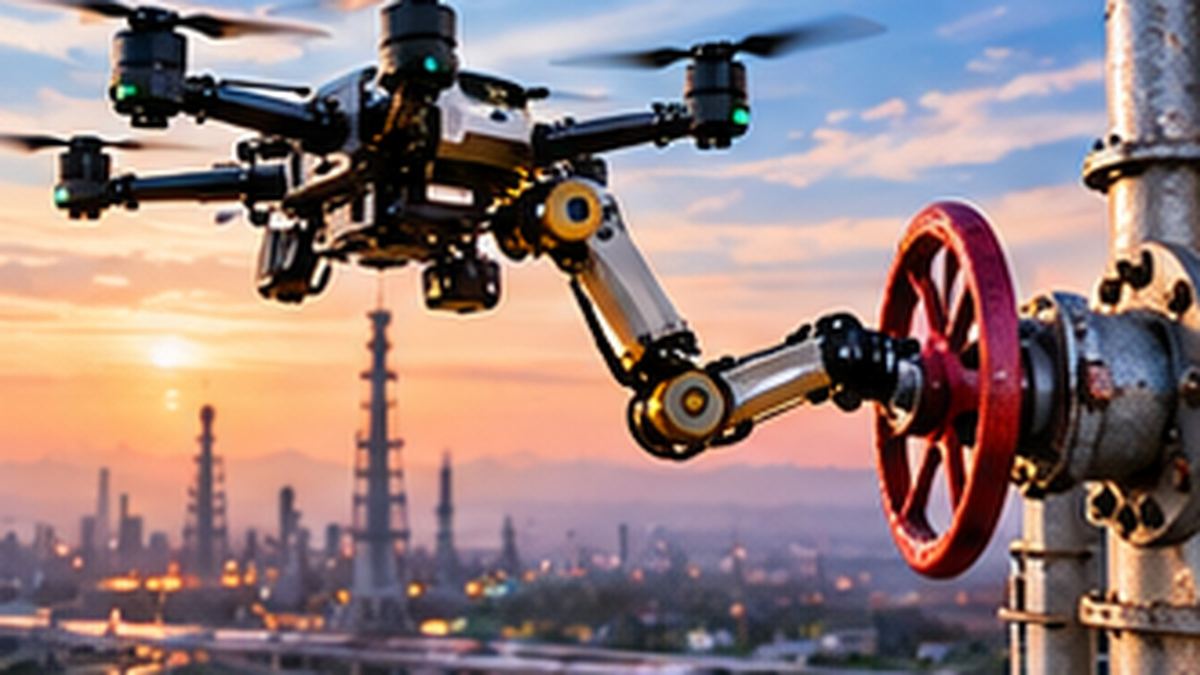
A flying toolbox changes the payload problem
The system uses two multirotors rather than asking one aircraft to carry every tool. A “toolbox” drone carries interchangeable end-effectors, while a smaller manipulator drone flies above it and uses a robotic arm to dock with the required tool. That architecture addresses a basic problem in aerial manipulation: the more hardware a drone carries, the more weight it must lift, and the harder it becomes to remain stable while pushing or pulling on an object.
The difficult part is not simply bolting a gripper onto a quadcopter. A robotic arm changes the drone’s centre of mass and creates reaction forces whenever the arm accelerates or touches something. Two nearby drones also disturb each other through rotor downwash. FlyingToolbox tackles both issues with visual sensing, pose estimation, trajectory generation and a learned disturbance model. The manipulator uses a downward-looking camera and fiducial markers to estimate relative position, while the support drone predicts the vertical disturbance created by the second aircraft.
How the two-drone system works
The Nature paper reports an average docking error of 0.80 ± 0.33 centimetres across 20 consecutive tool exchanges, even with downwash airflow reaching 13.18 metres per second. The system demonstrated multiple tasks, including moving an object with an electromagnet and manipulating a ball with a soft gripper. The researchers also showed docking while the toolbox drone was moving. Those are laboratory demonstrations, but they are important because they show that aerial robots can share tools rather than treating each drone as a self-contained machine.
The potential applications are easy to see. A drone inspecting a wind turbine, bridge or tall façade could carry a camera for most of a mission, then acquire a gripper, cutting tool, magnetic pickup or inspection probe when physical interaction is required. That could reduce the need for a worker to reach the same location. Aerial manipulation is also relevant to emergency response, where a drone might deliver a small object, operate a valve or interact with a structure that is unsafe for a person to approach.
What has actually been demonstrated
The limitations are equally important. The demonstrated manipulator has a relatively small workspace and payload compared with industrial robot arms. Precision depends on good visual references and careful flight control. Wind, dust, rain, poor lighting and flexible structures can make contact much harder than a controlled indoor test. The aircraft also pays an energy penalty for carrying the arm and for countering reaction forces. A drone that can pick up a 500-gram object is not automatically a flying replacement for a human technician.
Where aerial manipulation still falls short
Commercially, aerial manipulation is therefore better described as an emerging specialist capability than a mature mass-market product. The strongest near-term use cases are likely to be inspection, light intervention and tool delivery in places where access is expensive or dangerous. FlyingToolbox shows the direction clearly: the useful aerial robot may not be a camera with a battery anymore. It may be a mobile work platform that can choose the tool it needs while airborne.
The next step is contact reliability. Inspection and repair are different from simply carrying a camera because the robot has to touch the world without losing flight stability. Researchers are therefore exploring compliant arms, force-aware control and end-effectors that can absorb small positioning errors. A useful commercial system will also need a clear division of labour between autonomy and the human technician: the drone can hold position and manage the arm, while the technician specifies the physical task and confirms critical actions. That approach reduces the amount of precision flying required from the operator without pretending that an experimental arm can replace an experienced industrial robot or technician.