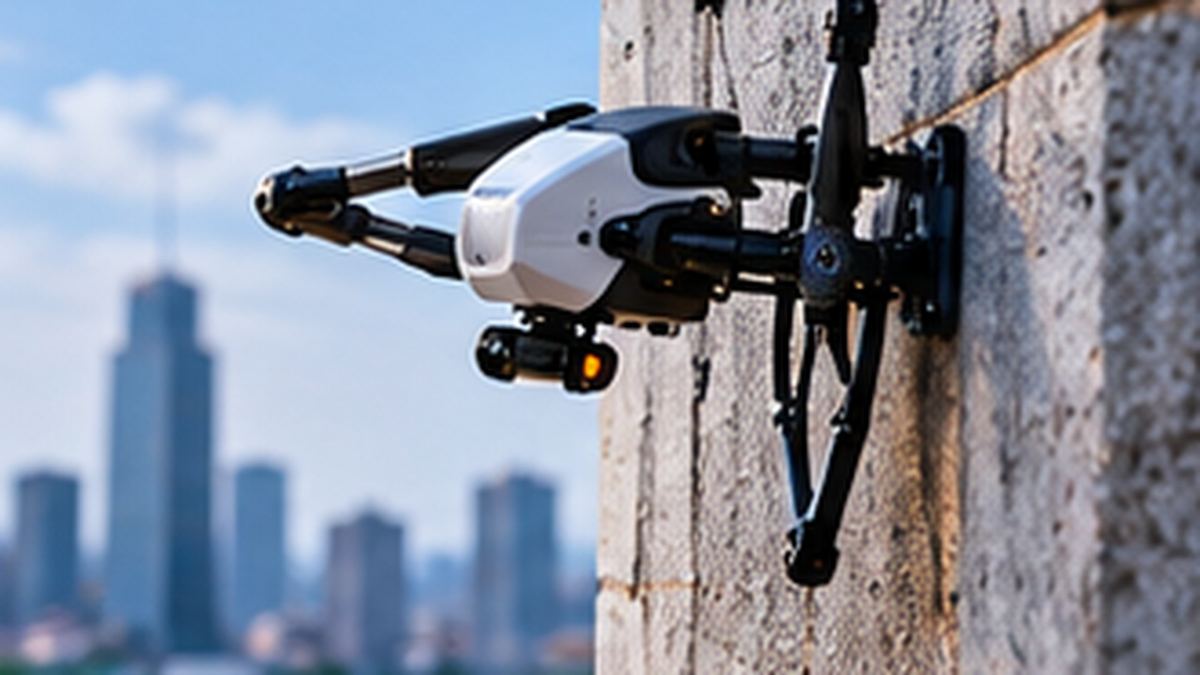
Why engineers want a drone to stop flying
A multirotor spends energy every second it hovers because its propellers must continuously generate upward thrust equal to the vehicle's weight. A perching mechanism changes the energy budget: the drone still spends energy reaching the target, but once attached it can reduce or stop hover thrust. That can be valuable when a mission needs a sensor to remain at one viewpoint for a long time rather than continuously travel.
The idea has been explored before the 2025 Fudan work. A 2021 Science Robotics study demonstrated dynamic bird-inspired grasping and perching on complex arboreal surfaces using a compliant leg and foot. [2] Another study of a deformable bird-inspired UAV reported that, in its tested configuration, the perching state reduced energy use to a small fraction of hovering. [3] These results are not universal battery-life guarantees: savings depend on aircraft mass, perch geometry, wind, sensor load and how often the drone must detach and fly again.
How the perching mechanism works
The Fudan mechanism is essentially a compact mechanical transmission between landing motion and toe closure. Its four-toe foot provides multiple contact points, increasing the chance of forming a stable grasp on a branch or similar cylindrical surface. Tendons route pulling forces through the leg while springs provide compliance and store mechanical energy. When the foot makes contact and the leg folds, the mechanism changes its tendon geometry so that the claws close around the perch. [1]
The architecture matters because it reduces how much active control is required after contact. Instead of four separate motors constantly holding the toes shut, the structure uses its own geometry and stored spring energy. The study also includes an active grasping sequence in which energy is preloaded and a contact-triggered switch releases the mechanism. The reported claw-closing time was about 500 milliseconds. [1]
From an engineering perspective, this is a form of mechanical intelligence: some of the desired behaviour is embedded in springs, linkages and force paths rather than being generated entirely by software. The trade-off is additional hardware, mass and moving parts that can fail or wear out.
What the experiments demonstrate - and what they do not
The 2025 study tested perching on branches with diameters of 60, 70 and 80 millimetres and evaluated grasping across 20 objects with different shapes and materials. The reported grasping trials succeeded for 19 of the 20 objects in at least two of three attempts. A 500-gram plastic bottle was the notable failure because its size, weight and smooth surface made it harder for the claws to secure. [1]
Those figures demonstrate feasibility rather than all-weather reliability. Real-world targets can be wet, dusty, flexible, vibrating or moving. Wind can alter the approach angle, while a camera may misjudge the usable diameter of a branch, cable or pole. The aircraft also needs enough remaining energy to abort a failed approach and try again. A commercial system would therefore need robust perception, contact detection and fault recovery in addition to a good mechanical foot.
Where perching could become useful
Perching is most attractive when the drone's job is observation. Forest monitoring, wildlife sensing, power-line inspection and selected bridge or building surveys could benefit because the aircraft can reach a difficult viewpoint and then become a stationary sensor. Earlier perching work also showed that a landed aerial robot can reduce noise and energy use compared with continuous rotor operation. [2][3]
For India, the strongest near-term opportunities are likely to be infrastructure and environmental inspection, where a small aircraft may need to remain near a structure for extended observation without carrying a larger battery. The concept is less useful where the aircraft must keep moving continuously or where suitable surfaces for grasping are unavailable.
The broader lesson is that drone endurance does not have to come only from better batteries. It can also come from changing what the aircraft does when it reaches its destination. A perching drone turns part of its airframe into a temporary support structure, allowing the motors to spend less energy holding the vehicle in the air.