In July 2026, researchers at the Technical University of Munich reported a system in which a laser on a small ground cart tracks a drone flying a pre-programmed grid over a crater on Vulcano, a volcanic island off Sicily, and maps the gas between them. Neither machine sits inside the corrosive plume. It hints at the honest answer to whether robots can work inside active volcanoes: yes, but mostly around the edges, and not yet for long.
Why Robots Go Where Scientists Cannot
Gas is one of the few direct signals from magma. Changes in the ratio of carbon dioxide to sulfur dioxide typically rise and then fall before eruptions, according to the Munich team. But gas dilutes quickly, so a January 2026 preprint on a legged volcano robot says accurate sampling requires proximity to the source, and it notes that about 29 million people live within 10 kilometres of an active volcano. At Poás in Costa Rica, a 2025 paper notes that traditional soil-gas measurements need two operators on site, and escalating activity in early 2025, including a phreatic eruption on 9 March, closed the park.
Three Kinds of Machine
Drones are the most mature. At Poás, a University of Alaska Fairbanks team flew two drones from a viewing platform about a third of a mile from the crater, one to scout a landing site and one to place a gas chamber and soil sensors, as a proof of concept. Another 2025 study flew small drones with ash samplers and gas sensors at Sakurajima and Etna, but flights were capped at 500 and 1,500 metres above the take-off points.
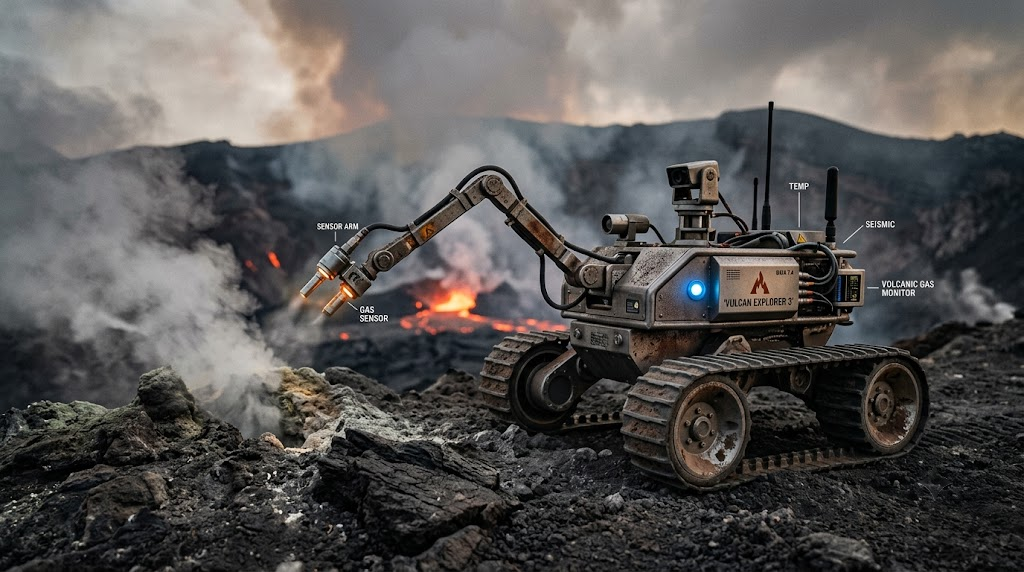
Legged robots are newer. A January 2026 preprint describes a quadruped on Mount Etna for autonomous gas monitoring, arguing that wheeled and wheeled-legged rovers cope poorly with uneven ground. Its authors write that, to their knowledge, no earlier robotic system had made successful in situ gas measurements on an active volcano, and they report lessons from the Etna deployment. It is a preprint and has not been peer-reviewed.
How Gas Is Read From a Distance
The Munich design keeps the delicate instrument out of harm’s way. A reflector hangs beneath the drone; a laser on the cart locks onto it and fires a beam that is slightly weakened as gas absorbs it. The drone flies for about 15 minutes, taking up to 3,000 measurements, and an algorithm that includes local wind data turns the weakened signals into a 3D map. Earlier wind-tunnel work showed about 5 percent error. A team member says a sensor inside the plume would need constant recalibration because the gas is corrosive.
Better sensors are still needed. The Sakurajima and Etna drone study says its carbon dioxide sensor, accurate to 100 ppm, must improve to 1 ppm before it can measure the CO2/SO2 ratio inside volcanic clouds.
Where Robots Still Fall Short
Most tests happen on calm days or in analogue sites. A researcher at the Vulcano test noted that the crater carries no major risk of an imminent eruption, and the Munich drone was due to fly at Etna next. A July 2026 Frontiers study sent a Unitree Go2 quadruped into a lava tube; terrain confined it to a narrow path and it covered about 32 metres, stopping at a split it could not reach. A European team’s three-robot system for lunar and Martian lava caves was tested in Lanzarote’s volcanic caves. None of these are erupting volcanoes.
Heat and corrosion explain why designs favour stand-off sensing, but the sources reviewed give no operating-temperature figures. The Etna preprint’s authors call for adaptive sensing strategies, tighter integration of global and local planning, and improved hardware design.
So robots can already take readings that once required a person at the crater rim. Staying inside an erupting crater, in heat and acid gas, is a different problem and remains unsolved in the sources reviewed.