A swarm is more than many drones flying together
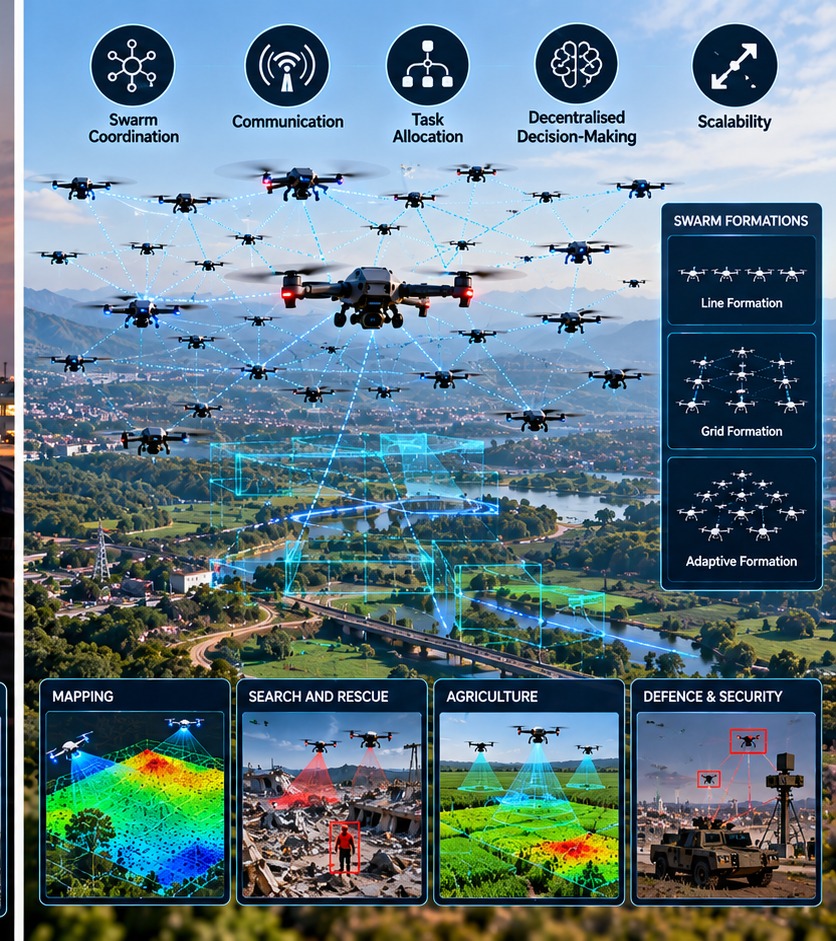
A group of drones becomes a swarm when the aircraft coordinate their behaviour toward a shared mission. They may divide an area, maintain a formation, share information or reassign tasks when conditions change.
There are different levels of coordination. A central computer can assign each drone a route while the individual aircraft execute it. A leader drone can provide guidance to followers. Or the drones can use distributed rules in which each aircraft reacts to local information and communicates with its neighbours.
Research literature describes these architectures as a spectrum rather than a single definition. The more decision-making is distributed, the less the system depends on one central controller—but the harder communication, coordination and safety become.
Communication is the nervous system
For a swarm to coordinate, the drones need some way to exchange information. Depending on the architecture, that can involve links between drones, links to a ground station, or a combination of both.
The information might include position, speed, battery state, sensor observations or task status. The system then has to cope with delay, interference, limited bandwidth and drones moving out of communication range.
This is one reason swarm demonstrations do not automatically prove that dozens or hundreds of drones can operate independently in every environment. Communication is an engineering constraint, and losing a link can change what the rest of the group knows.
Task allocation: deciding who does what
A useful swarm should avoid having every drone perform the same work. Task allocation is the process of assigning jobs to individual aircraft or groups.
Imagine a large area that needs to be mapped. One approach is to divide the area into sectors and assign one drone to each. In a search-and-rescue mission, some drones could scan from higher altitude while others investigate promising locations more closely. In agriculture, aircraft could divide a field into sections or cooperate on scouting and data collection.
Task allocation can be centralised, distributed or hybrid. A central system has a global picture and can optimise assignments, while distributed approaches allow drones to make decisions using local information and peer-to-peer communication. Both approaches involve trade-offs between global efficiency, resilience and computational complexity.
Where swarms are being explored
Mapping is a natural application because a large area can potentially be divided among multiple aircraft. Agricultural research has also explored multi-UAV systems for field scanning and sensing; one study modelled multiple drones reducing scanning time for a simulated irrigation field.
Search and rescue is another active research area. Recent work has tested coordinated multi-drone approaches using different altitudes and thermal and visual sensors for locating people. India's SwaYaan innovation challenge has also specified collaborative autonomous multi-drone systems for disaster scenarios, including survivor identification and geotagging.
Defence is where some of the most visible demonstrations have occurred. DRDO publicly demonstrated a decentralised swarm of 25 drones with minimal human intervention in 2021. More recent Indian programmes and challenges continue to explore autonomous swarm systems.
These examples should not be read as proof that every swarm can perform every mission without human oversight. Demonstrations are usually conducted under defined conditions and with specific objectives.
The gap between a demonstration and a science-fiction swarm
A swarm that looks impressive in a controlled demonstration may still face difficult real-world conditions: unreliable communications, GPS loss, battery limits, sensor errors, weather, obstacles, regulatory constraints and the need to keep multiple aircraft safely separated.
A recent 2026 review of UAV swarming research found a significant validation gap: only 23.3% of the studies it mapped reported experimental implementation, with many experiments limited to controlled indoor environments. That finding puts claims about large-scale autonomy in perspective.
The future of swarms is therefore less about a magic number of drones and more about what the system can reliably coordinate. A team of five drones that can divide a mapping job, recover from a failure and remain under safe supervision may be more practically useful than a much larger formation that works only under ideal conditions.
The defining technology is not the number of aircraft. It is the coordination layer that lets them share information, allocate tasks and adapt without losing safety or mission control.