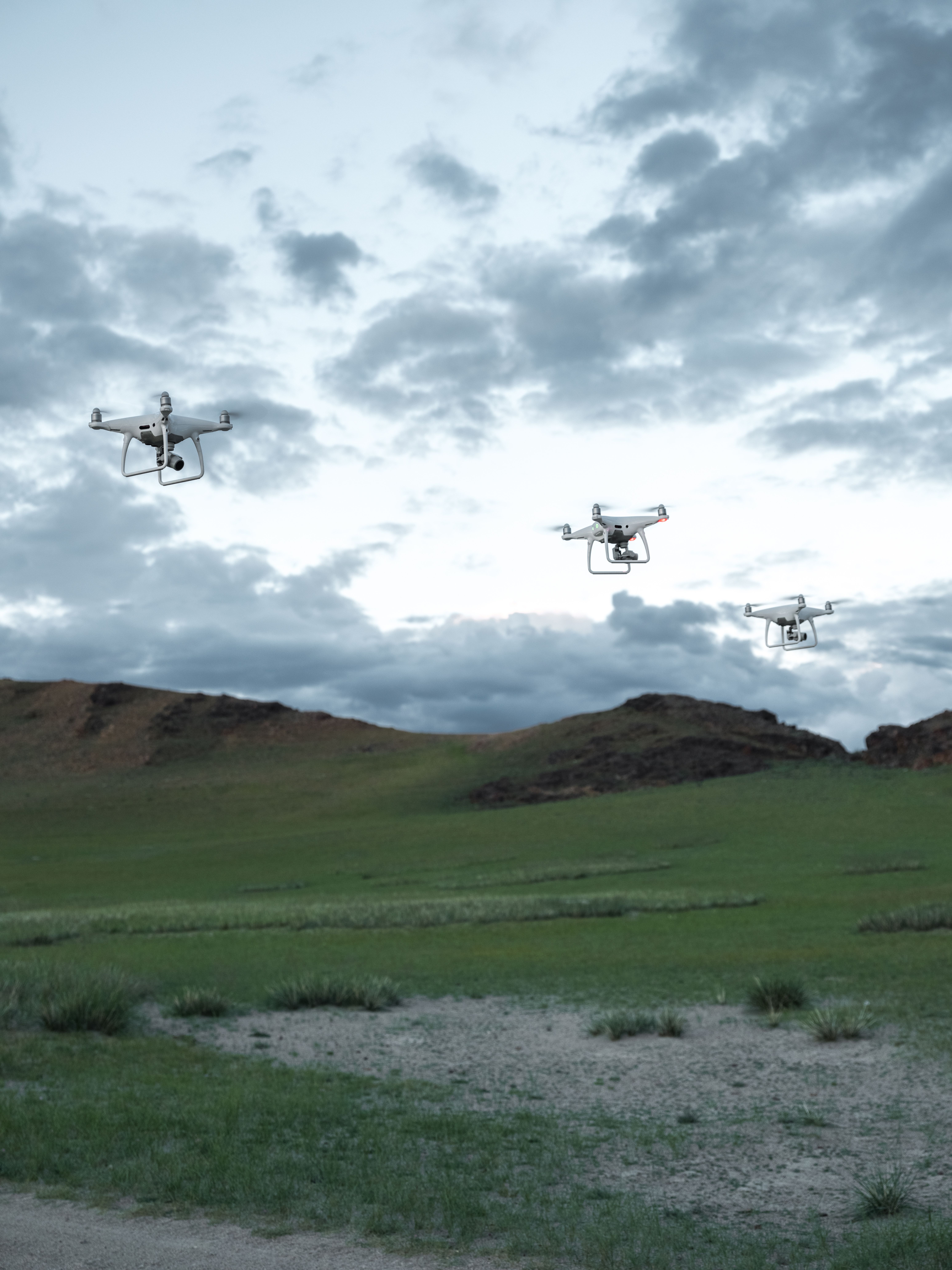
Put 100 drones in the sky and you have an impressive photograph.
You do not necessarily have a swarm.
The important idea behind drone swarming is not the number of aircraft. It is coordination: multiple autonomous machines sharing information, dividing work and adapting their behaviour without a human individually piloting every member.
That distinction is about to matter a great deal.
Fleet versus swarm
Consider two performances.
In the first, 200 drones follow trajectories calculated beforehand to create a glowing logo above a stadium. Beautiful, certainly. But each aircraft may essentially be executing a predetermined script.
In the second, ten drones are told: “Map this area.”
They divide the region among themselves. One aircraft fails, so the others redistribute its section. They avoid collisions, share observations and adjust routes as conditions change.
The second group is much closer to what roboticists mean by a swarm.
NASA describes swarm autonomy in terms of distributed systems that can coordinate planning, navigation, estimation and reconfiguration. Its Starling mission, involving four CubeSats rather than atmospheric drones, has been testing swarm manoeuvre planning, networking, relative navigation and autonomous coordination without continuous direct ground control.
Different vehicles. Same fundamental problem.
How does the swarm decide what everyone does?
There is no single swarm architecture.
Some systems are hierarchical. One vehicle or controller assigns jobs to others.
Others are more distributed. Each machine makes local decisions using shared rules and information received from neighbours.
An individual drone might know its position, battery level, sensor capabilities and assigned target. Algorithms then determine questions such as who should inspect which area, how aircraft should avoid one another and what should happen if communication breaks down.
The remarkable part is that sophisticated group behaviour can emerge from relatively simple local rules.
Nature discovered this somewhat earlier. Ant colonies contain no ant with a corner office.
The real engineering problem is scale
Controlling two robots is one problem. Controlling 200 creates several new ones.
Communication networks become congested. Position estimates contain errors. Batteries discharge at different rates. Machines fail. Sensors disagree. One poorly considered command can affect an entire group rather than one vehicle.
DARPA's completed OFFSET research programme explored swarms of up to 250 collaborative air and ground robots and explicitly studied swarm autonomy, tactics and human-swarm interaction. The human-interface problem was central: how does one operator meaningfully direct hundreds of machines without acquiring hundreds of joysticks and several additional arms?
Research remains active. In 2026, the University of Pennsylvania announced a multi-year project studying how large teams of physical AI agents can cooperate and act safely at scale.
The civilian possibilities are enormous
Swarms are often discussed in military terms, but the same principles extend much further.
NASA's Earth Science Technology Office is developing an AI-enabled drone-swarm concept for wildfire detection and mapping. Multiple aircraft could provide frequent coverage, combine observations and generate maps while reducing dependence on continuous human control.
Agriculture, disaster assessment, infrastructure inspection and search operations offer similar opportunities.
Instead of one expensive aircraft serially scanning 100 square kilometres, many cheaper vehicles could potentially divide the job and combine what they discover.
But autonomy introduces difficult safety questions. What happens when agents make conflicting decisions? How does a swarm behave when communications disappear? How can humans understand why hundreds of machines collectively chose a particular action?
Those questions get harder, not easier, as the swarm becomes more intelligent.
And that is why counting drones misses the point.
The breakthrough is not putting 100 aircraft into the air.
It is telling the group what you want accomplished instead of telling aircraft number 73 exactly where to fly next.