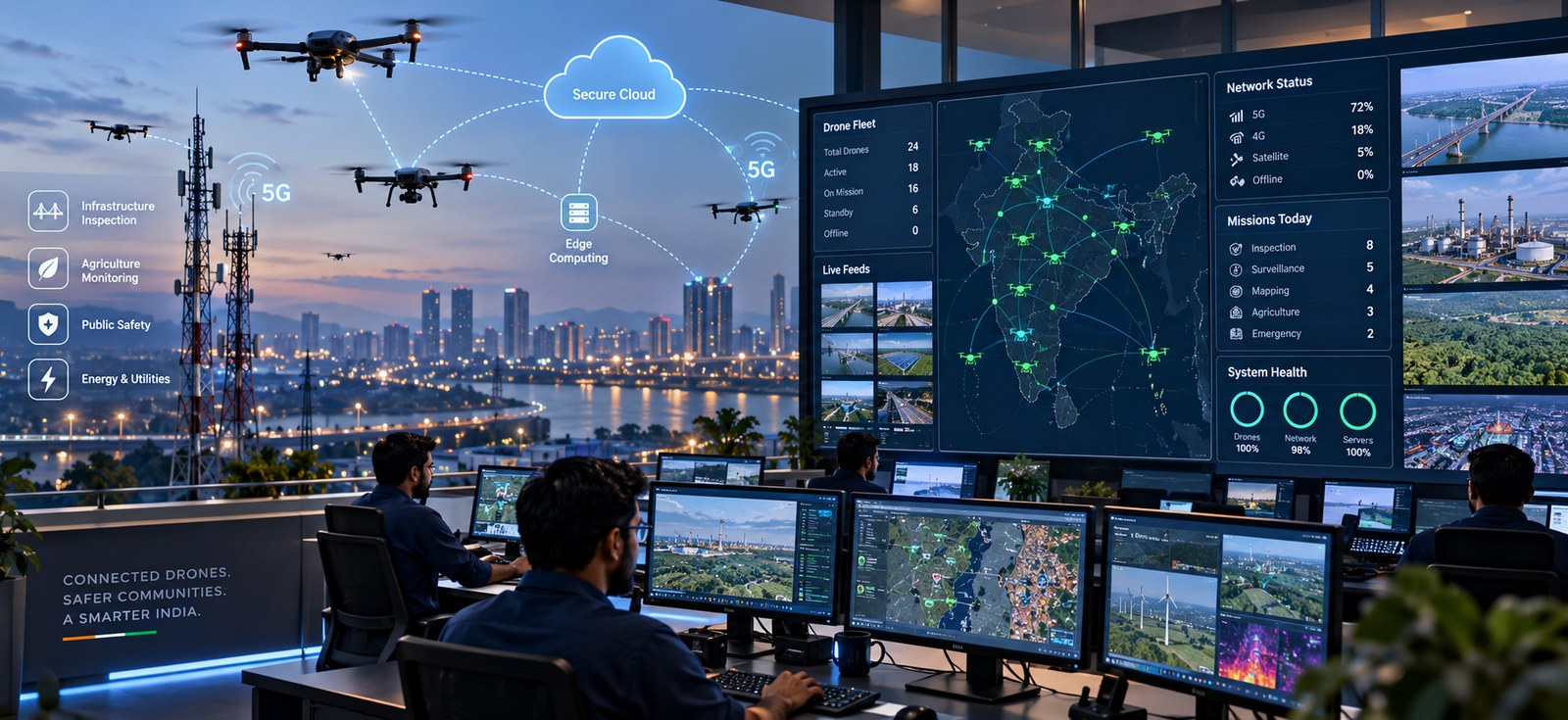
The drone becomes a networked machine
A conventional drone is usually controlled through a nearby radio link. A cloud-connected drone can add another layer: the aircraft sends telemetry and data through a cellular or other network to remote software, where operators can monitor the mission from a dashboard.
Telemetry is the stream of operational information produced by the aircraft. It can include position, altitude, speed, battery status, heading and sensor status. The cloud does not necessarily fly the drone by itself; it can provide mission planning, fleet visibility, data storage, analytics and coordination while the flight-control loop remains onboard.
4G and 5G extend the operator's reach
Cellular connectivity can provide a wider-area communications path than a short-range controller link. A drone equipped with 4G or 5G can potentially send telemetry and video to remote software and receive authorised commands over the network. Indian telecom training material has demonstrated drone connectivity over Wi-Fi or 5G, while commercial enterprise platforms offer 4G/5G-connected drone avionics and cloud control.
The benefit becomes clearer with fleets. A control centre can view multiple aircraft, missions and alerts on one interface. But cellular coverage is not guaranteed everywhere: mountains, industrial structures, remote terrain and network congestion can create gaps.
What stays on the drone: edge computing
Sending every image and sensor reading to the cloud can consume bandwidth and introduce delay. Edge computing puts processing close to the sensor, often on the aircraft. It can run tasks such as object detection, image filtering, navigation assistance or event detection before sending selected results to the cloud.
This reduces the amount of data that has to travel over the network. A drone might identify a person, vehicle or possible defect onboard and transmit the detection, location and relevant image instead of continuously uploading every raw frame. Recent UAV research is exploring cloud–fog–edge architectures in which processing tasks move between aircraft, nearby computing and central cloud services.
The command centre is the new ground station
A cloud dashboard can combine information from many aircraft into one operational view. An operator might see drone positions, battery levels and mission progress while separate panels show live video, alerts, weather or sensor data. Historical flight logs can be stored for later review.
For inspection companies, this could support repeated missions across bridges, power lines, mines or energy facilities. For emergency teams, it can help provide a common operating picture. Indian drone platforms are already being developed around fleet telemetry, mission management and cloud-based operations.
What happens when the connection disappears?
A networked drone cannot assume the network will always be available. A robust system therefore needs defined behaviour for connection loss. Depending on the aircraft and mission, it might continue a pre-programmed task, return to a safe location, hover temporarily or land. The exact behaviour is a system and regulatory design choice, not a universal feature.
This is why remote control should not be confused with removing onboard autonomy. The aircraft needs enough local intelligence and fail-safe logic to remain safe if the cloud becomes unreachable. For remote areas, network redundancy can matter as much as network speed.
Cloud connectivity creates a cybersecurity problem
The same connection that makes a drone easier to monitor also creates another attack surface. A connected system may involve the aircraft, cellular network, cloud account, operator dashboard, APIs, mobile devices and stored mission data. Weak authentication, insecure software, exposed interfaces or compromised credentials can create risks ranging from data theft to unauthorised control.
A systematic UAV security review highlights the importance of protecting communication between drones and ground stations. Practical protections include strong authentication, encrypted communications, access controls, software updates, network segmentation and logging.
India's drone industry is moving toward connected operations
PIB reported more than 38,500 registered drones and 39,890 certified remote pilots as of February 2026, alongside growing use in surveys, infrastructure, agriculture and disaster management. As operations scale, fleet management becomes more important. A cloud platform can help an organisation see where aircraft are, what missions are active and which systems need attention.
But cloud connectivity should be treated as infrastructure, not magic. Reliable communications, onboard fail-safes, cybersecurity, data governance and compliance all have to work together. The next step is not simply putting drones online; it is building a dependable network around them without making the aircraft unsafe when that network fails.