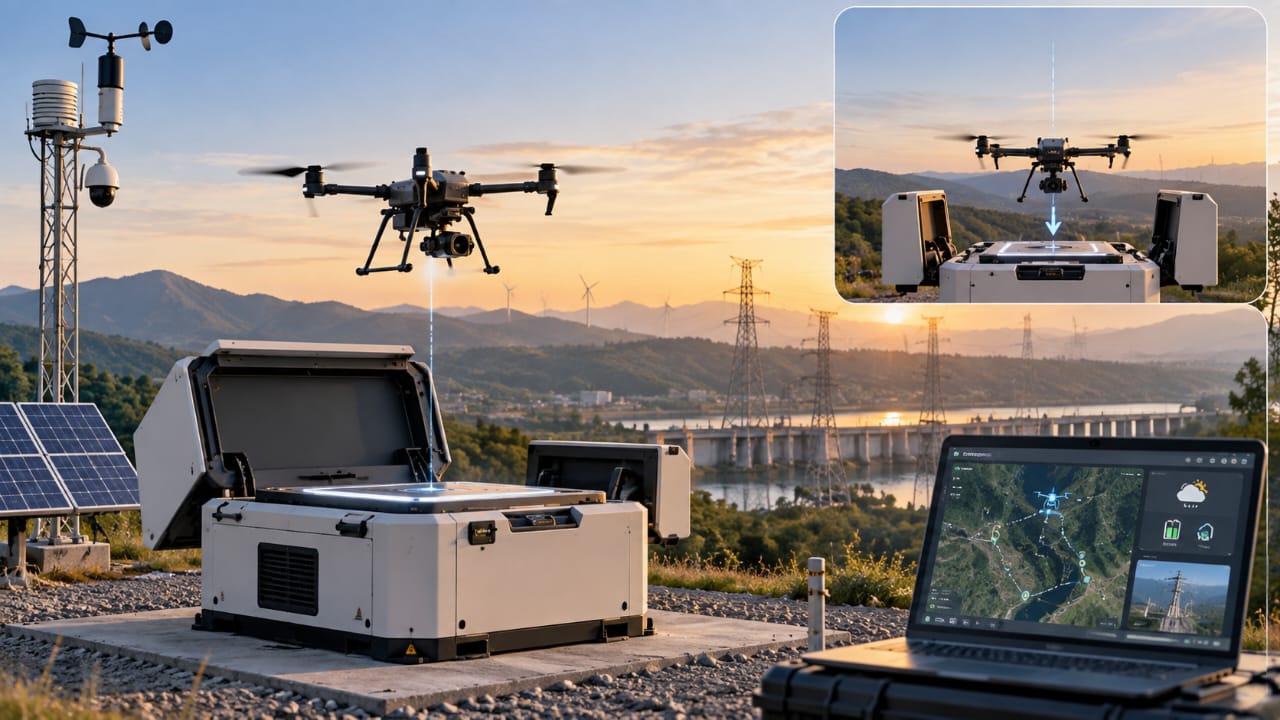
The box is more than a charging pad
A conventional drone mission usually needs someone to bring the aircraft to the site, inspect it, launch it, monitor the flight, land it and recharge its battery.
A drone-in-a-box system changes that workflow. The aircraft is stored at a fixed docking station, sometimes called a dock or nest. The station provides a protected place to land and wait between missions and can handle functions such as charging, data transfer and remote communications.
The goal is not simply to make takeoff automatic. The complete system has to coordinate the aircraft, dock, software, communications and environmental information reliably enough to operate without a person standing beside it.
How an automated mission works
A typical mission can begin with a scheduled task or an instruction from a remote operator.
The software sends the aircraft a predefined route or inspection mission. The drone leaves the dock, flies to the area of interest, collects imagery or sensor data and returns to the same location. Precision landing systems help the aircraft align with the docking station.
Once it lands, the system can secure the aircraft and recharge it. Some docking platforms support battery charging rather than physical battery replacement.
For example, DJI's Dock 2 uses RTK positioning and visual recognition to assist precision landing. The company says the system can recharge its supported aircraft from 20% to 90% in about 32 minutes under specified test conditions. This creates a shorter turnaround between missions, but it does not remove the fundamental limits of battery-powered flight.
Weather becomes part of the flight plan
An unattended drone cannot depend on a person looking outside the window before every flight. The dock therefore becomes an environmental monitoring station as well.
Modern systems can measure factors such as wind and rainfall and combine that information with weather forecasts. DJI Dock 2, for example, includes wind-speed, rainfall and temperature sensors and can use cloud software to warn operators or terminate flight tasks when conditions become unsuitable.
This matters because a drone may be perfectly capable of flying in calm weather but unsafe to launch or land during strong winds or heavy rain.
Weather protection also applies while the aircraft is sitting on the ground. The enclosure has to protect the drone and its electronics from rain, dust, temperature changes and other environmental exposure.
Remote monitoring does not mean zero supervision
A drone-in-a-box can remove the need for a pilot to be physically present, but the system still needs oversight.
Operators may need to monitor the aircraft's location, battery level, communications, payload and mission progress. Cameras around the dock can provide a view of the aircraft and its surroundings. If a mission encounters an unexpected obstacle, a communications problem or a hardware fault, a person may still need to intervene.
Connectivity is another dependency. A remote system needs reliable communication between the dock, aircraft and control software. Research and field studies of dock-based UAV operations identify connectivity, weather, terrain and environmental conditions as important considerations for unattended deployment.
Why continuous flight is still difficult
The phrase “continuous drone operation” can be misleading.
A dock can allow repeated flights, but the drone still has a finite flight time. It must return to recharge, and charging takes time. DJI Dock 2, for example, lists a maximum aircraft flight time of 50 minutes under controlled test conditions, while its stated 20%-to-90% charging interval is 32 minutes.
The dock itself also needs power, communications and maintenance. A backup battery can keep some functions running during a power outage, but it does not make the system independent of infrastructure.
Regulatory requirements can also determine whether a remote or unattended mission is permitted in a particular location. Depending on the operation, airspace, aircraft and local rules, an organisation may still need approvals, procedures and trained personnel.
That is why drone-in-a-box systems are best understood as an automation layer around a drone rather than a way to remove humans completely. They can make recurring inspection and monitoring more practical, especially at fixed sites, but reliable operation still depends on weather checks, connectivity, maintenance, safe mission planning and human oversight.
For India, this model could be relevant to infrastructure sites, industrial facilities, solar and wind installations, mining areas and other locations where the same aerial inspection needs to be repeated. The important question is not whether a drone can fly by itself once. It is whether the entire system can perform the same task safely and reliably over hundreds of missions.