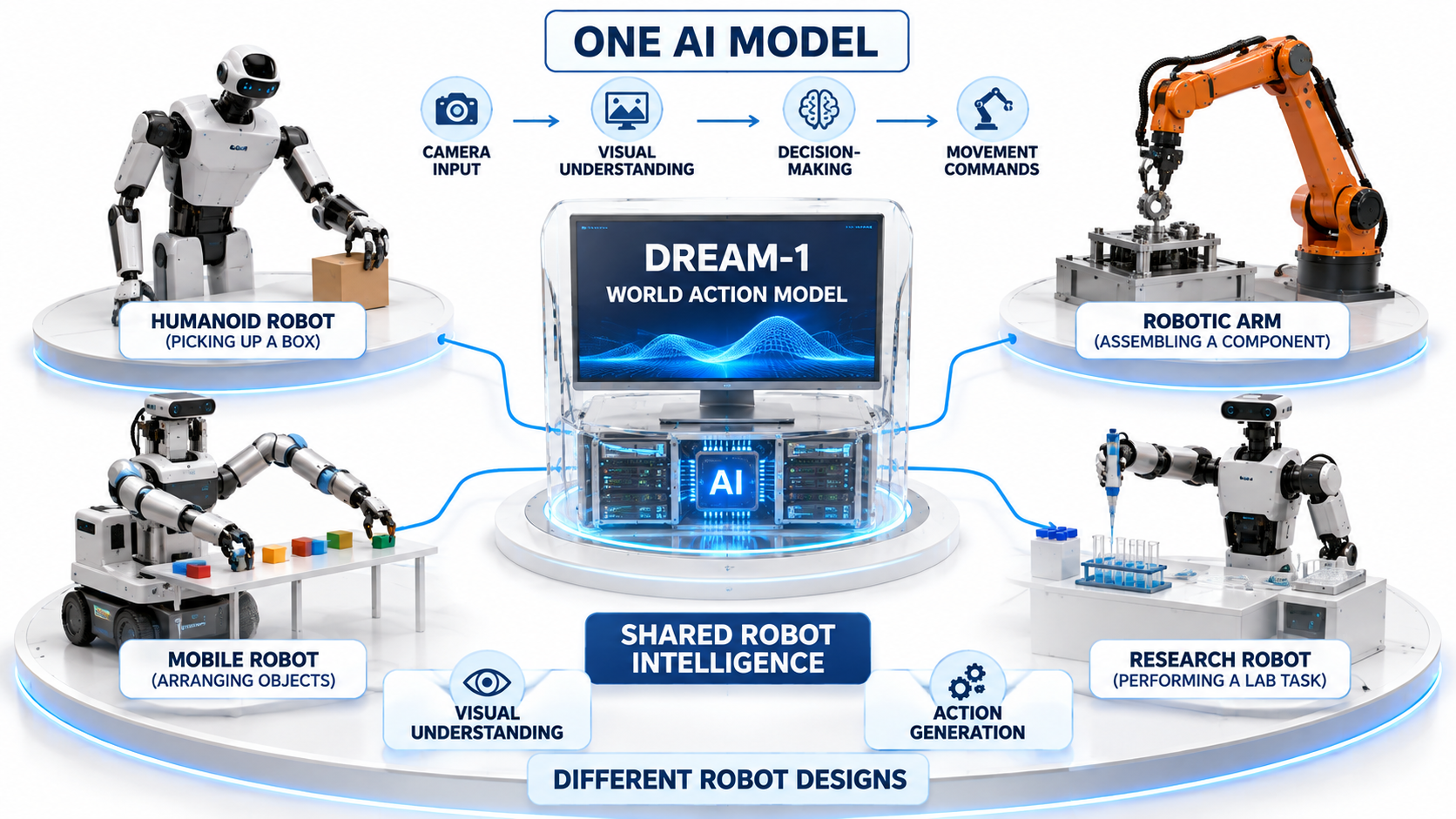
Imagine learning to ride one bicycle, then riding a different one without any practice. Dream Labs says its new Dream-1 robot AI model can do something similar. The company claims it can control two-armed robots it has never seen, with no new demonstrations or fine-tuning. It could matter because robots are costly to teach. That is a big claim, and it still needs independent testing.
A Public Robot API From Dream Labs
Dream Labs is a San Francisco startup founded by former NVIDIA robotics researchers. It announced Dream-1 in October 2026, and one report gives October 19 as the date. The company also said it raised $90 million in seed funding.
Dream-1 runs through a public API. Developers connect their robot to Dream Labs’ online service instead of running the model themselves. The company lists the price as $3 per hour, or $2 for a lighter version called Dream-1-flash.
How Dream-1 Controls a Robot It Has Never Met
Dream-1 is called a World Action Model. It predicts how a scene will change and decides the robot’s next move together. Think of a person who imagines pouring water before lifting the jug.
The model uses three cameras: one on the head and one on each wrist. It also receives the robot’s current position and a written task, such as “put the banana in the bowl.”
Then it tells each gripper where to go and whether to open or close. The robot’s own software turns that target into arm movements. Dream Labs says every robot looks like moving shapes in a video, so a new body is less confusing for the model.
Why Skills That Transfer Between Robots Matter
Today, a new robot usually needs its own training data. That costs time and money. Dream Labs says Dream-1 can start on a new two-armed robot with two-finger grippers right away.
The company tested it on 27 unseen robots in simulation and four real ones. Results differed from robot to robot. Dream Labs also cites an outside test by a group called Robocurve. Readers should check that report themselves, because Dream Labs published the comparison.
Where Dream-1 Still Falls Short
Dream-1 is a research beta. Dream Labs says it makes mistakes and is not validated for safety-critical use. It supports only two-arm robots with parallel grippers. Mobile robots and robot hands are not covered yet.
Results also depend on each robot’s movement software. When zero-shot is not enough, the company offers fine-tuning. Five minutes of data helped some robots, while harder cases needed 77 and 98 minutes.
Because Dream-1 runs online, robots will likely need a steady internet connection and ongoing fees.
What Comes Next for Dream-1
Dream Labs plans to extend the model to mobile robots and dexterous hands. It is inviting people with two-arm robots to test it, and it says it already works with hardware partners. Independent results from many labs will show whether the claim holds up.
A robot that adapts to new hardware could save a lot of time. For now, Dream-1 is a promising early test. The real proof will come when other teams try it and share honest results.