AI and Learning: Benefits, Risks and Unanswered Questions

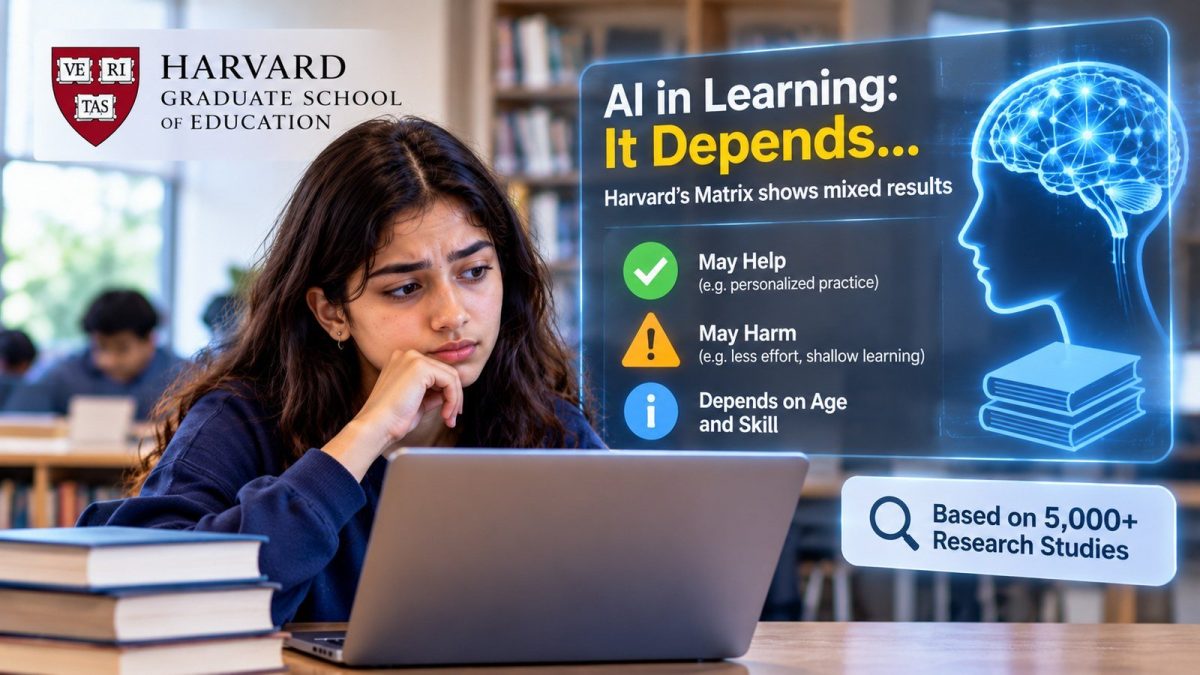
Harvard’s new AI Guidance by Age Matrix pulls from 5,000 studies to help parents and teachers navigate classroom AI while exposing how thin direct research still is.

By Kothapally sai charan teja
Published: Nov 17, 2026
4 min read
👁️ 66 Unique Views
AI and Learning: Benefits, Risks and Unanswered Questions
Premium Insight

Why It Matters

As Indian schools, CBSE classrooms, and coaching hubs rapidly adopt AI tutors and homework apps, parents and teachers face fierce debates over whether these tools help or hurt young learners. Harvard’s age-based matrix offers Indian educators a practical way to match AI tools to a child's developmental stage—such as protecting independent memory practice in middle school—while reminding policymakers under NEP 2020 not to treat early AI hype as proven science.

What Is Happening?

People are arguing about whether artificial intelligence helps or hurts students. Some tech companies say it is a miracle tutor, while others worry it will make kids stop thinking. On November 10, 2026, the Harvard Graduate School of Education launched the Compass Collaborative and its free online AI Guidance by Age Matrix.

As reported by Education Week and Inside Higher Ed, the tool looks at over 5,000 studies. Instead of giving a simple yes or no, it shows how AI might help or harm students depending on their age and what skill they are learning. But there is a catch: Harvard's tool does not actually test new AI chatbots in classrooms. Instead, it applies older studies about child psychology to modern apps.

How Does It Work?

To see why this tool matters, look at how different programs work. Older learning software uses strict rules and math problems to guide students step-by-step. In contrast, AI chatbots guess the next word in a sentence using massive data weights.

While AI is great for brainstorming ideas, it does not know what is actually true. Because of this, it often makes up false facts and presents them with total confidence. Furthermore, as noted in Education Week, experts worry that letting AI do homework instantly stops students from doing retrieval practice—the hard mental effort needed to build long-term memory.

Harvard's guide tries to organize these pros and cons for different ages. However, as shown by Stanford’s AI Hub for Education, true, long-term studies on AI in schools are very hard to find. As The Hechinger Report points out, most existing research only looks at short-term tasks over a few weeks rather than lasting learning over several school years.

Why Is It Important?

School boards spend millions of dollars on software based mostly on clever marketing ads rather than hard proof. As Stanford researchers note, clear proof that AI improves grades in regular K-12 classrooms is still missing.

When schools buy unproven tech, they take a big gamble on student success. As reported in Education Week, some experts suggest waiting before jumping into new edtech tools while developers still figure out how well they actually work.

What Are the Challenges?

The biggest problem is that Harvard relies on older child psychology instead of testing modern chatbots directly on kids over many years. This leaves teachers in a tough spot, forced to make big choices based on theories rather than facts.

What Happens Next?

As Harvard updates its online guide, schools need to look past flashy sales pitches. Teachers should treat AI as a helpful helper rather than a full replacement for real teaching. Younger children still need to practice basic writing and math on their own, while older teens can learn how to spot mistakes in AI answers.

Found this analysis insightful?

Share with colleagues, engineers, and your network.

Tags & Topics

Related Analysis & Next Reads

Curated Exploration

Discussion

Leave a Comment

No comments yet. Be the first to start the conversation!

Link copied to clipboard!