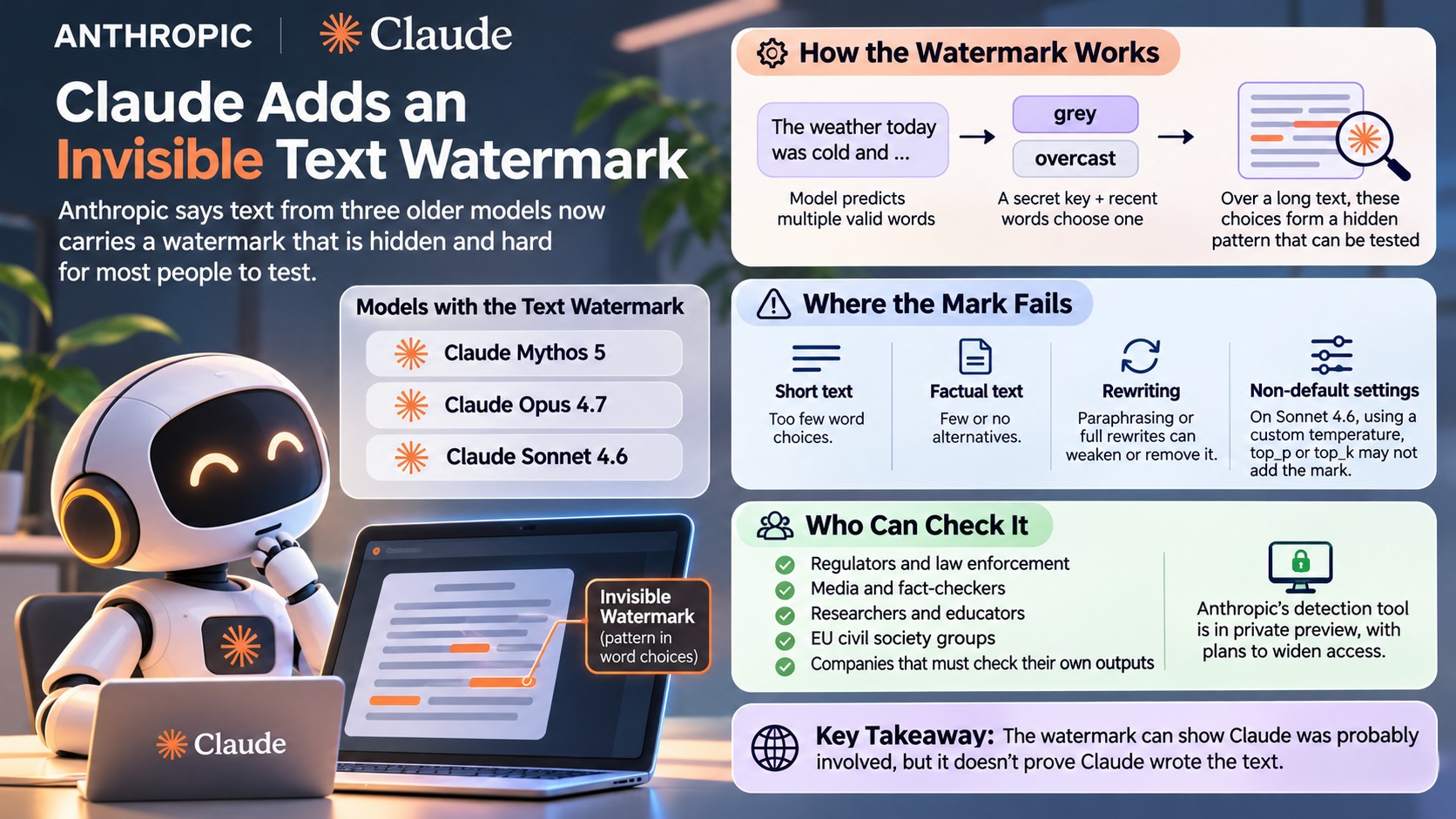
The Claude text watermark now covers three older models. On November 3, Anthropic said text from Claude Mythos 5, Opus 4.7 and Sonnet 4.6 now carries it. Early reports named a fourth, Opus 4.6. Anthropic's own pages disagree on it, so it is left out here.
How the Mark Hides in Word Choices
An AI model writes one word at a time. Often, many words fit equally well. After "The weather today was cold and," both "grey" and "overcast" work. Normally, the model picks one using a random number.
The watermark changes where that random number comes from. It uses a secret code, called a key, plus the few words before. The model still picks natural words. But over a long text, its choices form a pattern. Only someone with the key can check for it. Anthropic says nothing extra is added to the text.
The idea comes from SynthID-Text, a method Google DeepMind described in 2024. Google tested it on nearly 20 million Gemini answers. Users rated marked and unmarked answers about the same.
Where the Mark Fails
A pattern needs many word choices. Short texts have too few. Facts leave little room, because only one word is right. If Claude only fixes your grammar, the mark may not show.
Rewriting also weakens it. Anthropic says small edits probably leave the mark, but a full rewrite removes it. A 2025 study of Google's version found that rewording the text, or translating it back and forth, can cut detection a lot. No outside test of Anthropic's version has been found.
A found mark proves less than you might think. It shows Claude was probably involved. It does not show Claude wrote the text. On Sonnet 4.6, if a developer changes some settings that control how random the model is, the mark might not appear. Anthropic does not say why.
Who Can Check It
The tool that checks for the mark is not public. Anthropic has a test version for approved groups. These include government regulators, law enforcement, news media, fact-checkers, researchers, schools and some EU public-interest groups. Companies that must check their own text to follow the law can use it too.
The mark applies to Claude users everywhere, not only in Europe. The EU's AI Act is the reason for it, but Anthropic says it does not yet have a lasting way to limit it to one region. Its pages mention no way to turn it off. Other AI companies signed the same voluntary EU code, but each will use its own key.
The method is public. The key and the checking tool are not. How well the mark survives real-world rewriting has no public outside test yet.