Humanoid Robots Are Helping Sort Parcels at China Post
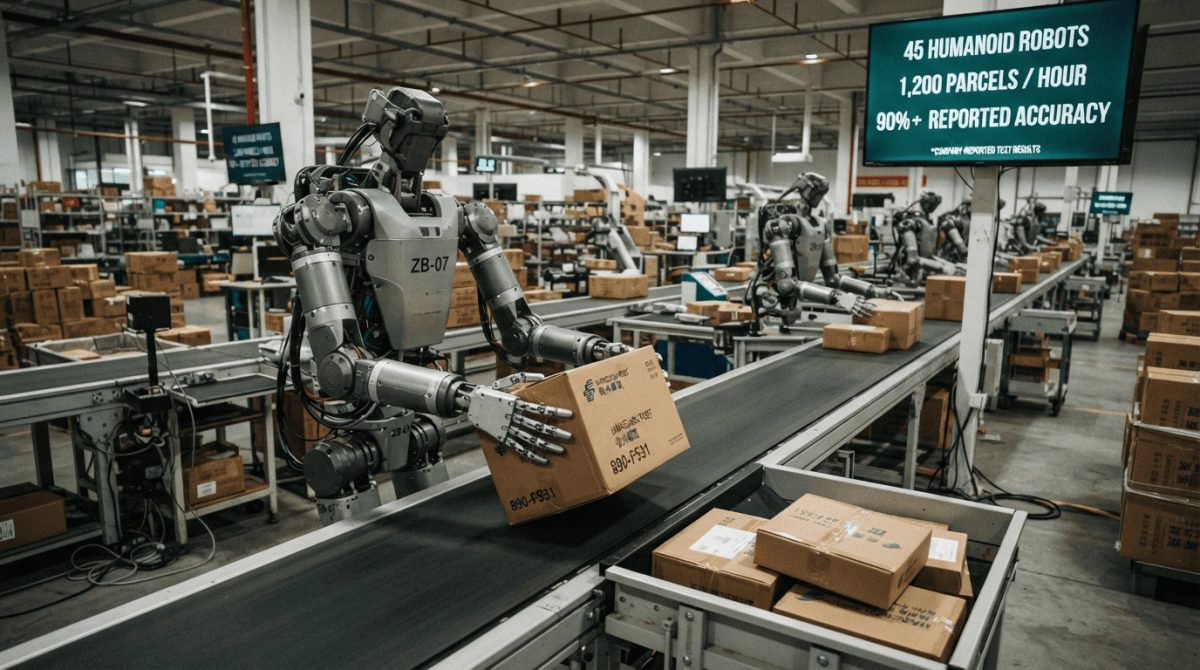
Imagine a post office getting hundreds of parcels every hour. Workers have to pick up packages, check them, and put them on sorting belts. Now, robots are helping with these tasks at a postal center in China. On November 26, 2026, robotics company ROBOTERA announced that 45 humanoid robots are being tested at China Post's sorting center in Hangzhou. Unlike many robot demonstrations, this is happening at a real working facility.
What Is Happening in Hangzhou?
ROBOTERA says China Post started testing its robots at the Hangzhou center in April 2026. The robots pick up small parcels and place them onto sorting belts. The company describes this as one of the largest humanoid robot trials in China's postal industry. But some reports say the testing began in September, so the exact start date is still unclear.
How Do the Robots Handle Parcels?
The robots use cameras to identify packages and robotic hands to pick them up. They can lift parcels, adjust their position, and place them on the sorting belt, much like human workers do. Chinese reports name the robot as the M7 model. It mainly has an upper-body design, so it doesn't need to walk around like a full humanoid robot.
How Fast Can They Sort Packages?
According to ROBOTERA, the robots raised parcel-handling speed from around 500 to 600 parcels per hour to about 1,200 parcels per hour in some tests. The company also reported an accuracy rate above 90%. But it hasn't clearly explained whether the 1,200 parcels per hour were handled by one robot or by all 45 robots together.
Another report from China Daily mentioned eight robots working at a China Post center in Guangzhou. They handled around 800 parcels per hour, with a target of reaching 1,600 by the second quarter of 2027. Since these tests happened at different places, their results can't be compared directly.
Why Are Humanoid Robots Useful?
Traditional sorting machines can handle parcels quickly, but installing them often means changing the building and the conveyor systems. ROBOTERA says its robots can work with existing sorting belts, scanners, and automated carts without big changes. This could make it easier for postal centers to bring in automation. But the companies haven't shared enough information about maintenance costs, breakdowns, or how often human workers need to step in.
What Happens Next?
ROBOTERA says its robots are also working at 11 China Post hubs across eight cities in Guangdong. China Post plans to bring more automated equipment into its sorting centers. The robots still need to prove that they can work reliably during busy periods without making too many mistakes.
Using 45 humanoid robots in a real postal center is an important step. But more testing is needed to find out whether they can really save time, money, and effort compared with human workers.