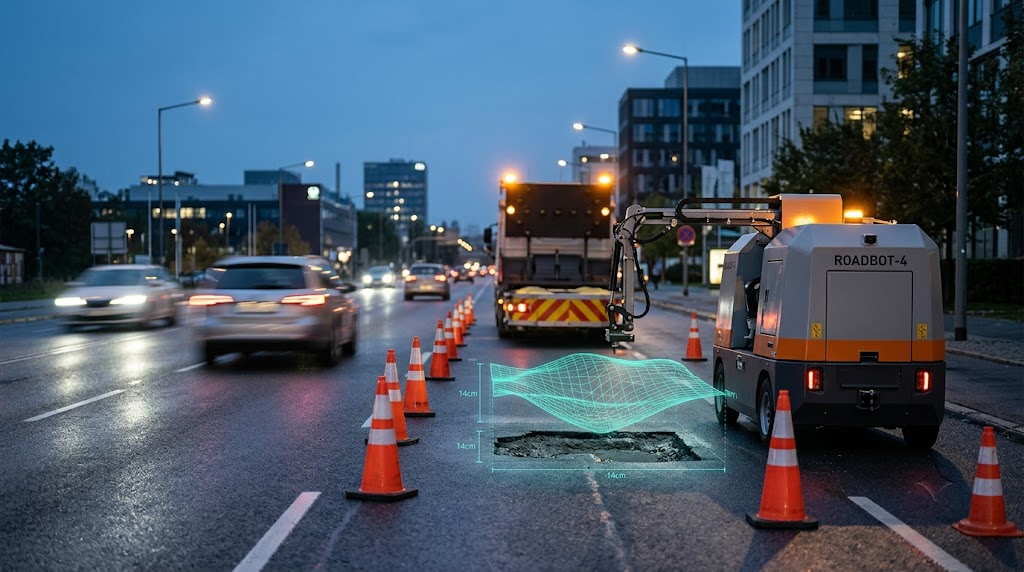
In August 2026, a Pittsburgh startup showed a robot that scanned a pothole with a depth camera, calculated how much patch material it needed, and had a robotic gantry place it minutes later. The catch: the prototype could not yet clean the hole beforehand or tamp the patch afterwards. That gap, between a clever demo and a finished repair, defines where road-repair robots stand today.
How a Robot Reads a Road
A robot cannot repair what it cannot measure. Cameras or lasers capture the road surface as a 3D scan, often stored as a point cloud, a dense map of height readings. A neural network then labels each region as crack, pothole or sound pavement, a task called segmentation. Software converts the labelled region into length, width, depth and volume, which decides how much material to apply.
UK firm Robotiz3d says its laser scanning measures defects at up to 60 mph with millimetre accuracy, a company claim. A 2026 paper by Chang’an University and Michigan Technological University, describing a crack-sealing robot, reported 80.21 percent real-time crack segmentation accuracy, measured on public image datasets rather than live roads.
Detection is only half the job. The same robot, an unmanned four-wheel platform, pairs its segmentation network with an adaptive fuzzy controller that keeps the sealing head following the crack it has detected.
What Exists Today, and What Is Still a Prototype
Robotiz3d is furthest along. Its ARRES Eye scanning service is offered commercially. Its ARRES Prevent crack-sealing vehicle completed a first out-of-lab trial in Potters Bar, Hertfordshire, on 6 March 2024, after which the developers planned further trials before full production. It was demonstrated live at a UK parliamentary reception in January 2026, an event the company sponsored. A larger machine, ARRES Ultra, meant to repair potholes as well, is still in development.
Silly Surfacing, a Pittsburgh startup founded in 2024, held its first public demo on 21 August 2026. Its goal is a self-contained system needing just one crew member, who could stay inside the truck. The prototype was built over roughly a year by the University of Pittsburgh’s IDEA Lab and more than a dozen engineering interns. The business case rests on scale: AAA’s 2022 estimate put US drivers’ pothole-related vehicle repair bills at roughly $26 billion a year, and PennDOT spends about $9 million annually repairing potholes statewide, figures cited in the Technical.ly report.
The company has run on a $100,000 grant and is seeking $5 million. Its plan is to start with private parking lots and later pursue government clients. The Chinese crack-sealing robot remains a research system.
The Hard Part Is Traffic, Not Potholes
The pitch is to keep lanes open and crews out of harm’s way, so the real test is working beside moving vehicles. The Chinese robot sealed cracks at roughly 0.05 metres per second, about 3 metres a minute, with an average error of 5.17 millimetres on slender cracks, in experiments rather than live traffic. At that pace, safety, not speed, is the case for automation.
The risk is real. In March 2026, Virginia lawmakers, weighing a pilot of driverless crash-barrier trucks, cited an average of 77 strikes on conventional crash-barrier trucks over four years and more than 50 operator injuries since 2020. Driverless versions aim to remove the operator from the position where vehicles most often strike. Robotiz3d’s Paolo Paoletti has said a robot that does everything itself would need legislative change to allow autonomous driving.
What Still Limits Deployment
Four limits stand out. Completeness: the Pittsburgh prototype still lacks hole cleaning and tamping, and a half-finished patch still needs a crew back on the road. Evidence: published figures come from vendors, datasets or controlled runs, not independent audits on live roads. Cost: no independent comparison with human crews was found, only vendor claims. Regulation: rules on driverless vehicles in work zones may keep a human driver in the loop, as Robotiz3d’s co-founder has acknowledged.