A satellite that runs out of fuel is usually retired, even if its electronics still work. Robotic servicers promise to refuel, repair or move such satellites instead. As of 13 October 2026, the year’s two flagship attempts point in different directions. One rescue failed, and the other vehicle has not yet reached its first customer.
Docking With a Satellite Never Built to Be Caught
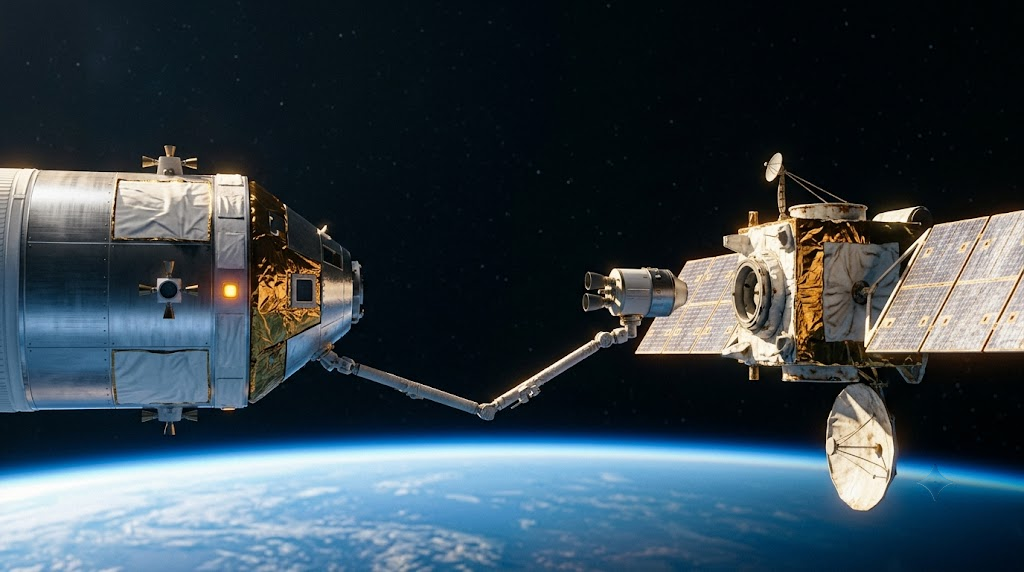
Most satellites have no docking port, so a servicer must approach on its own, match the target’s motion and grip a surface never designed for it. That demands precise autonomous navigation, delicate robotic arms and reliable control of the servicer itself. The last requirement is where 2026’s first rescue mission failed.
Swift Rescue: When the Servicer Lost Control
Katalyst Space’s LINK spacecraft launched on 3 July 2026 to capture NASA’s Swift Observatory and raise its decaying orbit. After an anomaly affected LINK’s attitude control, Katalyst and NASA jointly decided to drop the capture and boost. That decision came in mid-August. LINK reentered on 25 September.A Katalyst official told a National Academies committee that the loss of reaction wheels was largely responsible for the failure to rendezvous, capture Swift or boost it, though he said the team came very close. Swift is expected to reenter in the coming months. Katalyst built the spacecraft in under a year, so the failure may reflect that speed, though no root cause is confirmed in these sources. The lesson is that the hard part was flying the servicer, not the grasp.
Northrop Grumman’s Space Mechanic Is Still in Transit
On 21 July 2026, Northrop Grumman launched its Mission Robotic Vehicle (MRV) and three Mission Extension Pods on a Falcon 9. The MRV carries two robotic arms, developed by the US Naval Research Laboratory under a DARPA-funded program. It is meant to install the pods, which extend the life of aging geosynchronous satellites. Sources disagree on how long: at least six years, or up to eight. The vehicle and pods will spend about a year heading to geosynchronous orbit, so no servicing has happened yet.
What Is Proven, and What Is Only Promised
Working products versus demonstrations
Northrop Grumman says it is the first and only company to have extended the life of commercial satellites, using its first-generation Mission Extension Vehicles. That is the company’s claim, and those vehicles extend life rather than repair. In-orbit repair, refueling and capture of a non-cooperative satellite have not been demonstrated commercially. LINK never reached the capture attempt.
Research prototypes versus commercial systems
LINK was a one-off built for a single rescue. The MRV is described as a commercial multi-mission servicer, but its arms come from a DARPA research program, and it has not yet worked on a customer satellite.
Company claims versus verified results
Northrop says the MRV will enable inspection, relocation, repair, debris removal and upgrades, and that it will use AI. Those are statements of intent. The most reliable record of what happened to LINK is Katalyst’s own timeline, NASA’s mission page and the committee remarks. I found no independent assessment of the MRV yet.
Near-term versus long-term
Near-term, expect life extension and inspection of fuel-starved geosynchronous satellites. Routine repair, upgrade and refueling of any satellite is long-term speculation. Most satellites aren’t built for servicing, which is my inference rather than a finding from these sources.
What Orbital Repair Could Change
If the MRV works, operators could extend satellites instead of replacing them, which would change the cost of keeping a constellation in service. A failed servicer is also a hazard for the satellite it was sent to help. That is an inference. Watch for the first pod installation, a published failure analysis from Katalyst, and any independent verification of the MRV’s results.