From Needle to Result: How Far Can Robots Go in Blood Tests and Diagnostics?
Robots now draw blood in clinical trials, sort and pipette samples in labs, and cut some errors. Staff still validate, supervise and step in when the machine cannot proceed.
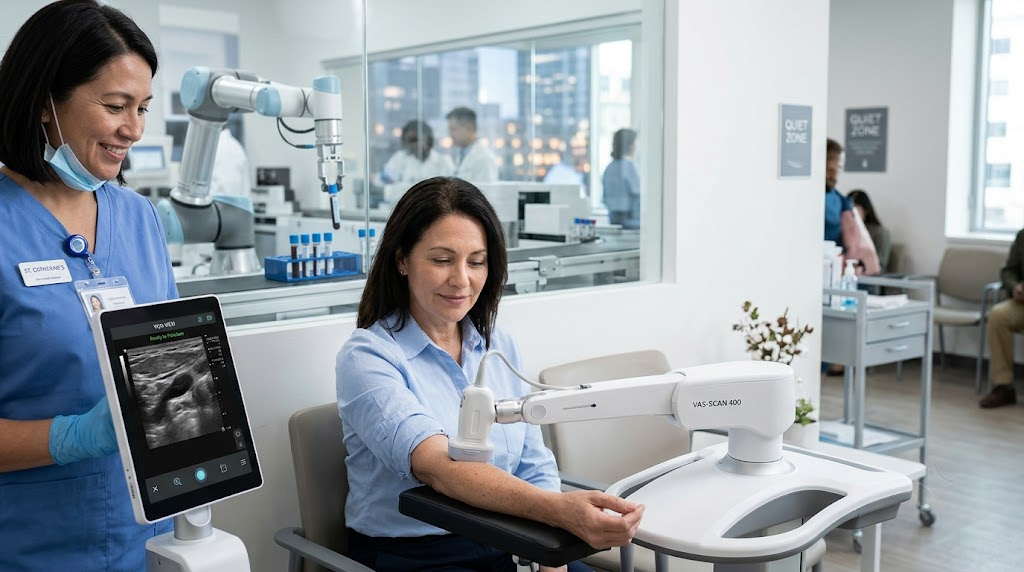
Yes for parts of the process, but not for all of it. In August 2026 the U.S. FDA authorized Aletta, a robotic device that draws blood from a patient’s arm without hands-on operator intervention, according to the Center for Phlebotomy Education. It was authorized through the agency’s De Novo pathway and described as the first standalone device of its kind in the U.S. Behind the lab door, robots have long handled sorting, pipetting and transport. In both places, people still set the limits.
The Robotic Blood Draw
Medscape reports that Aletta uses near-infrared light and Doppler ultrasound to find a suitable vein and tell it apart from an artery. If it cannot identify a suitable vein, it does not attempt the draw.
The main evidence is the ADOPT trial, published in Clinical Chemistry in 2026. Epocrates reports a first-stick success rate of 94.5% among 1,633 outpatients in whom the device found a suitable vein. Counting patients the device did not proceed with, overall collection success was 88.5%. A draw took about 2.5 minutes, 90% of surveyed patients rated pain as comparable to or less than a manual draw, and 18% said they would still prefer a person next time. Epocrates notes that the trial was single-arm and industry-funded, compared against published literature rather than phlebotomists, and that the data FDA reviewed has not yet been published.
A separate pilot study in Clinical Chemistry and Laboratory Medicine found a first-attempt success rate of 95.2% for robotic venipuncture against 100% for manual, with more precise blood volumes and anticoagulant-to-blood ratios. How “success” is defined matters. One registered trial of an AI and ultrasound venipuncture device defines it as collecting at least 1 mL of blood at the first needle insertion.
Robotic Sample Handling and Pipetting
Inside the laboratory, the degree of automation varies. A 2026 paper in Diagnostics on collaborative robots says full automation can replace human operators in sorting, sample preparation, pipetting, inter-analyzer transport and measurement. In partial automation, robots perform only repetitive tasks while laboratory staff keep oversight of the process. A companion Diagnostics review says total laboratory automation lines now cover pre-analytical, analytical and post-analytical steps.
Roche Diagnostics says robotic sample reception can sort out inadequate samples and flag errors to lab managers. For pipetting, a 2026 LabX buyer’s guide lists Eppendorf’s epMotion with optical sensors for liquid level, labware and tip detection and under 2% systematic error at 1 microliter, and credits Hamilton’s STAR V with robust error recovery. These are manufacturer specifications.
Error Reduction
Most laboratory mistakes happen before the analyzer. The Diagnostics review says 50 to 70% of detectable laboratory errors still arise in the pre-analytical phase, during ordering, collection, labeling and transport. The collaborative-robot paper says robotic pre-analytical systems have been shown to improve data quality compared with manual handling. A news report on Vitestro’s earlier trial of 609 participants cited a company-reported median draw time of 1 minute 49 seconds, against five minutes for manual phlebotomy, which is a company claim.
Why Human Oversight Remains
The rules still assume people are responsible. The Diagnostics review explains that under the U.S. Clinical Laboratory Improvement Amendments, laboratories must validate all processes that affect specimen integrity, results or reporting accuracy, including pre-analytical robotic handling. Aletta’s design also builds in a human fallback, since patients without a suitable vein are referred for manual phlebotomy, according to Medscape. Medscape adds that performance should be judged not only by success after an attempt, but also by how many patients are excluded, procedure time, workflow effects and the need for manual intervention.