Can Robots Really Work at the Microscopic Scale?
Robots can handle tasks that require extremely small movements, but microscopic precision is not simply a matter of building a smaller robotic arm. Manufacturing tiny components requires accurate motion, specialised grippers, sensitive measurement systems and carefully controlled environments. In semiconductor production, optical equipment and miniature electronics, even a small positioning error can affect how a component works.
The key distinction is between a robot's ability to reach a position and its ability to place a component there repeatedly with the required accuracy. Those are related, but not identical, capabilities.
Precision Actuators: Controlling Extremely Small Movements
Conventional electric motors and gear systems work well for many factory tasks, but very small adjustments may require specialised actuators. Piezoelectric actuators, for example, convert electrical signals into tiny mechanical movements. They are useful in precision stages, optical alignment equipment and systems that need controlled positioning over very short distances.
A January 2026 study on a piezo-actuated mobile robot demonstrated sub-micrometre path-following capability across movement ranges from 100 micrometres to 10 millimetres. This is a specific experimental result, not proof that every industrial robot can achieve the same precision.
Multi-degree-of-freedom piezoelectric actuators are also being studied for applications where movement must be controlled across several axes. Their practical performance depends on factors such as travel range, load, sensor feedback and control stability.
Micro-Robotics: Handling Tiny Components
Micro-robotics focuses on machines and mechanisms designed to manipulate objects at very small scales. Depending on the application, these systems may use miniature grippers, compliant mechanisms or optical and magnetic forces rather than conventional gripping tools.
At this scale, surface forces become increasingly important. A tiny component may stick to a gripper, shift because of static electricity or become difficult to release. Dust, vibration and small variations in shape can also disrupt assembly. A gripper that works reliably with a larger component may not behave the same way when handling microscopic parts.
Research published in 2026 on microgears and miniature mechanisms highlights how friction, adhesion, manufacturing errors and measurement uncertainty become more significant as components shrink.
Semiconductor Handling: Precision in a Cleanroom
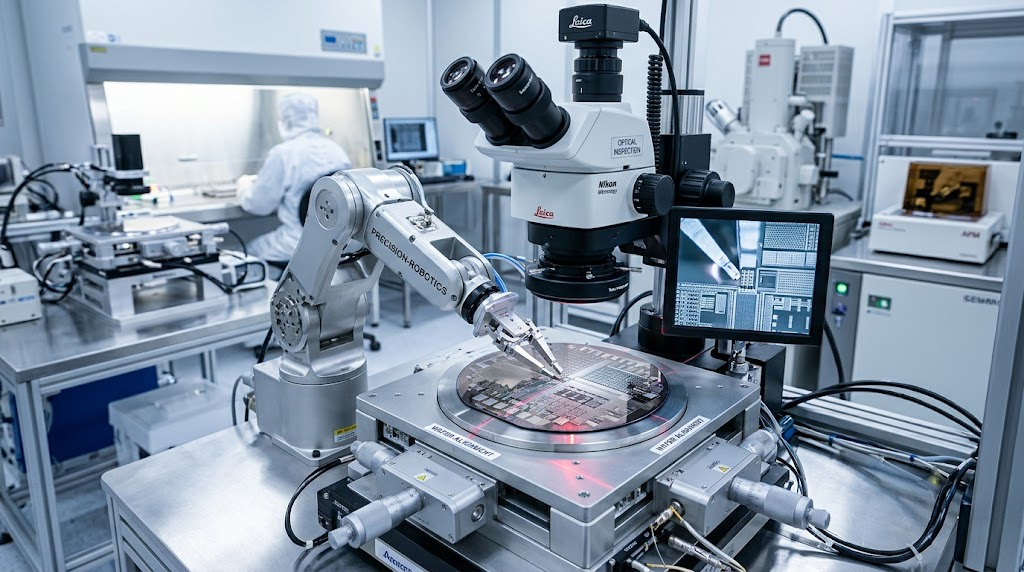
Semiconductor manufacturing is one of the clearest examples of automation working with highly sensitive materials. Robots transfer silicon wafers between carriers and processing equipment, while alignment systems position them for the next operation. Automated handling helps reduce unnecessary human contact and supports repeatable production.
However, wafer transport is only one part of the process. Lithography systems must align successive patterns accurately, while inspection and metrology equipment measure whether the manufactured features meet specifications. A robot can position a wafer consistently, but it cannot compensate for every error in the tools or processes that follow.
India's semiconductor industry is also moving towards a broader manufacturing ecosystem. At SEMICON India 2026, the government highlighted precision manufacturing, equipment, research, packaging and skilled talent as important areas for the next phase of industry development.
Optical Alignment: When Light Reveals Errors
Optical alignment is critical in cameras, laser systems, microscopes and photonic devices. A component may appear correctly positioned but still produce poor results if its angle or distance is slightly wrong.
A research paper published online in August 2026 demonstrated a feedback-guided robotic workflow for assembling a compact laser system. The approach combined visual positioning, optical feedback, step-by-step adjustment and permanent bonding. It shows how measurement can guide a robot during assembly instead of relying only on a preset movement.
The Physical Limits of Robotic Accuracy
No robotic system is perfectly immune to error. Heat can expand mechanical parts, vibration can disturb positioning, and joints or frames can flex under load. Sensors also have finite resolution and uncertainty, while calibration can drift over time.
Manufacturers therefore combine robotics with precision stages, optical measurement, feedback control, temperature management and repeated inspection. In some applications, the most accurate solution is a robot working alongside a dedicated positioning stage rather than a robot acting alone.
What Comes Next?
As electronic, photonic and semiconductor devices become smaller, demand for controlled micro-assembly and reliable measurement is likely to grow. Research published in 2026 continues to explore ultra-precision manufacturing, miniature actuators and improved alignment methods.
The practical goal is not to make every robot achieve nanometre-level accuracy. It is to match the robot, tooling, sensors and environment to the tolerance required by each task. In microscopic manufacturing, dependable measurement and error correction are just as important as the robot's movement.