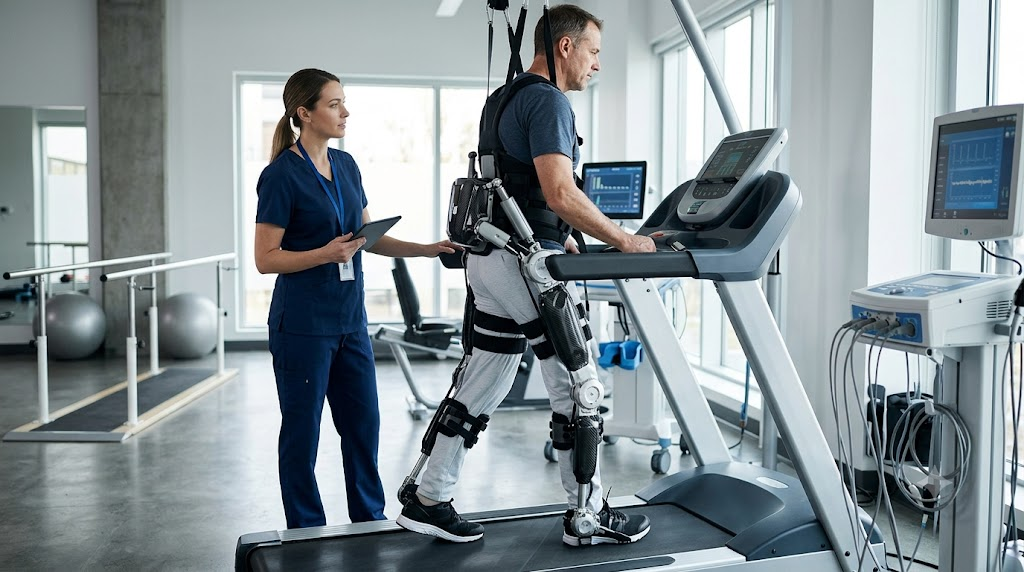
Eligible wheelchair users in the US can now be prescribed an exoskeleton that balances itself, with no crutches, and take it home. On 11 August 2026 the FDA cleared Wandercraft’s Eve, which the company calls the first self-balancing personal exoskeleton. It launched on 17 September. On 1 October, Wandercraft bought Ekso Bionics, another medical-exoskeleton maker. The hardware is advancing quickly; the evidence for what it does for patients is advancing more slowly.
How an Exoskeleton Moves a Paralysed Leg
A lower-limb exoskeleton is a wearable frame with motors at the hip and knee, sensors that read the wearer’s posture and movement, and a computer that decides how much force each joint applies. Control comes in degrees. Assist-as-needed modes help only when the user’s own muscles fall short, which suits rehabilitation. Full robotic control takes over the legs entirely, which is how a person with spinal cord injury can walk at all, according to a 9 October 2026 overview of the field.
Eve adds self-balancing: its software, not the user’s arms on crutches, keeps the wearer upright, leaving both hands free, according to the company.
What Changed in 2026
Eve’s clearance covers adults with spinal cord injury at any level who can operate its remote controller. It is intended for level indoor surfaces and adjoining areas such as patios, under the supervision of a trained companion. Users need a clinical assessment, fitting and five two-hour training sessions. The clearance rested on trials led by the James J. Peters VA Medical Center and Kessler Foundation; participants’ reported benefits, such as better sitting balance, are self-reported and come from the company’s announcement.
Money and ownership are shifting too. Medicare has had a reimbursement pathway for personal exoskeletons since 2024, and Lifeward said on 17 February 2026 that Aetna joined UnitedHealthcare and Humana in issuing prior authorisations for its ReWalk under Medicare Advantage. Wandercraft expected Eve to become Medicare-eligible within 60 to 90 days of the August announcement; no confirmation was found. Its Ekso purchase, terms undisclosed, joins products used at more than 700 rehabilitation centres, by the companies’ count.
What the Evidence Shows
Results are mixed. A 2026 meta-analysis of seven randomised trials, covering 288 stroke survivors, found overground exoskeleton training raised walking speed by 0.09 metres per second, with no significant change in stride length or cadence. A separate 2026 overview of reviews of robotic gait training after stroke found only one review with high-certainty evidence, and concluded the benefits do not reach clinically meaningful functional thresholds.
For spinal cord injury, a July 2026 meta-analysis pooled ten controlled studies, mostly small, and reported an average 31-metre gain in six-minute walking distance, but with very high heterogeneity (I² of 99 percent). No serious device-related adverse events were reported. Its authors call for larger randomised trials. An earlier randomised trial of 161 veterans with paralysis, published in JAMA Network Open in 2024, found no significant mental or physical health difference between wheelchair-plus-exoskeleton and wheelchair-only groups, and the exoskeleton group used the device little.
Beyond Paralysis: Soft Suits for Older Adults
Not every device targets paralysis. A feasibility study from the Technical University of Munich and Heidelberg University tested a soft, tendon-driven hip exosuit in 10 adults aged 69 to 85. With assistance on, participants managed 1.8 more sit-to-stand repetitions in a minute and used 13.6 percent less energy per distance walked than with it switched off. The study was tiny and the authors say larger, longer trials are needed.
The Limits That Remain
Eve does not make a wheelchair obsolete; its maker says it is meant to complement one. It is limited to level surfaces and needs a trained companion nearby, and the wearer must be able to operate its remote controller. The strongest peer-reviewed evidence concerns rehabilitation training in clinics, not daily home use, which is only now beginning. Cost, device access and the lack of standard training protocols were flagged as barriers in the 2026 spinal cord injury meta-analysis.
For patients, the practical question is not whether the robot can walk, but what walking in it changes for health, independence and daily life.