One Arm, Many Trades: How Robots Swap Tools to Switch Jobs in Seconds
Standard flanges, automatic tool changers and calibration routines let one arm take on different tasks. The limits are payload, setup time and how much the robot can handle on its own.
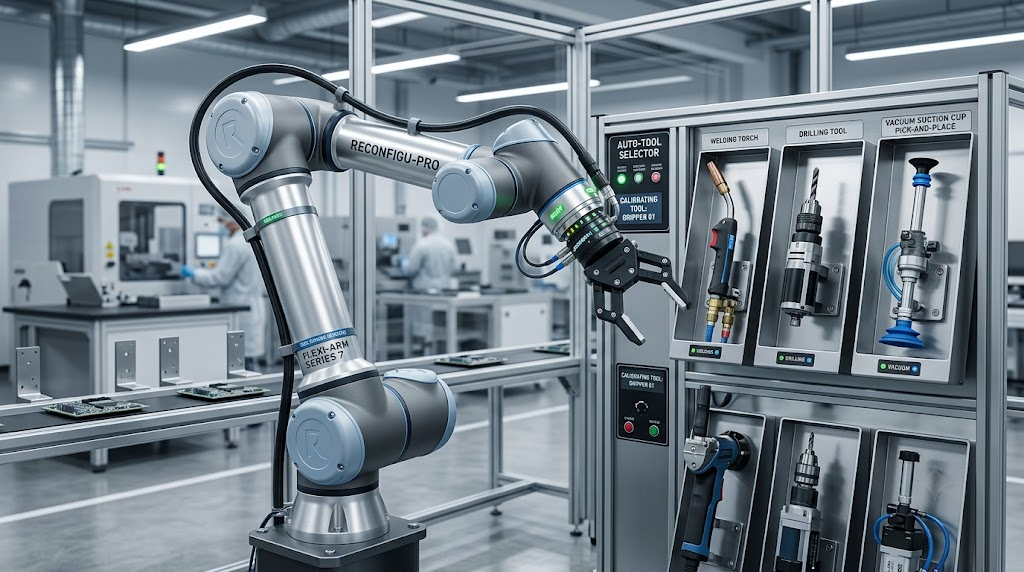
Yes, within limits. A robot arm can do different jobs if the tool on its wrist can be swapped and the software knows what it is holding. Vendors now sell changers that exchange tools in seconds, and 2026 research shows robots changing their own tools. But “completely different jobs” still depends on payload, utility connections, calibration and programming.
The Hardware: Changers and Standard Flanges
Most changers start with a standard flange. OnRobot’s Quick Changer, a manual unit, lists a tool change time under 5 seconds, a 25 kg payload rating, a combined weight of 200 g and 5,000 tool-change cycles, all on an ISO 9409-1 interface. ATI’s QC-7 is an automatic changer rated for 16 kg payloads, with a fail-safe locking mechanism that keeps the tool attached and a direct mount for ISO 9409-1 robot wrists. These are manufacturer specifications.
Safety features matter too. ATI’s tool-stand interlock option prevents the robot from releasing a tool unless the stand is supporting it. Automation also saves labor. A patent covering mobile robots notes that replaceable end effectors are ineffective when changing them requires a technician.
Interchangeable Attachments: From Grippers to Kitchen Tools
A May 2026 arXiv paper called Any-ttach shows how far swapping can go. A Franka FR3 arm and a tool dock let the robot attach and detach modules on its own. The team tested 15 tools in two sets. Six interchangeable modules, a gripper, spatula, spoon, peeler, knife and fork, were used for multi-step tasks such as assembling a sandwich. The authors argue that new capabilities can come from adapting tools rather than redesigning one complex hand.
Laboratories are using the same idea. An August 2026 arXiv paper describes a synchrotron experiment platform with a UR5e arm and a Wingman automatic tool changer. The robot hot-swaps a vacuum gripper, used to move thin-film sample wafers, and a custom pipettor for liquid handling.
Calibration: Telling the Robot Where the Tool Tip Is
Each tool needs its tool center point (TCP) defined relative to the robot’s flange. A CAPTRON editorial notes that when the tool changes, the TCP is simply adjusted for every program that uses it, and the company recommends a quick calibration routine after each change to confirm the tool was inserted correctly. That is a sensor vendor’s view.
The usual manual method is a four-point procedure, taking at least four joint readings with the tool tip at the same point from different orientations. RoboDK’s TwinTool automates it with an off-the-shelf linear gauge sensor, and a company developer says it is simple enough for operators without robotics knowledge. A 2026 guide from Encycam advises recalibrating after tool changes or unexpected impacts and logging the date of each calibration.
Software Adaptation
Software has to know which tool is attached. A December 2025 paper in Actuators describes a quick-change control system with an end controller, tool-end adapter modules and host computer software. Motor-driven claws lock and unlock tools, and tool signals are converted to the RS485 protocol so multiple end-effectors can be controlled over a single bus.
Motion also needs planning. In Any-ttach, tool coupling and decoupling follow predefined waypoints for approach, docking, insertion or release, and retreat relative to the dock. The synchrotron system uses a ROS 2 action server and a custom microcontroller for its pipettor. This shows how much structure still has to be built around each swap.
The Limits
Payload ratings of 16 to 25 kg in the vendor examples above are fine for many tasks and too small for others. Tools also need air, power or data connections, calibration after each change, and docks placed within reach. Most autonomous swapping evidence comes from research demonstrations, and the speed and cycle figures come from manufacturers.