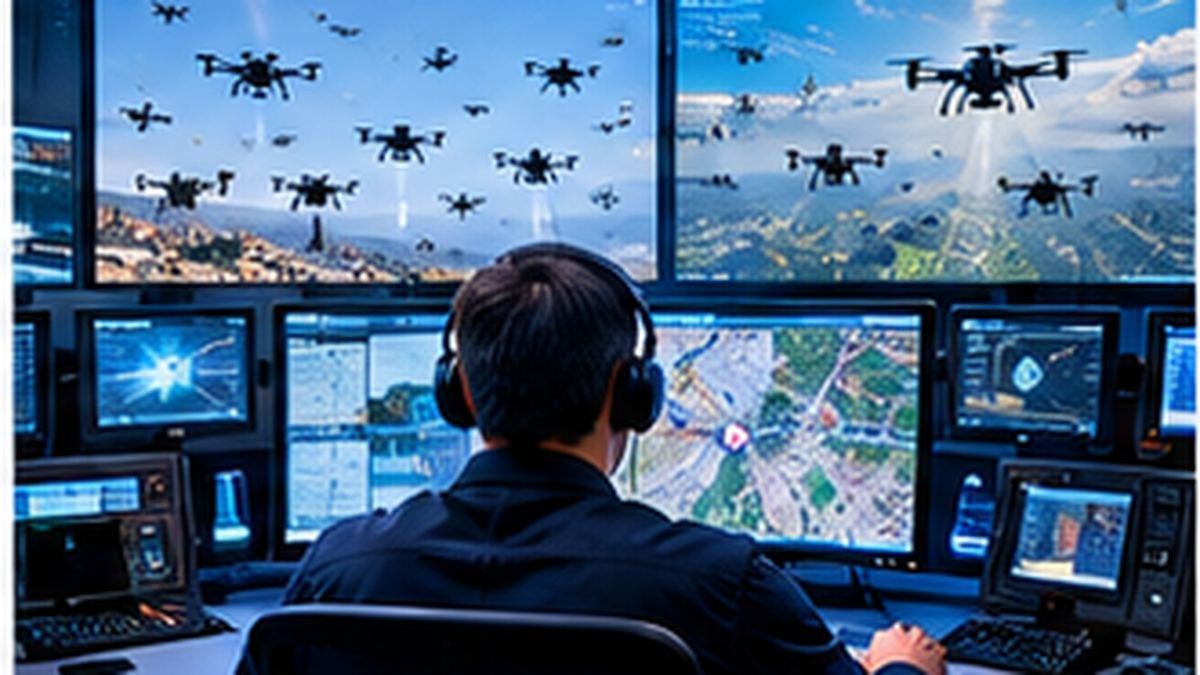
The real problem is operator workload
L3Harris made that problem central to its February 2025 launch of AMORPHOUS, an open-architecture command-and-control platform. The company says the software is designed for a single user to command and control collaborative autonomous assets, and that government-managed tests demonstrated control of multiple separate assets across vehicle types and domains. [1] This is an important distinction for readers: the demonstrated result is a multi-asset test capability; the company's much larger claims about thousands of assets describe intended scale, not evidence that one operator is already running thousands of commercial drones in routine airspace.
The basic operating model is better described as supervision than remote piloting. An operator can define a search area, route or mission objective. Software can then allocate jobs, generate paths, monitor vehicles and make routine adjustments. The human becomes the exception manager, stepping in when a drone encounters a hazard, loses navigation, discovers an unexpected object or needs a new task.
What the autonomy layer actually does
One-to-many control depends on distributing decisions across the fleet. Each aircraft needs enough onboard computing to interpret sensors, maintain its position, avoid obstacles and report important events without continuously sending every raw data stream back to the operator. NASA's Distributed Spacecraft Autonomy work demonstrates the broader idea: responsibilities can be shared among vehicles so operators do not have to issue every low-level command. [2]
Communications remain a constraint. A fleet that streams high-resolution video from every aircraft can overwhelm the link that is supposed to coordinate it. Edge processing, event-based alerts and selective data transmission can reduce bandwidth demand, but they shift more responsibility onto onboard software. That means the fleet becomes more scalable only if the autonomy is also reliable.
What independent research says
A September 2025 peer-reviewed study on human-centred UAV swarms provides a useful counterweight to company marketing. Its prototype allowed a single operator to control more than 20 UAVs simultaneously and evaluated usability, interaction efficiency and cognitive support. The researchers reported preliminary evidence that their design could reduce cognitive load, while noting that interface refinement was still needed. [3] The finding supports the feasibility of one-to-many supervision in a research setting, but it does not establish a universal safe operator-to-drone ratio.
That limitation matters because workload depends on the mission. Watching twenty aircraft fly simple, separated routes is not the same as supervising twenty aircraft performing recognition, navigation and emergency responses at the same time. A 2026 simulation study likewise found that task structure and allocation strategy materially changed how many semi-autonomous UAVs a team could manage. [4]
How other autonomy efforts compare
L3Harris is not the only organization moving decision-making away from the joystick. NASA has shown distributed autonomy in its Starling spacecraft swarm, where the spacecraft can share observations and coordinate tasks with limited direct intervention. [2] In the drone world, UAS Traffic Management research adds another layer: safe scaling also requires digital sharing of flight information so multiple operators and systems can coordinate the airspace. [5] These efforts solve different parts of the same scaling problem—aircraft autonomy, human workload and traffic coordination.
Where it could work first
The most credible early applications are structured missions with repeatable tasks: infrastructure inspection, mapping, disaster-area surveying and security patrols. The software can divide large areas into jobs and prioritize only the events that need human attention. India could benefit from this model for large-area inspection and emergency response, but scaling will require dependable command links, obstacle detection, airspace coordination, contingency procedures and clear responsibility for human supervisors.
A fleet supervisor, not a vanished pilot
The evidence supports a measured conclusion. One operator can supervise multiple autonomous aircraft in research and company demonstrations, and systems are being designed for larger fleets. But the practical ceiling depends on mission complexity, interface quality, communications and safety rules. The likely commercial model is therefore not 'one person replaces every pilot'. It is 'one person supervises a software-assisted team of machines'. As routine flying becomes automated, the quality of human oversight becomes more important, not less.