In June 2026, three finalists in the XPRIZE Wildfire competition tried to do something no fire department does today: detect a wildfire and put it out with no human involvement. The test area covered 1,000 square kilometres of Alaskan wilderness near Nenana, and teams had to hit the fire within 10 minutes of ignition while leaving decoy fires alone, according to Dryad Networks, one of the finalists. Dryad's own comment on the result is the useful one: drones can suppress a small ignition, but their limited payload makes them largely ineffective once a fire has grown.
What thermal imaging does through smoke
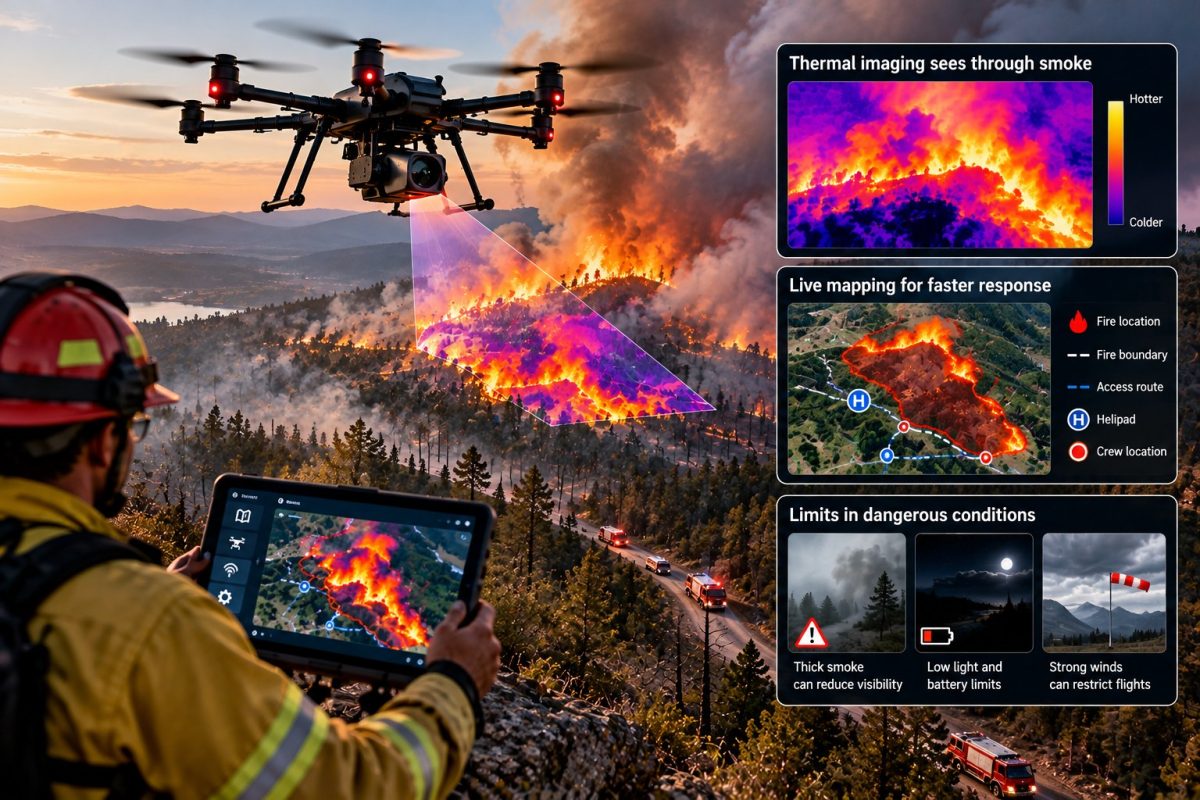
A thermal camera records heat, not visible light, so it can show where something is hot even when smoke hides the scene from a normal camera. A fire crew in Alachua County, Florida, told local television in April 2026 that with a thermal camera they can see "exactly where the fire is" through a wall of smoke and how hot it is. Honolulu firefighters said their thermal drones can pinpoint flames and the direction of fire spread from almost 1,000 feet away, which they use to decide where to put people on the ground.
Thermal data is also a map. In March 2025 the US Forest Service used a new drone with an infrared camera to map the Rattlesnake Branch Fire in North Carolina through smoke. In August 2026 the drone maker BRINC added live satellite fire detections and smoke-density layers to its flight software so a pilot can see fire activity beside drone video and telemetry on one map. Thermal drones also scan burned ground for hidden embers that could reignite.
What the tests showed
The XPRIZE finals were the most demanding public test of autonomy so far. Anduril took first place with $1.2 million, and Dryad won $800,000 for a system in which ground sensors detect smoke and an observation drone and a suppression drone respond. Dryad says its suppression drone carries up to 100 litres. AURA Foresight placed third and met the 10-minute detection requirement. An analysis site noted that the trials show integration working in realistic conditions, but that a large gap remains between this and drones reliably extinguishing wildfires at scale.
Daily firefighting is less dramatic. A 2026 guide from the Drone Launch Academy says fire-service drones are mostly "eyes, not hoses": size-up, thermal hotspot mapping and wildland perimeter mapping. It also says no drone built only for firefighting is commercially available and that no drone can replace a crewed airtanker. That is one training firm's assessment, but it matches what departments say.
The limits in a real fire
Honolulu's drone programme, the largest in its state with 10 drones and 26 pilots, listed its constraints plainly: batteries last about 30 minutes, high winds can keep drones grounded, and civilian drones are a problem. Another guide notes that an unauthorised drone near a wildfire can force crewed firefighting aircraft to stop, because pilots cannot safely share airspace with an unknown aircraft. It also warns that crews must understand the limits of thermal sensors and confirm what an image means. As a general limitation, thermal cameras read surface temperature, and they cannot see through water, glass or thick structures.
What is in use, and what is not
In practice: thermal and optical drones for size-up, perimeter mapping, hot-spot scans and live maps.
Tested: autonomous detection and suppression of small fires, as in the XPRIZE finals.
Planned or aspirational: drones that reach upper floors of high-rise buildings with foam. India's iDEX programme asked for one with 150 metres of reach, 150 kilograms of payload and 45 minutes of flight, which describes a requirement, not a product. Delhi Fire Services' 25-year roadmap, reported in June 2026 and still under government review, also plans drones for real-time incident assessment.
The constraint that matters most: payload and endurance. A drone can reach a fire first and show where it is, but a small tank and a 30-minute battery cannot stop a large fire.
Used well, drones shorten the time to understanding a fire. They do not yet shorten the time to putting one out, except at the very start.