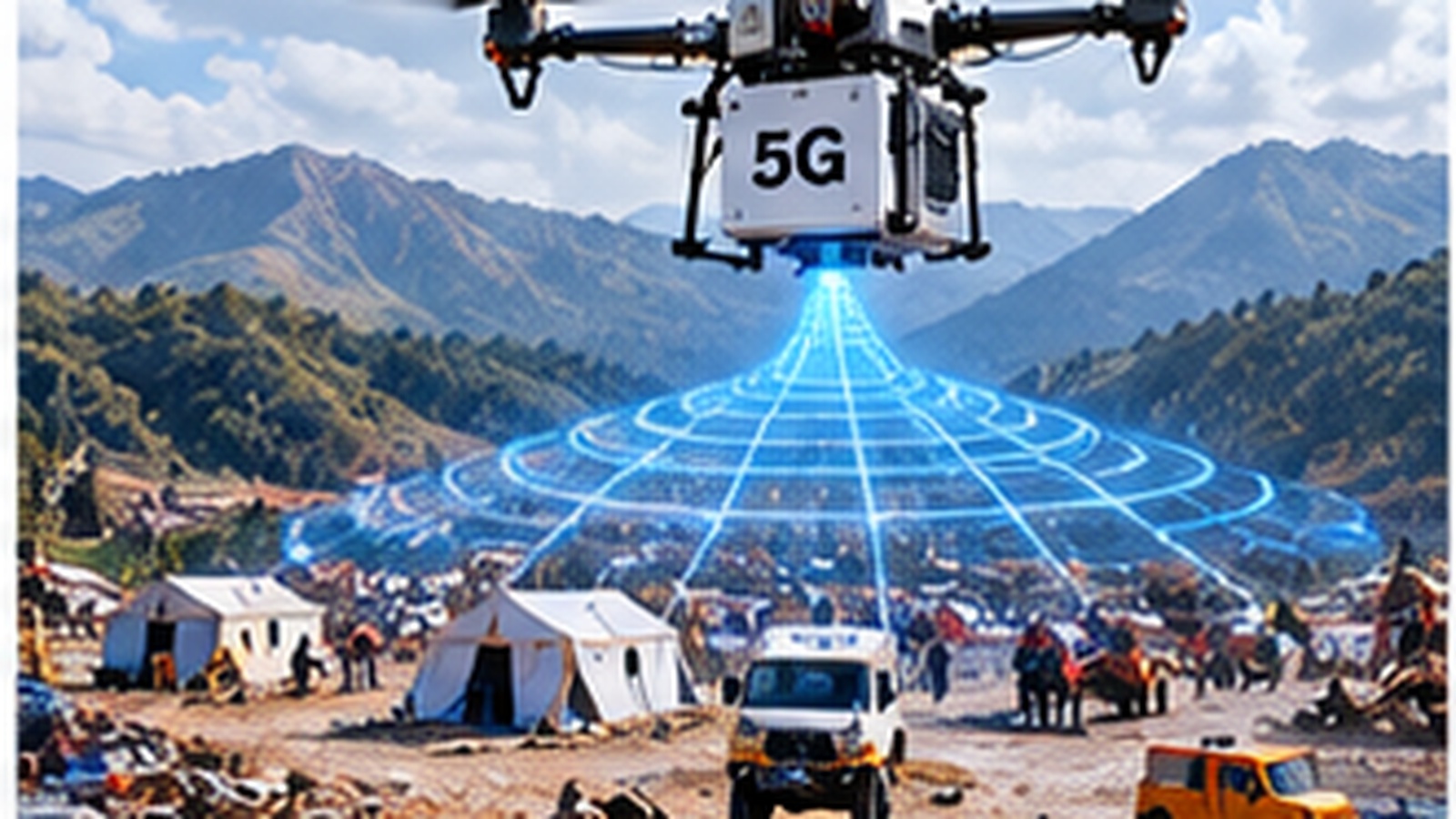
A 5G base station takes to the air
The idea is simple but technically demanding: put enough of a cellular network on an aircraft to create a temporary coverage zone, then connect that airborne network to the wider internet or an operator core through a backhaul link. In the Oulu demonstration, the drone carried a compact local 5G base station and satellite communications equipment. The researchers reported stable mobile coverage at different flight altitudes and tested the concept in simulated disaster scenarios.
A drone-based base station solves a very specific problem. Floods, earthquakes, fires and landslides can damage towers, power supplies and fibre routes at the same time that emergency responders most need communications. A conventional replacement tower takes time to transport, install and connect. An aircraft can be moved into position comparatively quickly and can create a coverage footprint without depending on a functioning tower at the centre of the affected area.
How an airborne cell works
The concept is not entirely new. A January 2025 GSMA case study described ZTE’s airborne base-station work, including deployments after severe weather in China. ZTE reported that an uncrewed helicopter equipped with an airborne base station restored connectivity in Wenchang after Typhoon Yagi in 2024. In one six-hour period, the company said 8,600 users connected to the airborne station, generating 6.7 GB of data traffic and more than 470 voice calls. Those figures come from ZTE’s case study and should be treated as company-reported deployment data, but they demonstrate that the idea has moved beyond pure simulation.
The engineering challenge is keeping the radio payload connected while the aircraft itself moves in three dimensions. The system has to manage antenna orientation, interference, backhaul capacity, aircraft endurance and the geometry of the coverage area. Satellite backhaul helps when terrestrial fibre is unavailable, but it can introduce its own latency, capacity and weather considerations. The aircraft also has to operate safely over people and in the same airspace as rescue helicopters and other aircraft.
What disaster deployments show
Regulation is another constraint. The Oulu team noted that live airborne 5G transmission faces regulatory restrictions in Japan, which is one reason the live radio trial was conducted in Finland. That illustrates an important point: a technically functional airborne base station is not automatically an operational emergency network. Spectrum authorization, aviation permissions, network integration and cybersecurity all have to be solved together.
Why it is not a permanent tower replacement
Commercially, the strongest use case is probably temporary coverage rather than permanent replacement of terrestrial towers. Disaster response teams, remote industrial sites, major events and isolated communities could use an airborne cell as a bridge until conventional infrastructure is restored. The 2026 Oulu–Tokyo test shows the hardware is becoming credible; the remaining question is how quickly operators can turn that capability into standardized, deployable service packages.
The 5G architecture also suggests a broader idea: future emergency networks may combine airborne, terrestrial and satellite layers rather than depending on one infrastructure type. A drone can provide local radio access, a satellite link can provide backhaul, and surviving terrestrial networks can handle traffic where they still work. That layered approach is valuable because disasters rarely destroy everything uniformly. Some towers may remain functional while a particular valley or neighbourhood becomes disconnected. An airborne cell can fill the gap temporarily, then move as the rescue operation shifts. The technology is therefore less about replacing telecom towers permanently and more about making connectivity mobile enough to follow the emergency.