How automated inspection works
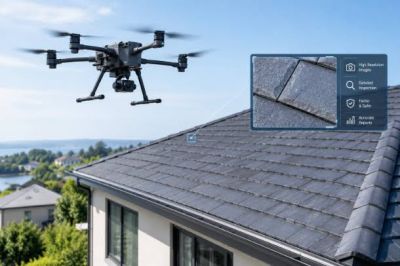
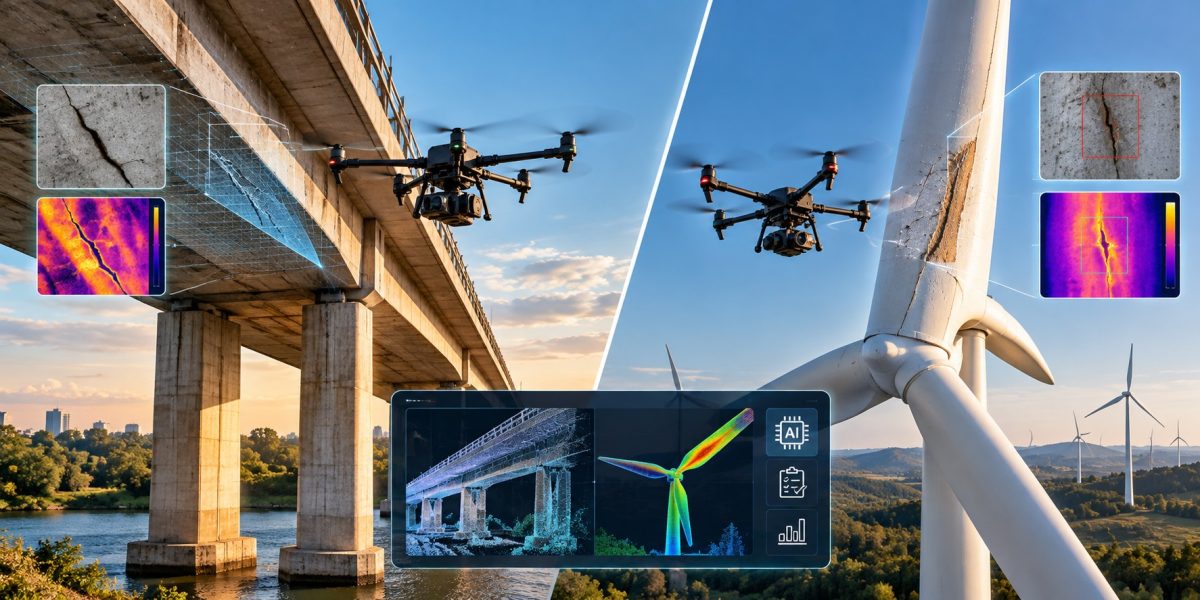
A drone flies a planned route around a blade or beneath a bridge deck while its camera captures high-resolution images. Some carry thermal cameras, which show heat patterns that can reveal moisture or delamination, the separation of layers inside a material. Software then compares each image against what damage looks like. SkyVisor’s tool uses convolutional neural networks, a type of image-recognition AI, to classify cracks, erosion, delamination and lightning damage, and tags images containing anomalies so engineers review only those.
Combining sensors helps. A December 2024 preprint by Ukrainian and Polish researchers merged thermal and ordinary images of turbine blades. On a benchmark dataset, accuracy for the YOLOv8 detector rose from 91 to 95 per cent and missed defects fell from five to two.
Where it works best
Wind turbines suit drones because the structure is repetitive and the inspection is mostly visual. A 2024 thesis from Utah State University notes the dangers of manual inspection: inspectors risk falling from height or being hit by falling debris, and turbines are normally switched off during inspection.
Bridges are harder. The underside of a deck is where fatigue cracks, tiny fractures that grow under repeated loading, tend to form, and it is a poor place for a drone. GPS signals are weak or absent under a bridge. A Utah State University team working with Idaho transportation officials studied this, and the Minnesota Department of Transportation found that its first test drone, limited to GPS positioning, could not capture images upward from beneath a bridge. The Minnesota assessment names two features it considers critical in inspection drones: a camera that can look upward, and the ability to fly without a GPS signal.
Where the evidence is weaker
Small defects are the central difficulty. Heriot-Watt University research from 2025 notes that blade images are ultra-high-resolution while defects are tiny. Splitting images into slices improved detection accuracy but increased processing time. A May 2025 Iowa Department of Transportation pilot study, described in a report published by Iowa State University’s InTrans (linked in Sources), tested whether drone images could detect hairline cracks, with widths of roughly 0.008 to 0.022 inches (about 0.2 to 0.55 millimetres), on bridge decks. The report lists practical obstacles: shifting shadows, passing trucks and equipment under the bridge.
Motion matters too. The Utah State thesis points out that if turbines keep turning, blurred images make detection harder, which is why deblurring is being studied.
The earlier Idaho work is a sobering reference point. Researchers used a drone at an in-service bridge and, while they detected concrete defects and rust, they did not detect the known fatigue cracks. Their image-processing algorithms were shown to be feasible but needed more training images.
What is deployed, and what is not
In practice: drone image capture with AI-assisted screening of turbine blades, and drone photography of bridge decks, piers and hard-to-reach members, as shown by the Minnesota DOT assessment.
Experimental: reliable automatic detection of fatigue cracks and hairline cracks, and flying under structures without GPS at scale.
The real-world limit: inspection is more than looking. Minnesota’s assessment lists bridge areas that are hard to image with larger mapping drones, especially where an inspector wants to use a tool such as a hammer for sounding. Human inspectors remain responsible for the final judgement on safety-critical structures.
The honest conclusion is that drones already take people out of the most dangerous positions and speed up screening. They have not yet replaced the engineer who decides whether a crack is dangerous.