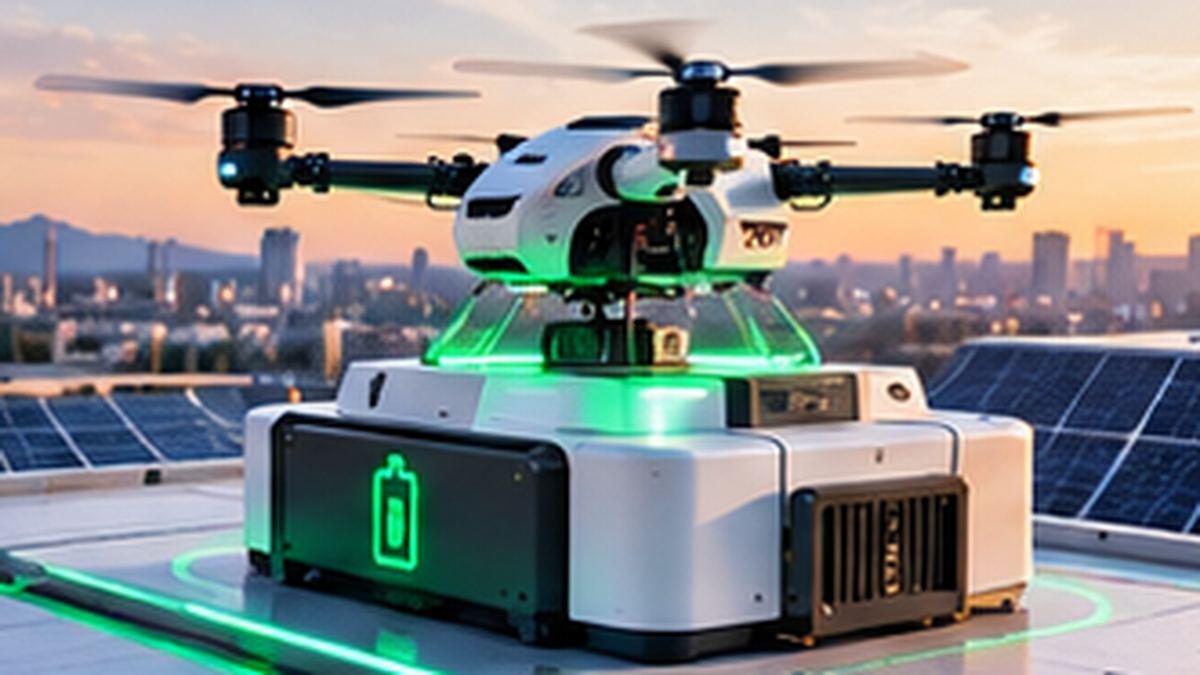
The charging station becomes part of the drone
Battery endurance is one of the simplest ways to stop a drone from becoming truly autonomous. If an aircraft has to land every 20 or 40 minutes and wait for a person to change its battery, the operation is only partially automated. Autonomous charging aims to close that gap by making the drone responsible for its own energy cycle.
There are several approaches. The most direct is a docking pad with electrical contacts: the drone uses visual markers, GNSS, precision landing or a combination of sensors to position itself over the charger. Wireless charging removes the need for exposed contacts. Battery swapping goes further, using a mechanical station to remove a depleted pack and install a charged one. A good autonomous system also needs health monitoring, thermal management, charging control and a reliable launch sequence after recharge.
Three ways an aircraft can recharge itself
A 2025 Aerospace Science and Technology review compared energy sources, docking stations, battery-swapping methods and wireless power-transfer architectures for quadrotors. The authors highlight inductive, capacitive and hybrid approaches and note that the design is a systems problem: power level, alignment, charging efficiency, battery chemistry, docking geometry and aircraft weight all interact. Wireless charging is convenient, but it is not free; the transfer hardware adds mass and there are efficiency losses between the source and the battery.
Galvion’s BATLCHRG UX, introduced at DSEI 2025, illustrates another direction: a portable wireless charging platform intended for unmanned systems in field environments. The company describes magnetic-resonance charging designed to tolerate imperfect alignment and operate through environmental obstacles. This is not the same as a universal consumer-drone charging pad, but it demonstrates how docking infrastructure is becoming part of the unmanned-system architecture.
What autonomous docking requires
The hardest problem is precision. A drone can be centimetres off the ideal charging position and still land safely, but a small misalignment can matter when electrical contacts or inductive coils have limited tolerance. Weather adds another layer: water, dirt, ice and debris can affect both landing and charging. A truly unattended station must also detect failed landings, prevent unsafe charging, and decide whether to retry, wait or return to a safe location.
Commercial usefulness already exists in controlled environments such as security sites, solar farms, industrial campuses and infrastructure monitoring. The economics improve when the drone performs repetitive missions and the station can be shared across many flights. Fully unattended operations will require reliable docking, robust batteries, remote diagnostics and regulatory approval, but the basic concept is no longer speculative. The important shift is from “a drone with a long battery” to “a robotic aircraft with an energy station.”
Where unattended operations make economic sense
The most mature deployments are likely to use a “dock, charge, check, relaunch” cycle rather than trying to make every flight extremely long. A station can inspect battery temperature, propeller condition, storage capacity and communications before authorizing another mission. If the drone arrives with too little energy or a fault is detected, the station can keep it grounded instead of sending a damaged aircraft back into the air. That turns the charging dock into a small robotic service bay. Over time, this could matter as much as the charger itself because reliable unattended operation depends on maintenance decisions as well as energy transfer.
The best charging systems will also have to solve battery degradation. A station that repeatedly charges a pack at high power can shorten battery life if thermal management is poor. Monitoring state of health allows the system to rotate packs, reduce charging rates or schedule maintenance before a failure occurs. That turns autonomous energy management into a fleet-management problem rather than a simple electrical connection.