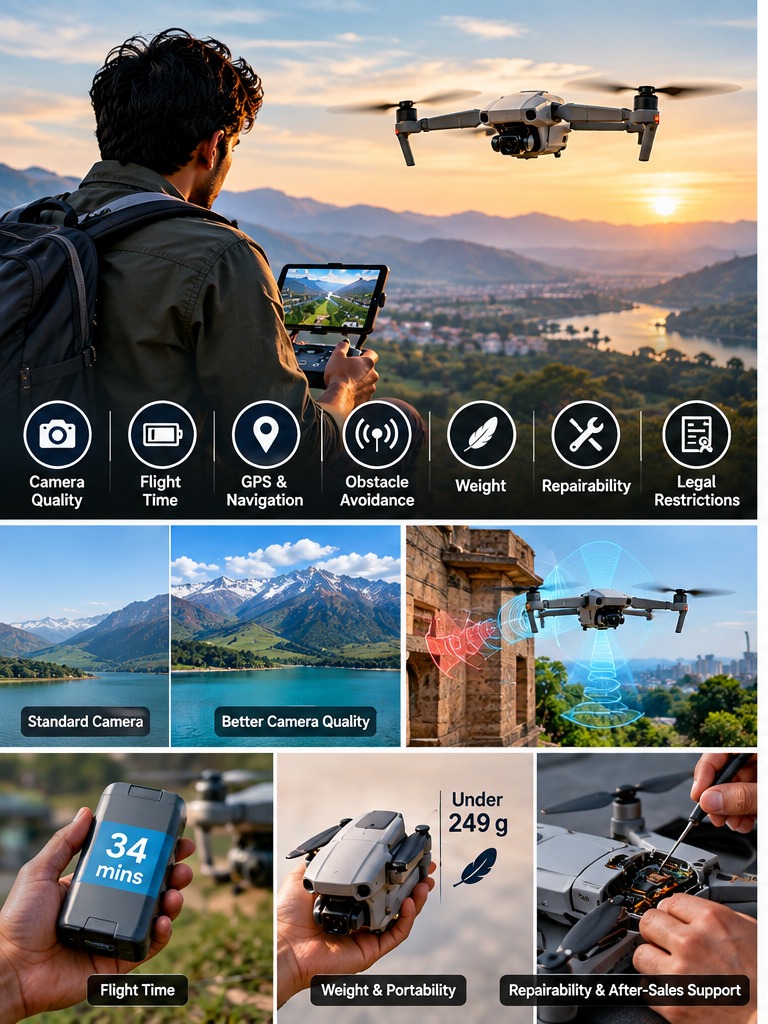
Buying a drone is easy; buying the right drone is harder. A beginner may be tempted by a long flight-time figure, a 4K label or a low price, but those numbers do not tell the whole story. The better question is what the aircraft needs to do: capture travel footage, learn to fly, inspect a property, map land or support paid work. Camera quality, positioning, obstacle sensing, weight, batteries and after-sales support matter differently for each use.
Start with the job, not the specification sheet
For casual flying, portability and predictable controls may matter more than a large camera sensor. For travel video, a stabilised camera and a lightweight folded design are useful. For serious photography, sensor size, lens quality, dynamic range and RAW capture matter more than a headline megapixel count. For mapping or inspection, reliable positioning, repeatable flight paths and data compatibility can be more important than cinematic features.
A useful example is the DJI Mini 4 Pro: DJI lists a take-off weight below 249 g, a 1/1.3-inch 48 MP camera, 4K/60fps HDR video, GNSS using GPS, Galileo and BeiDou, and omnidirectional vision sensing. Those specifications show why a drone should be evaluated as a system rather than by camera resolution alone. citeturn3search0
Camera quality is more than 4K
A 4K label tells you the video resolution, not how good the image will look in difficult light. Sensor size, lens aperture, stabilisation, bitrate, colour profiles and image processing all influence the result. A three-axis mechanical gimbal can also matter more to usable footage than an extra number in the camera specification.
If your main goal is social-media clips in daylight, a compact camera drone may be sufficient. If you want night scenes, professional grading or still photography, spending more on the camera system can make sense. Do not pay for capabilities you will not use.
Flight time, GPS and obstacle avoidance
Manufacturer flight-time figures are controlled-test numbers. Wind, temperature, flying speed, camera use and battery age can reduce real-world endurance. Treat a published maximum as a comparison point, not as the time you should plan to use every battery.
GPS is now part of a broader positioning system. GNSS helps the aircraft estimate its location, while downward vision or other sensors can help it hold position close to the ground. Obstacle sensing adds another safety layer, but it does not make a drone crash-proof. Sensors have blind spots and can struggle with poor light, thin wires, reflective surfaces or objects outside their effective detection conditions. DJI’s Mini 4 Pro, for example, uses omnidirectional binocular vision plus a bottom infrared sensor, with published detection ranges that vary by direction and conditions. citeturn3search0
Weight changes both portability and regulation
India classifies civil drones by maximum all-up weight including payload: nano is up to 250 g, micro is above 250 g up to 2 kg, and small is above 2 kg up to 25 kg. The weight category affects the regulatory requirements that apply to the aircraft and operation. citeturn2search25
Buyers should not assume that a drone being light makes every flight automatically legal. DGCA guidance says pilots should fly only type-certified and registered drones where required, check airspace before every flight, follow the applicable Remote Pilot Certificate requirements, maintain visual line of sight, respect safe distances and fly only in permitted weather. citeturn2search10
Repairability can matter more than extra features
Propellers are consumables. Batteries age. Gimbals, arms and motors can be damaged in a hard landing. Before buying, check whether replacement batteries, propellers and other parts are available in India and whether there is an authorised service channel. A cheap aircraft that is difficult to repair can cost more over time than a better-supported one.
A practical beginner buying framework
For a first drone, divide the budget by use case. A low-cost learner should prioritise safe controls, spare parts and durability. A travel creator should prioritise camera quality, gimbal stability, portability and battery availability. A serious enthusiast should look for better sensing, manual camera controls, reliable positioning and a strong software ecosystem. A business user should go further: check certification, operational permissions, data workflow, service support and whether the aircraft is suitable for the required accuracy.
The best beginner drone is therefore not a universal model. It is the aircraft whose weight, camera, flight behaviour, repair support and legal operating requirements match the work you actually plan to do.