A lake may look clean and peaceful, but harmful changes can happen underwater. Sometimes algae grow very quickly and form harmful algal blooms. These blooms can affect water quality and may release dangerous toxins.
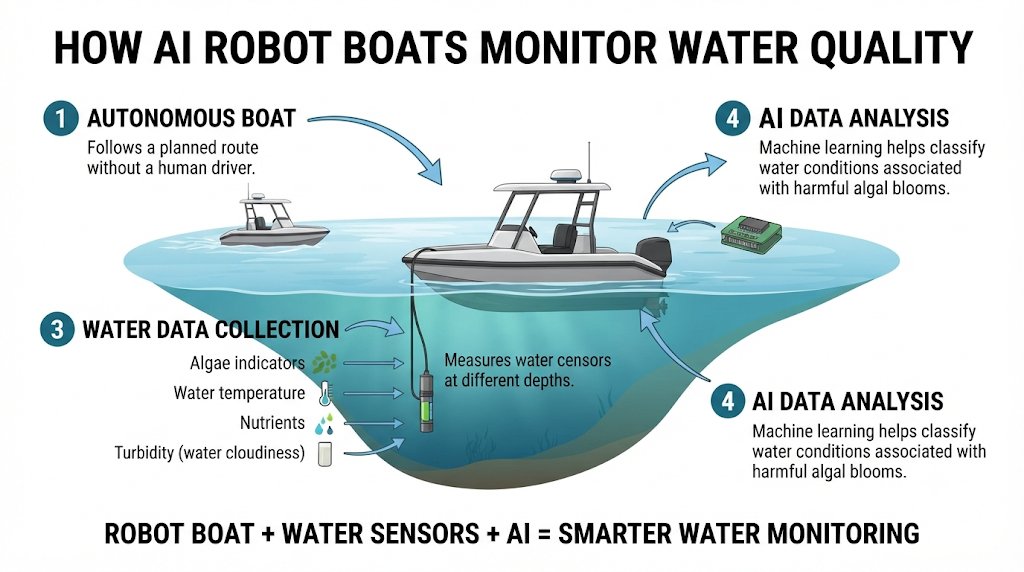
To study this problem, researchers developed a robot boat that collects water information automatically.
The research paper was shared on arXiv on November 13, 2026.
What Did the Researchers Test?
The researchers tested their robot boat in Lake Pontchartrain, Louisiana.
They also collected water measurements from False River, Louisiana, to study different water conditions.
The boat travelled along planned routes and stopped at selected locations to collect information.
It measured water conditions at different depths instead of checking only the surface.
The researchers collected data about algae, nutrients, water cloudiness and temperature.
This information can help scientists understand how water conditions change.
How Does the Robot Boat Work?
The researchers used a robot boat called BlueBoat.
It is an autonomous surface vessel, which means it can travel across water without someone controlling every movement.
The boat carries different sensors to collect information.
One important device is a water-quality sensor called a sonde.
A motorised winch lowers this sensor into the water to measure conditions at different depths.
The boat also uses side-scan sonar to study underwater surroundings.
Another device, called an event camera, detects changes in what the camera sees.
Together, these tools allow the boat to work like a small floating laboratory.
How Is AI Used?
After collecting the water data, the researchers tested a machine-learning system.
Machine learning helps computers find patterns in information.
The system studies water measurements and tries to identify whether the conditions are linked to an algal bloom.
It separates the data into two groups: bloom conditions and non-bloom conditions.
However, this does not mean the system can already predict every harmful bloom.
Why Is This Research Important?
Harmful algal blooms can affect people, animals and aquatic life.
Scientists need regular water measurements to understand when and where these blooms may develop.
Usually, researchers travel by boat and collect water samples manually.
A robot boat could make this process easier by travelling along the same routes and collecting information from different locations.
It can also measure water conditions at several depths.
Repeated measurements may help scientists notice changes in lakes over time.
What Are the Limitations?
The research is still in its early stages.
The study shows that the boat can collect water data automatically and that machine learning can be tested using that information.
However, it has not proved that the system can reliably warn people before harmful blooms appear.
The boat also needs more testing in different lakes, weather conditions and seasons.
Its sensors require regular maintenance and calibration to keep measurements accurate.
The paper is also a preprint, meaning it has not yet completed formal expert review.
What Happens Next?
The researchers hope to improve the system and test it in more locations.
Future work could help scientists monitor water quality more regularly.
This robot boat is a useful step toward better lake monitoring, but more research is needed before it can become a reliable harmful algal bloom warning system.