Why detecting a small drone is harder than it looks
A small quadcopter can be slow, low to the ground and difficult to distinguish from birds or background clutter. Its radio link may also be absent or difficult to detect. That makes counter-drone security less like switching on one alarm and more like combining several imperfect sensors.
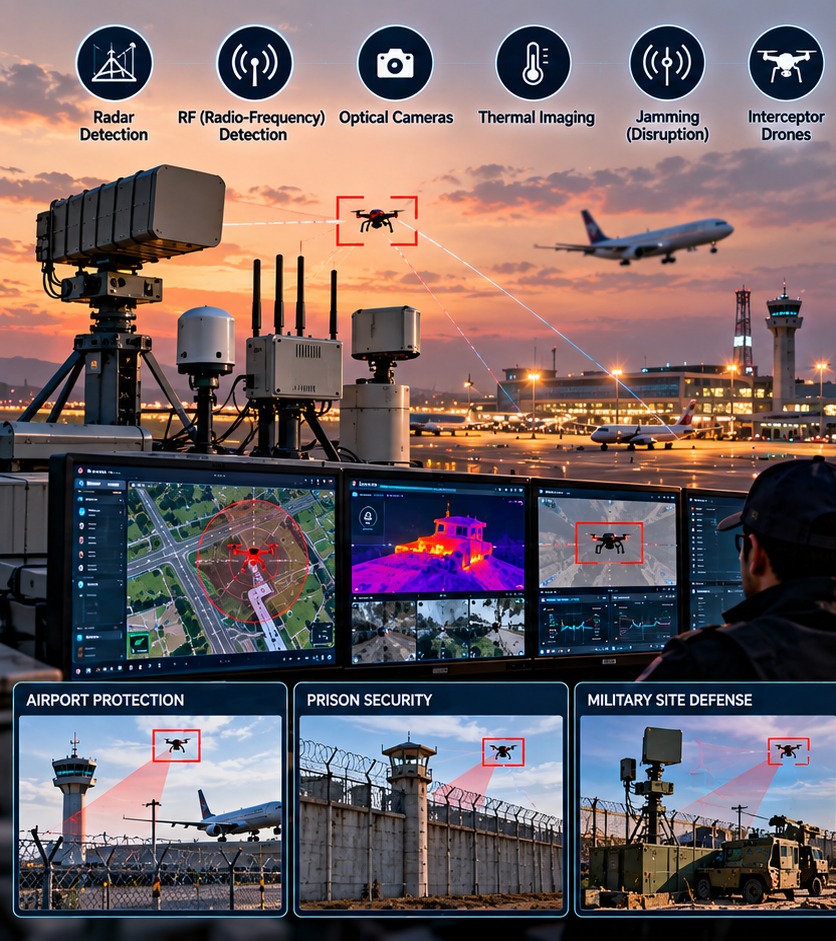
DRDO's counter-drone documentation describes a layered approach: radar and RF systems can contribute to detection and tracking, electro-optical systems can help identify a target, and other technologies can be used to respond to a confirmed threat. The basic architecture is detection, identification and then an appropriate response.
The key idea is redundancy. If one sensor struggles because of weather, terrain or the drone's operating mode, another may still provide useful evidence.
Radar and RF detection: finding the signal or the aircraft
Radar works by transmitting radio energy and analysing the returned signal. Counter-drone radars are designed to detect small airborne objects and track their movement. Their challenge is that small drones have a small radar signature and often fly close to buildings, trees or other clutter.
Radio-frequency detection takes a different approach. Instead of looking for the aircraft directly, RF sensors can look for radio emissions associated with a drone or its controller. This can help identify an active control link, but an autonomous drone or one using a communication method that the detector cannot observe may provide little or no useful RF evidence.
This is why DRDO has described combining radar, RF, electro-optical and infrared capabilities rather than relying on one detector.
Cameras and thermal imaging add identification
Once a possible drone is detected, cameras can help answer a different question: what is actually in the sky?
Electro-optical cameras provide visible imagery and can support visual confirmation and tracking. Thermal cameras detect differences in infrared radiation and can be useful in low-light conditions or when visible contrast is poor. They are not magic, however. Weather, distance, background temperature and line of sight all affect performance.
A useful counter-drone system therefore combines sensor outputs. Radar may indicate that something is moving through a protected area; RF sensing may provide evidence of a control link; and optical or thermal imagery can help an operator assess the object.
Jamming and other responses: why the 'counter' part is complicated
Detection alone does not stop an unauthorised drone. Counter-drone systems can use non-destructive or destructive responses, depending on the legal authority, threat and environment.
Radio-frequency jamming attempts to interfere with communications between a drone and its controller. GNSS interference can affect satellite-navigation signals. Other systems may use physical interception or directed-energy technologies. India's DRDO describes these as soft-kill and hard-kill categories.
These responses are not simple switches. Interference can affect other radio users, navigation systems or legitimate equipment. A response also has to account for where a disabled or redirected drone could fall. For that reason, counter-drone deployment is a security and regulatory problem as much as an engineering problem.
This article intentionally avoids operational details such as frequencies, power levels, targeting procedures or instructions for defeating counter-drone systems.
Airports, prisons and military sites need different layers
The same technology can serve different security environments, but the priorities change.
At airports, the system has to distinguish potential drone activity from a busy aviation environment and coordinate with established air-traffic and security procedures. At prisons, the concern may include drones approaching restricted areas, while reliable detection and identification can help security teams respond before an intrusion reaches the facility. Military sites generally require a broader, layered architecture because the protected area and threat environment can be more complex.
India's recent deployments show this layered direction. In February 2026, the V.O. Chidambaranar Port Authority announced an integrated RF- and radar-based anti-drone system for port security. The Defence Ministry's current product information also describes the DRDO-BEL D4 system as combining search, detection, tracking, optical/thermal information and countermeasures.
The practical lesson is straightforward: effective counter-drone protection is not one device. It is a chain of sensors, software, trained operators, rules and response options designed to work together.