How China Is Using US AI Answers to Train Its Own Models
A Reuters review published on 17 November 2026 looked at more than 300 Chinese academic papers, patents, company reports, job notices and government documents. It says AI model distillation has grown from school experiments into everyday industrial use in China. This matters because distillation builds AI skills in a way that chip export limits can’t directly block.
What distillation is
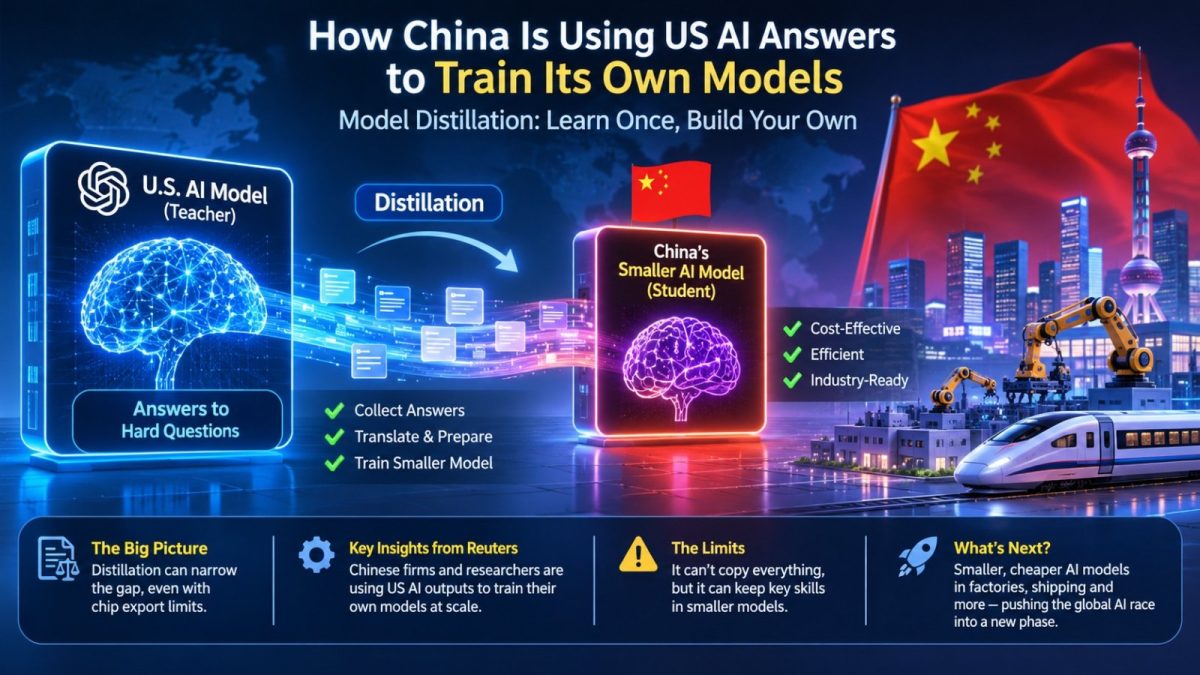
In distillation, a strong “teacher” model writes answers, and developers use those answers to train a smaller “student” model. Reuters says it isn’t illegal and is common in other parts of the world. For example, an American model can answer a hard question once, and a Chinese team can keep the useful examples and train its own system with them.
What Reuters found
The records show Chinese companies building software to automate this, and special workers preparing material to train smaller local models. One example is a November 2024 paper from Shanghai Jiao Tong University. The researchers picked about 5,000 answers from OpenAI’s o1 model and translated them with GPT-4o mini. They built 10,750 bilingual training examples to train Alibaba’s Qwen2.5-72B further. In an April 2025 paper, Alibaba researchers used GPT-4 and GPT-4o to make training material in other languages. Then they improved and scored the answers before training smaller Qwen models.
The government side
Chinese government documents encourage distillation so cheaper AI can spread across industry, including manufacturing. Reuters says they don’t tell companies to copy American models.
The limits
Reuters says distillation can’t copy everything a top model can do, and it doesn’t remove the need for strong computing power. It can keep chosen skills in smaller, cheaper systems. Two people who know how Chinese developers work told Reuters that distillation is only one factor, along with engineering, algorithms, data and model design. Reuters also says the practice could weaken the effect of US chip limits.
Rules and politics
OpenAI’s terms limit using its output to build competing models, with some exceptions, and Anthropic’s terms are similar. A US official told Reuters that Washington believes industrial-scale distillation is the main reason Chinese models have caught up. Chinese officials defended distillation as a normal technique, but they made no firm promises, according to the same official. The topic is also a point of tension before the APEC summit in Shenzhen on 18 and 19 November.
An earlier Reuters review, on 31 July, found researchers linked to China’s military using output from OpenAI and Anthropic models. China rejected the accusations.
What could happen next
Smaller, cheaper models could be used in factories, shipping and other industries. That’s what Beijing’s AI and manufacturing plans aim for, but it’s not clear how far it can go. US labs may tighten their terms and get better at spotting copying. Companies that make small, efficient models could gain.