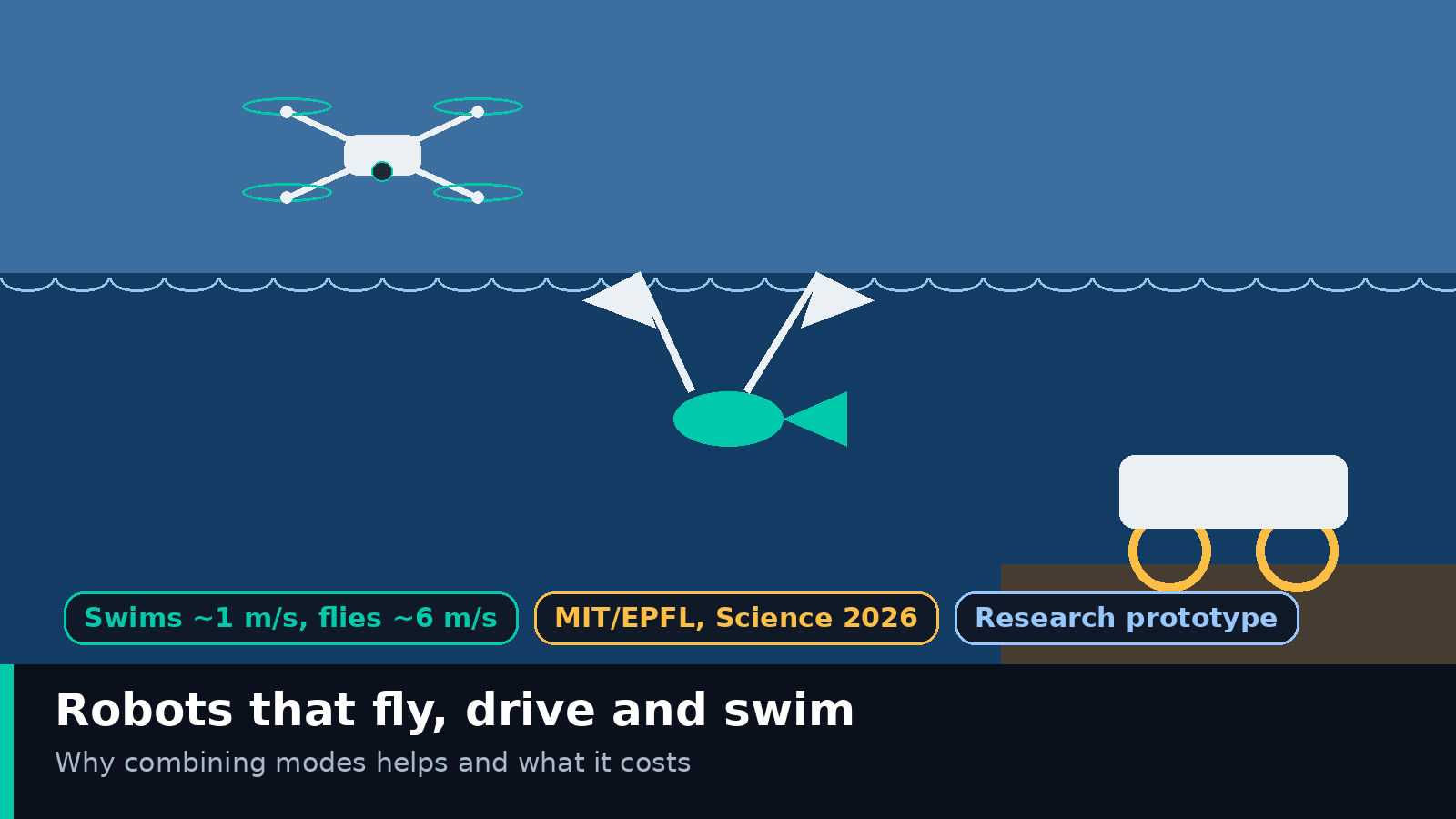
Water is about 1,000 times denser than air, so a machine built for one medium is normally wrong for the other. In July 2026, engineers at MIT and EPFL reported in the journal Science a robot of less than 300 grams that swims underwater and then flaps its way out into the air. It did so in a water tank and in Lake Geneva, without anything like the foot-paddling that diving birds use to take off.
How the flapping robot works
The vehicle has a body, two flexible flapping wings and a steerable tail. A waterproof motor drives a crankshaft that pumps the wings, and the wing membranes are coated with hydrophobic nanoparticles to shed water. The team modelled its flapping rates on data from diving birds. In tests it swam at nearly one metre per second at about five flaps a second and flew at around six metres per second.
Getting out of the water was the hard part. The researchers found that the robot needed to be pitched at 70 degrees so the wingtips did not touch the surface, and that medium-sized wings, 80 centimetres across, worked most reliably. Wing flexibility mattered: soft enough to limit flapping in water, firm enough to hold the robot up in air.
NPR reported that the design floods the whole body with water, so every component is waterproofed individually, which also helps keep the robot neutrally buoyant. The team estimates that a single charge could cover not quite four miles in the air or a little over a mile of swimming. That is an estimate, not a measured mission.
Why combine modes at all
Each mode solves a problem the others cannot. Flying crosses obstacles quickly but burns energy fast. Rolling is efficient but gets stuck on rubble. Swimming gets under the surface, which a quadcopter cannot do. The MIT team's stated aim is oceanography: launch from a boat, fly to an iceberg, port or pod of whales, dive to take a measurement, then fly back with the data.
The same logic drives ground-and-air designs. Caltech's M4, published in Nature Communications in 2023, uses wheels that fold up and turn into rotor housings. It can roll, stand on two wheels, use its wheels as legs and fly, and the team tested it outdoors on the Caltech campus. The pitch was disaster zones, where a robot may meet rubble, then a gap, then open ground. That work is older than the 2025–26 window, but it remains the reference design for aerial-terrestrial robots.
Other prototypes
A June 2025 preprint described SurfAAV, a vehicle that cruises underwater, glides on the surface and takes off by gliding, with air-to-water landing planned for later. A bachelor's thesis project at Aalborg University in Denmark produced a drone with variable-pitch propellers that dives into a pool and flies out again. Both are early prototypes.
The cost of doing everything
Every extra mode adds weight, parts and failure points. Wheels and joints add weight that a pure flyer would not carry. The MIT paper itself lists unfinished work: wings that can turn as well as flap, and tests in choppy water and wind. Saltwater protection is also a concern that news coverage of the robot raised. Control software has to decide, without a human, when and how to switch modes, and the MIT robot still depends on preset commands.
Is it commercially useful?
No. These are research machines, and none of the sources describes a product for sale. The strongest case is niche work in places where a single-mode robot would have to be replaced mid-mission, such as sampling water near a hazardous coast or searching a collapsed building.
The useful way to think about multi-modal robots is as specialists in awkward transitions, not as universal vehicles. For most inspection and delivery jobs, a plain drone remains cheaper, lighter and more reliable. The research matters because it tests whether crossing boundaries, between air and water or air and ground, can be done at all, and the MIT result suggests that it can.